
David et Jonathas
A tragédie en musique in five acts by Marc-Antoine Charpentier
Sunday, June 21, 2026 | Gannon Concert Hall, DePaul University, Chicago
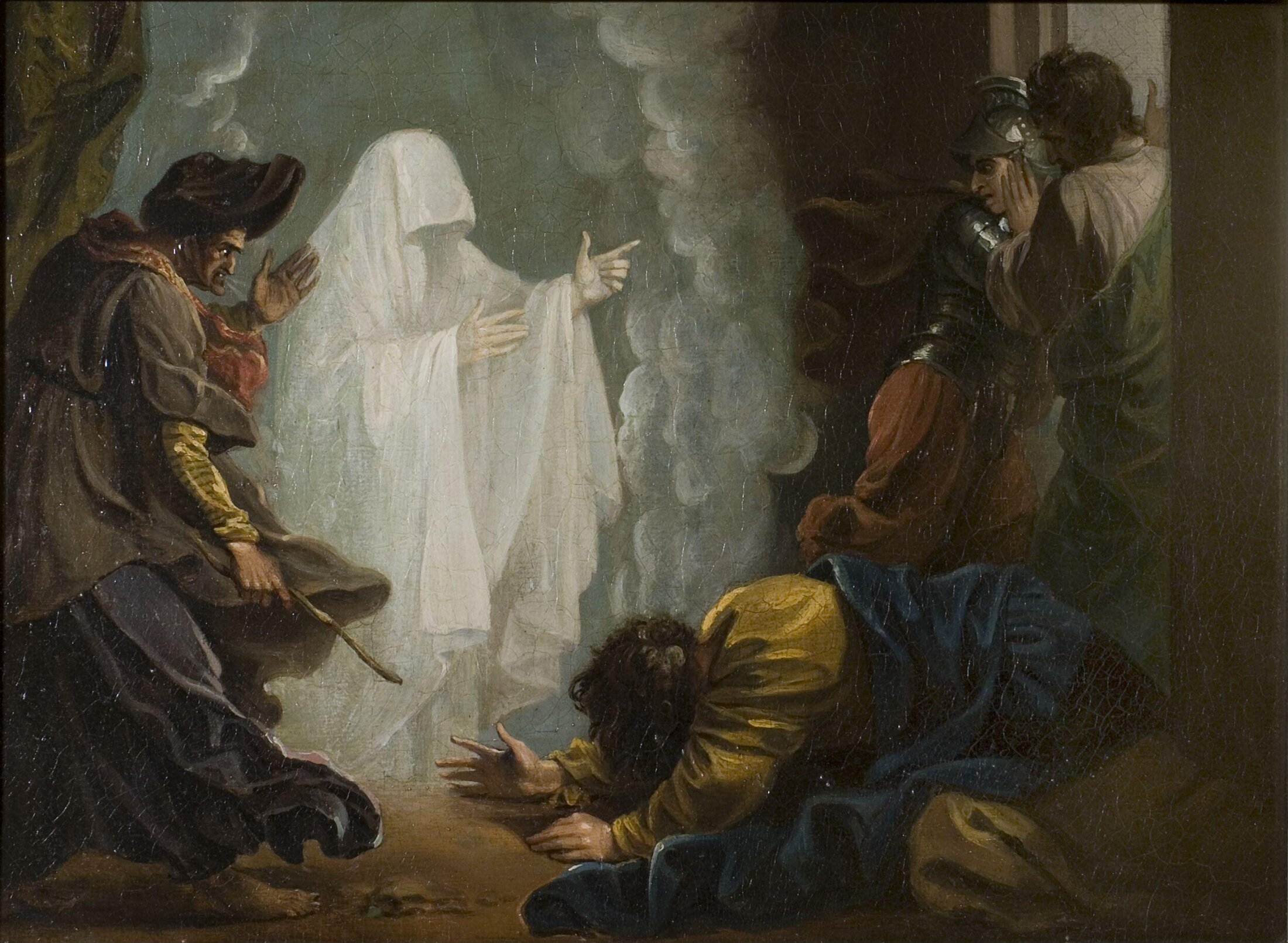
Benjamin West (1738–1820), Saul and the Witch of Endor, late 18th century. Oil on canvas, Victoria and Albert Museum, London.
“Five Stars”
No’a L. bat Miri, Bachtrack
“Haymarket Opera treats Chicago to compelling Baroque brotherly love”
No’a L. bat Miri, Bachtrack
“Members of the public were moved both emotionally and physically, dancing along in their seats, gasping at moments of profound musical execution, and producing torrential applause.”
No’a L. bat Miri, Bachtrack
“Scott Brunscheen’s tenor was remarkable”
No’a L. bat Miri, Bachtrack
“The musical quality of the ensemble was substantial enough to transport the audience into the world of David, Jonathan and Saul, not just the political scenario, but the apparently irreconcilable drama of existing as tender people in the midst of a holy war.”
No’a L. bat Miri, Bachtrack
“The most distinct and delightful voice was found in none other than the Witch of Endor, with tenor Justin Berkowitz riddling the operatic trope of the gender-bent witch with almost magical amounts of care.”
No’a L. bat Miri, Bachtrack
“Kimberly McCord offered a reliable, strong soprano that filled the hall with ease, while Hannah De Priest stood out for a brilliant, richly colored sound.”
No’a L. bat Miri, Bachtrack
“Energetic, occasionally leaping up from his instrument, Vinikour’s conducting strength was well situated in his enthusiasm for the piece, and his advocacy for its correct playing.”
No’a L. bat Miri, Bachtrack
Saul’s insane jealousy tests the loving bond between David and Jonathan, ending on the battlefield with suicide and heartbreak. Haymarket returns to French Baroque opulence with the Chicago premiere of Charpentier’s tragic David et Jonathas.
David et Jonathas
Music by Marc-Antoine Charpentier
Libretto by Father François Bretonneau
Sunday, June 21, 2026, at 2pm
Performance length: 2.5 hours, including one 20-minute intermission.
This performance is sung in the original French, with projected English titles.
Pre-concert talk
1:15pm pre-concert talk presented by Jory Vinikour.
Free for all ticket holders.
Gannon Concert Hall
Holtschneider Performance Center at DePaul University
2330 N. Halsted Ave, Chicago, IL 60614
About the performance
Hear the Chicago premiere of Marc-Antoine Charpentier’s 1688 tragic masterpiece David et Jonathas with early-music specialist Jory Vinikour conducting the acclaimed Haymarket Opera Orchestra and a star-studded cast. Sumptuous French music and high-baroque drama propel the story of the deep friendship between David and Jonathan that sets them against the jealousy of King Saul. Listen to the heartrending bond of friendship and devotion as these Old Testament heroes confront sacrifice, loyalty, and the tragic consequences of their fateful devotion, through the music of one of France’s most expressive and theatrical composers.
Following the company’s groundbreaking U.S. premiere of Marin Marais's Ariane et Bacchus, Haymarket is thrilled to return to French baroque music, presenting a semi-staged concert performance of this tragédie en musique for Chicago audiences.
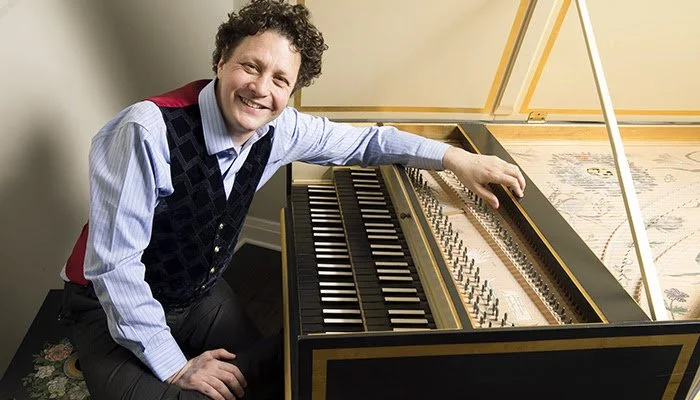
Jory Vinikour, Conductor and harpsichordist
Grammy®-nominated artist Jory Vinikour returns from France to conduct Haymarket’s orchestra of 17th-century period instruments. Vinikour is widely recognized as one of the outstanding harpsichordists of his generation. A longtime Haymarket collaborator, Vinikour performs in the world’s most important opera houses, concert halls, and festivals as a celebrated recitalist, soloist, and conductor.
Scott J. Brunscheen brings his “sweet lyric tenor” (Chicago Tribune) to the role of the unstoppable warrior David, devoted friend of the young Jonathan, sung by soprano Kaitlin Foley. Praised for his “thrilling bass” (Chicago Stage Style), David Govertsen sings the role of Saul, Jonathan’s father, whose jealousy of David’s prowess sets the story on a tragic trajectory. An ensemble of soloists portrays the warriors, captives, shepherds, and Philistines who are caught in the fray of battle between Saul and David. The cast features Geoffrey Agpalo, Justin Berkowitz, Evan Bravos, Nathalie Colas, Hannah De Priest, Patrick Kilbride, Kimberly McCord, Leo Radosavljevic, and Michael St. Peter. Haymarket General Director Chase Hopkins provides direction for this semi-staged concert presentation.

Gaspar de Crayer (1584–1669), De heks van Endor roept Samuëls geest op voor Saul, c. 1619. Oil on canvas, Groeningemuseum, Brugge.
The Cast
David: Scott J. Brunscheen, tenor
Jonathas: Kaitlin Foley, soprano
Saül: David Govertsen, bass
Un berger, un captif, ensemble: Hannah De Priest, soprano
Un captif, ensemble: Kimberly McCord, soprano
Un captif, ensemble: Nathalie Colas, soprano
Une Pythonisse, ensemble: Justin Berkowitz, tenor
Joabel, ensemble: Patrick Kilbride, tenor
Un du peuple, ensemble: Michael St. Peter, tenor
Ensemble: Geoffrey Agpalo, tenor
L'ombre de Samüel, Achis, ensemble: Leo Radosavljevic, bass
Un guerrier, ensemble: Evan Bravos, bass
The Orchestra
Conductor & harpsichord: Jory Vinikour
Violin I (dessus): Jeri-Lou Zike, Martin Davids
Viola I (Haute contre): Elizabeth Hagen, Kiyoe Matsuura
Viola II (Taille): Bruno Vaz da Silva, Wendy Benner
Viola da gamba: Craig Trompeter
Bass violin: Anna Steinhoff, TBD
Oboe & recorder: Kathryn Montoya, Stephen Bard
Theorbo: Dušan Balarin
Performance Support
Director: Chase Hopkins
Stage Manager: Adrienne Bader
French Diction Coach: Nathalie Colas
Pre-performance Lecturer: Jory Vinikour
Program note: Jesse Rosenberg
Surtitle Translator: Craig Trompeter
Projection Designer & Projected Titles Operator: Shawn Keener
Ushering support provided by The Saints: Volunteers for the Performing Arts
Synopsis
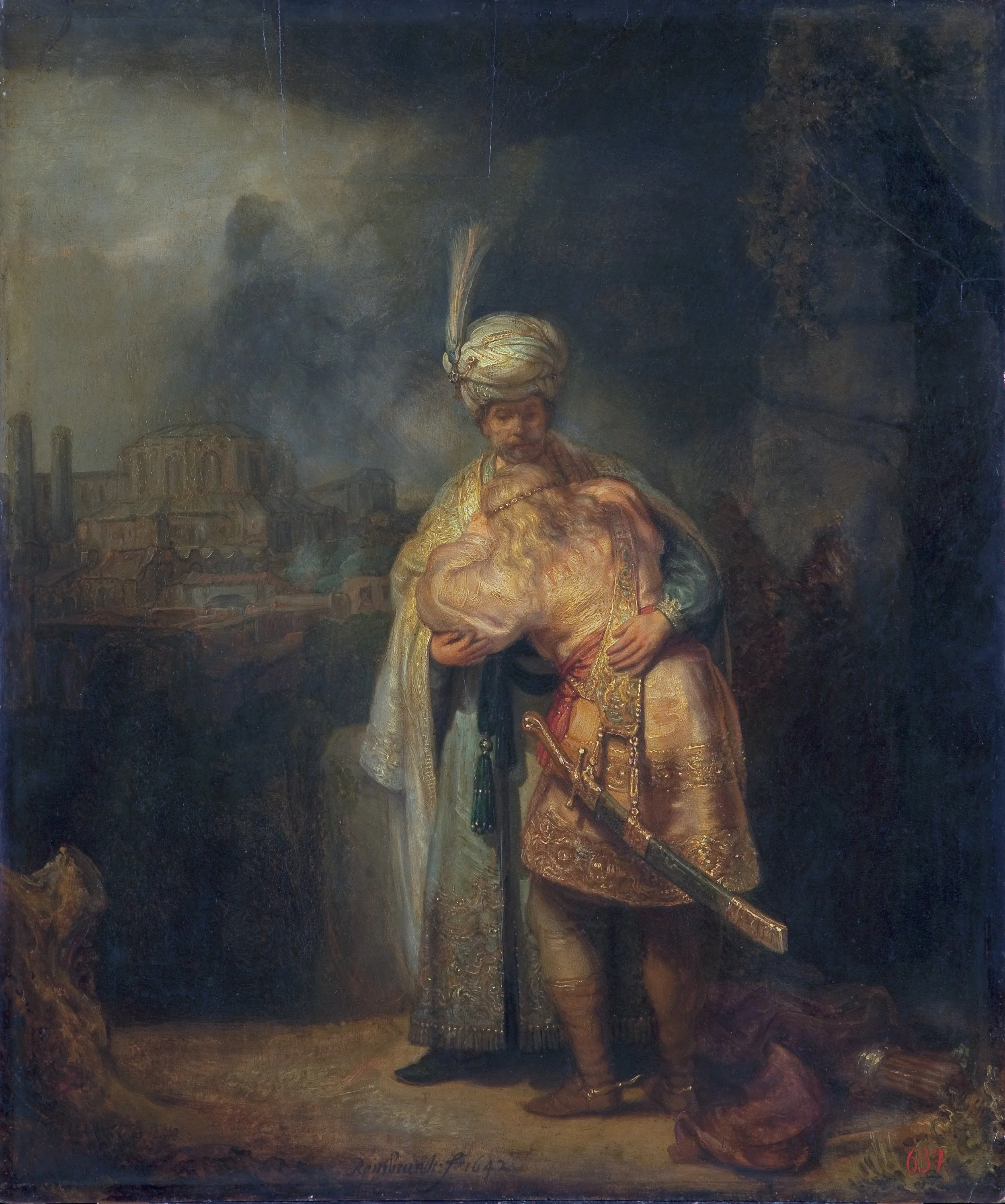
Rembrandt Harmenszoon van Rijn (1606–1669), David en Jonathan, 1642. Oil on oak‑panel, Hermitage Museum, Saint Petersburg.
David et Jonathas tells the biblical story of the deep friendship between David, the future king of Israel, and Jonathan, the son of King Saul. Tragedy ensues when Saul becomes increasingly jealous of David's youthful success and popularity. The opera explores themes of loyalty, love, and sacrifice. The emotional heart of the work is the bond between David and Jonathan. Despite his loyalty to his father, Jonathan ultimately sides with David, and the opera ends tragically when he dies in battle.
About the composer
Musical life at the court of Louis XIV was tightly controlled beginning in 1661 by the king’s Superintendent of Music and Master of Music, composer Jean-Baptiste Lully who held an extraordinary monopoly throughout France over opera production and stage works with music through his Académie Royale de Musique. Lully's exclusive privilege narrowly restricted professional opportunities for other composers. Marc-Antoine Charpentier’s (1643-1704) theatrical ambitions were thwarted to some extent, but his career flourished nevertheless in private and ecclesiastical contexts, where his distinctive style developed freely outside the boundaries of Lully’s royal monopoly. He gained the steadfast support of the highly influential Marie de Lorraine, Duchess of Guise, and lived in her palace as music master to her household for nearly 20 years. Charpentier’s music blends Italianate expressivity with French elegance, skillfully infusing lyricism into the high drama of the tragédie en musique. His legacy of superbly crafted works in many genres includes two of the 17th century’s most original operas, Médée and David et Jonathas.
About the librettist
Father François Bretonneau (1660–1741), a Jesuit scholar and educator, crafted the libretto for David et Jonathas for performance at Paris’s Collège Louis-le-Grand in 1688. His text draws from the First Book of Samuel, shaping the religious story with moral clarity to enhance dramatic tension and provide Charpentier with an intricately textured canvas for music.
Concert Sponsors
2026 Season Sponsors: Nancy Dehmlow, Ethel Gofen, Axel Kunzmann and Bruce Nelson, Gregory O’Leary and Patricia Kenney, Theodore and Emilysue Reichardt, Candace Rudmose, Lynne and Ralph Schatz, and Pam and Doug Walter
Lead Concert Sponsors: Amata Office Suites, Northern Trust Asset Management, Larry and Julia Antonatos, Debbie Crimmins and Paul Goerss, Debra L. Cox, Lynn Donaldson and Cameron Avery, Byron Harrison and Brian Klinksiek, Lori Laitman and Bruce Rosenblum, Nancy Schmitt, Marjorie Stinespring, Grant Upson, Clark Wagner, Michael and Jessica Young
Supporting Concert Sponsors: Drs. John M. Clum and Walter S. Melion, Timothy R. and Janet Fox, Joan Gordon and John Scheckter, Dr. Karen Patricia Smith

Jacob Cornelisz van Oostsanen (c. 1470–1533), Saul bij de heks van Endor, 1526. Oil on oak panel, Rijksmuseum, Amsterdam.
If you require access support to fully participate or have any questions about accessibility, please contact us at info@haymarketopera.org. To ensure the best experience, please try to contact us at your earliest convenience.