


Young Woman with a Lira da Gamba by Ferdinand Bol (1653), Kunsthistorisches Museum, Vienna.
Instrumentalist Adrienne Hyde on Peri’s Euridice and playing the Lirone
Hello hello hello Haymarketers!
I’m Adrienne and I had the joy of joining Haymarket Opera to perform in Jacopo Peri’s Euridice. If you were in the audience, you might have spotted me nestled between the magnificent triple harp and viola da gamba, playing my beautiful 13-stringed lirone, crafted by Philip Huntsmanberger. The lirone is an incredibly special and rare instrument, and I am lucky to have the opportunity to play it!
I am a historical-performance specialist, and my musical life involves playing Baroque cello, the bass and treble violas da gamba, and once in a rare blue moon, I get to play the enchanting, celestial, and lamenting lirone.
There are two questions I get asked all the time. The first, especially because I hop between many instruments, is: Do you have a favorite? A favorite composer, instrument, genre?
To me, that’s a bit like asking a parent which child they love most. Of course, we all secretly have an answer, but saying it out loud feels very wrong. I adore Bach, Handel, Telemann, Lully, all the ones we know and love. But secretly (or not so secretly, as my colleagues learned from my non-stop yammering in rehearsals), I LOVE early Italian opera and vocal repertoire.
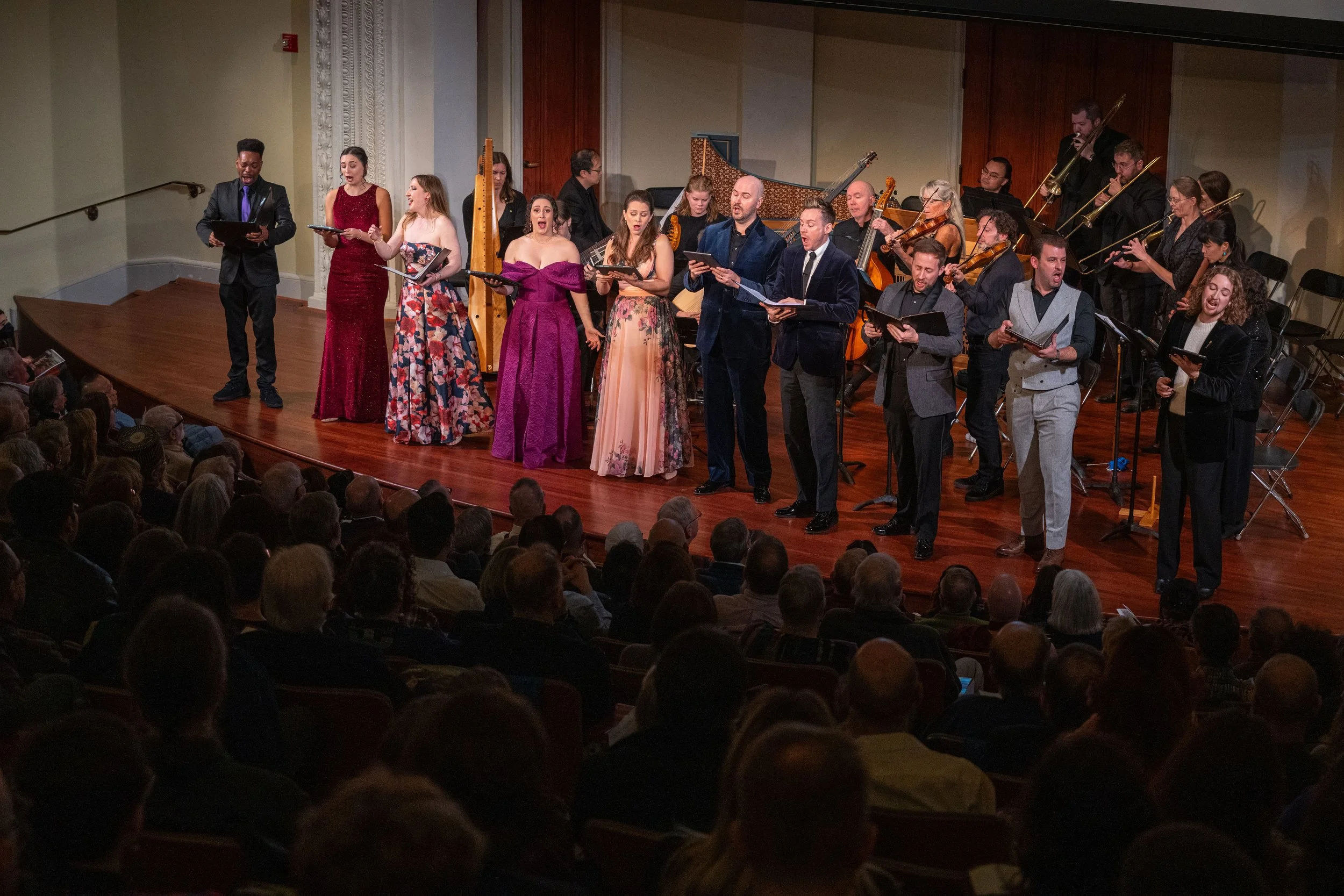
Euridice, Haymarket Opera Company and The Newberry Consort, 2025. Photo: Elliot Mandel
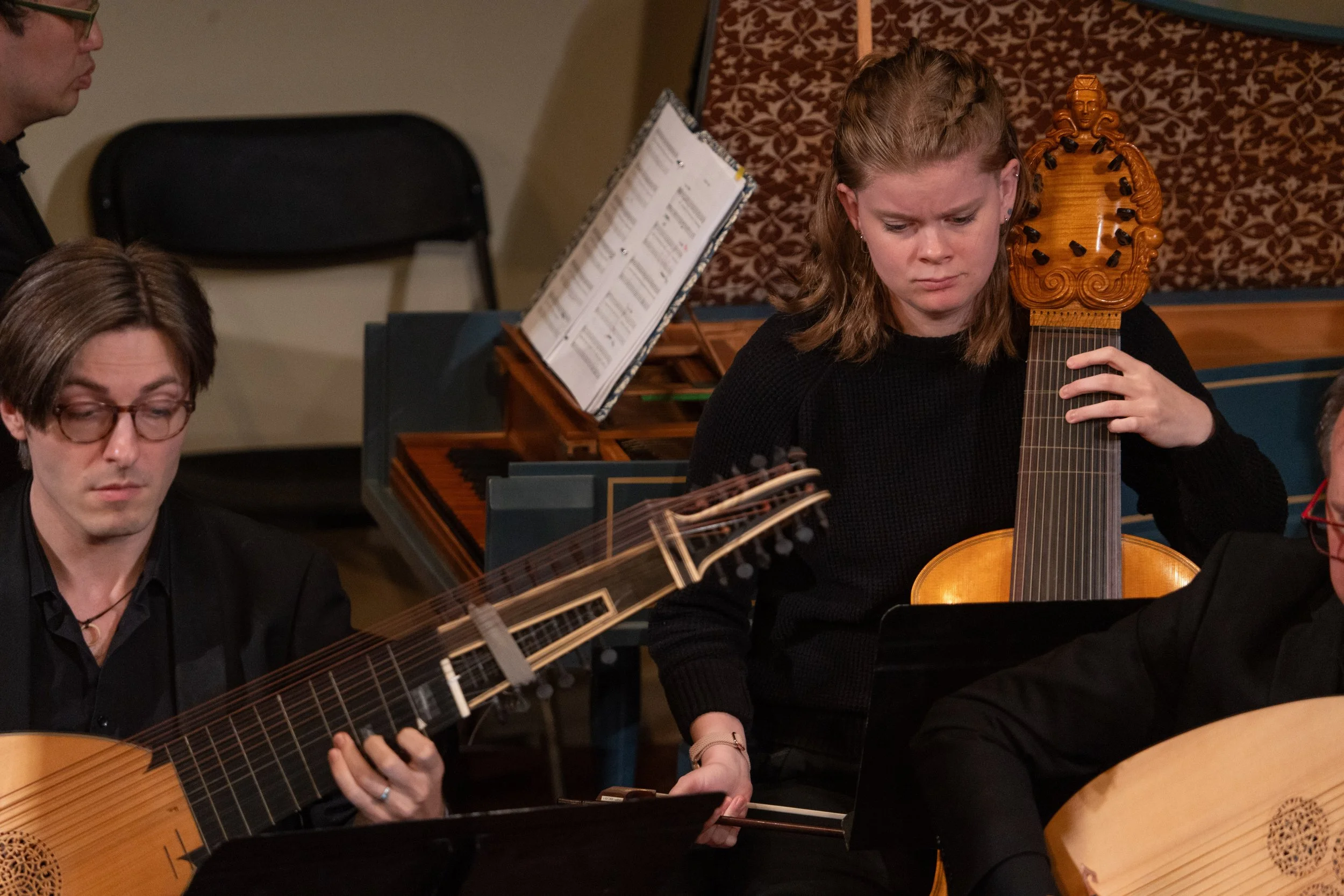
Euridice, featuring Brandon Acker and Adrienne Hyde, Haymarket Opera Company and The Newberry Consort, 2025. Photo: Elliot Mandel
Within the vast world of early music, to me this is the genre that feels most unbridled, most honest, most gloriously human, because it’s experimental and imperfect. The earliest operas, like Peri’s Euridice, are poetic storytelling: the music exists to serve the poem and the poem tells us a drama and teaches a lesson. Peri, his collaborators, and his contemporaries were inspired by ancient Greek drama and oration, and they wanted to create a form of sung storytelling, where music heightens the emotion and makes clear the narrative.
What Peri and others developed was called recitative, which is a style of singing that sits between speaking and singing an aria. The vocal part aligns with the natural rhythms of the spoken text, and the continuo team shapes the drama at every moment with expressive harmonies. There is so much freedom in this music, and that’s why it’s my favorite.
One of my favorite moments in Euridice comes when the Greek chorus sings “Sigh, heavenly breezes, weep, O woods, O fields,” followed by a series of vivid poetic contrasts. Here are a few of the verses, rendered poetically in English:
If the snowy Apennines
Breathe frost to restrain the waves
Joyful fire in closed dwellings
Sweet April brings back for us.
When the scorching rays of the sun
Seem to set the sky and world aflame,
Fresh streams of shining waves
Return the day joyful and playful.
Strip the impious
serpent of Tuscan flames;
Even fierce lions in burning rage
Are calmed in forest and grove.
The second question I’m always asked is: What are you thinking about onstage?
For starters, I am often trying to read my colleagues' minds! It’s actually my favorite part of playing continuo.
There’s something I call “continuo mind-meld” that occurs when a group of excellent players operate as one unified instrument. We move with a single intention, affect, and direction. No one is leading in particular, so everyone is listening acutely to each other. The smallest gesture; like a harpsichord riff, the way a theorbo releases a chord, even the way someone breathes, carries astonishing information to those in the mind-meld. It’s being in a musical flow state with five other continuo players. It feels instinctive, emotional, and effortless.
During the poetic passage above, that mind-meld became very apparent. The text gave us a lot to work with dramatically, too! You might not expect continuo players to study the language closely; we’re not the ones responsible for pronouncing it correctly onstage, after all! But I believe that knowing the language as well as the construction of the poetry is incredibly important. Continuo players who know the stressed syllables, the poetic structure, the meter, and the meaning deeply can attain this continuo mind-meld! This is what I’m always striving for in my own work to prepare an opera.
The joy of playing continuo is illustrating the text through every musical tool you own: harmony, rhythm, timing, articulation, color, shape, volume, etc. As the lirone player, my job is to show the poetry. In passages like these, I’m thinking about how to show you the snowy Appenines, and then the warmth of a sheltered fire, the danger of a poisonous serpent, and the calm valor of a resting lion. How loud or soft I play, how I articulate the beginning of a chord, what chord I choose to play underneath the words, whether the sound is biting, glowing, shining, dark, whether the chord is high or low in register—this is the only the beginning of what I’m experimenting with onstage.
This is why I love Italian opera so much; these texts are so rich and full of emotion. It’s a musical puzzle to figure out how to show the audience what’s happening in the drama. To me it really is the ultimate fun!
Learn more about Haymarket Opera Company and The Newberry Consort’s 2025 performance of Peri’s Euridice.
About the author
Adrienne Hyde is an arts administrator, music educator, and historical-performance specialist dedicated to creating equitable, accessible spaces within classical music. A versatile performer, Adrienne holds degrees in Baroque Cello and Viola da Gamba from the Juilliard School, where she was a Morse Teaching Artist, Music Advancement Program Fellow, and Gluck Community Service Fellow. She specializes in historical performance practices on the Baroque cello, bass & treble viol, lirone, and bass violin. She collaborates with notable groups such as Vox Luminis, Trinity Baroque Orchestra, Early Music Vancouver, Seattle Bach Festival, Haymarket Opera Company, Aston Magna, and Atlanta Baroque.
Committed to expanding representation within classical music, Adrienne has served as artistic administrator for the Valissima Institute, a conducting program supporting young women; and is the co-founder of Open Source Baroque, dedicated to performing music by women, BIPOC, and LGBTQ composers. She has also held positions coordinating music for patients in psychiatric and long-term care settings of hospitals.
Adrienne previously worked at the Baltimore Symphony Orchestra as the associate director of education & community engagement. In that role, she oversaw the BSO’s wide-ranging educational programs, designing curriculum and programming for children’s concerts, facilitating school and community residencies, and managing the BSO’s four youth orchestras. Now she works in the booking & artist management department at Young Concert Artists, promoting and supporting the careers of YCA’s incredible roster of emerging artists. In her latest bid to find hobbies outside of her work, Adrienne has been trying things like Olympic weightlifting, carb-loading (searching for NYC’s best bagel), and leaving her house even when it’s dark outside.
About The Haymarket Review: This new digital publication including thoughts about the work produced by Haymarket is designed to deepen our connection to audiences, nurture and feed audience curiosity about historical performance, offer critical opinions and thoughtful reflections on our performances, and provide a forum for Haymarket and its audience to connect through sharing insights, opinions, learning, and expertise.