

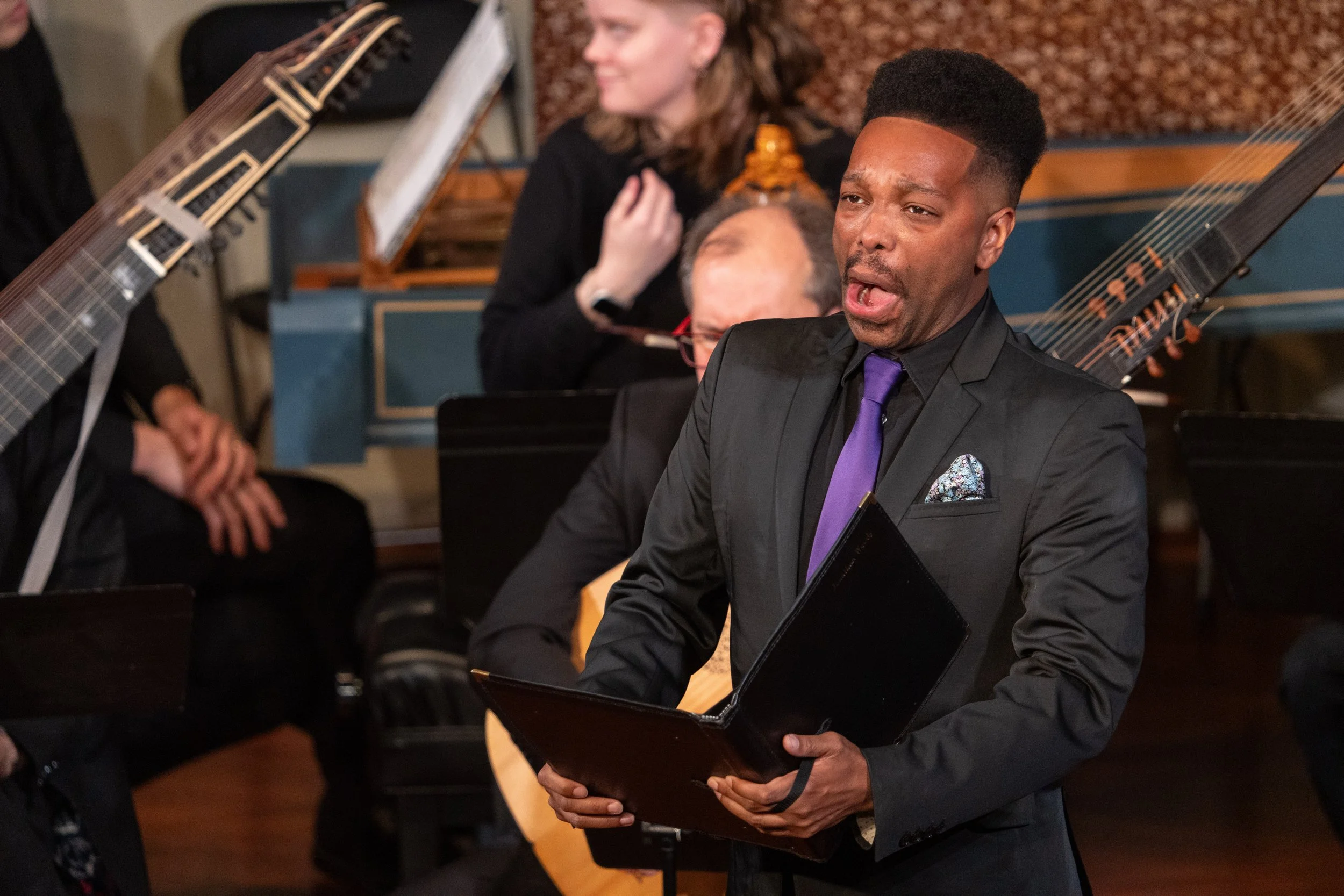
Euridice, featuring Jonathan Woody, Haymarket Opera Company and The Newberry Consort, 2025. Photo: Elliot Mandel
Bass-Baritone Jonathan Woody on Euridice, the oldest surviving opera
I recently had the pleasure of joining Haymarket Opera and The Newberry Consort in their joint production of Jacopo Peri's Euridice, a work of theater and music that premiered in the year 1600. If you've ever had an introductory music-history course, you might remember this piece as a historical footnote: It's the first published work in the category that would become known simply as opera. That was certainly all I knew about the piece when I was invited to join the cast. As a specialist in music of the Baroque era, I spend much of my concert season performing the repertoire composed between 1600 and 1750, and many of the works, styles, and performing conventions of this era are familiar to me, but Euridice as a score was not.
The first thing I discovered upon opening the score is that this Euridice was a work that was not exactly like anything I had seen before. Euridice tells the story of Orpheus and Eurydice, well-known mythological characters who experience a classic tragedy: Orpheus and Eurydice are a young couple celebrating their wedding, when she is suddenly bitten by a snake and perishes. Orpheus, distraught with grief, pledges to journey to the underworld and confront the god Pluto (played by yours truly) to try to win back his young bride's life. He plays his famous lyre, given to him by Apollo, with such effect that the stubborn god of death is finally moved and releases Eurydice back to life. (Some may know that there is a more tragic ending forthcoming, but Peri's Euridice prefers a happy ending).
Such a story is indeed operatic in nature, and has been set by composers many times in the centuries since, most famously by Monteverdi (L'Orfeo, 1607) and Gluck (Orfeo ed Euridice, 1762). What makes Peri's Euridice stand out is that most of what we have come to expect from opera, and indeed the features that even a newcomer to opera will expect, are almost not present in this proto-genre-creating work. Regular fans of opera will know of recitatives and arias, the two basic musical forms of vocal music in an opera. A recitative is sung text, usually set in a speechlike way without much melody, and could be considered equivalent to dialogue between characters in a play. Arias, on the other hand, are moments more like a play's soliloquy, where one character (or perhaps two, in a duet) "stops time" in the action, and sings a song reflecting on their character's emotion in that moment. Operas by Handel and Mozart are known for their recitatives, sometimes going on for pages and pages with many characters confused and sorting out the plot. Operas by Verdi and Puccini (and many others) are known for their famous arias, often excerpted and performed in concert. Think "Quando me'n vo'" or "La donna é mobile" for examples of famous arias.
Peri's Euridice has almost nothing that could be called an aria. Practically the entire show consists of recitative, with characters in constant conversation with one another; and crucially, even when expressing deep emotion and stopped time, they often continue in the form of recitative. This is a striking difference between Peri's work and what has come later in operatic history. Monteverdi's L'Orfeo, written only seven years later, develops this form dramatically, introducing more traditional arias as well as different sorts of incidental music featuring smaller trios and duets of nymphs and shepherds. The Peri contains little of this variety in form, so from where does the variety and interest come in this piece? It may seem unlikely, but from the recitatives themselves!

Resurrezione, featuring Jonathan Woody, Haymarket Opera Company, 2024. Photo: Elliot Mandel
If you have been to other productions by Haymarket Opera in the recent past, you may have heard recitatives composed by Handel in La Resurrezione, Alcina, or Tamerlano. You might recognize how recitative works musically: Usually accompanied only by basso continuo, the singers move quickly through the text, often with a satisfying cadence (a musical conclusion) at the end of each sentence. Basso continuo is the term for the instrumentalists who play the bass line of the music, and can consist of several players at once. Bowed bass instruments play the printed music (cellos and contrabasses) and keyboards and plucked instruments fill out the harmonies above, usually with a "cheat code" provided by notated harmonic figures in their parts, almost like a jazz chart. On top of this the singer tries to be as speech-like as possible.
Because Peri's Euridice consists almost entirely of recitative, the singers and instrumentalists have to make conscious choices to keep the music flowing and interesting. What is provided in the musical score by Jacopo Peri only gives us as performers an overview of how to bring the music to life. We have the notes and the text, yes, but many decisions are up to us, and much of our rehearsal time goes toward making all these choices. The basso continuo players have to choose, first, which instruments will play when. In our production, the "continuo team" consisted of Haymarket's artistic director Craig Trompeter playing viola da gamba, and there was also harpsichord, organ, two archlutes, harp, and lirone, a unique historical instrument that allows a bow to play chords. Those instruments have different colors, volumes, and abilities to project in a concert hall, and matching those variations in musical sound to the mood and subject of the text, as we progress through the story, is the big challenge in preparing a work like this.
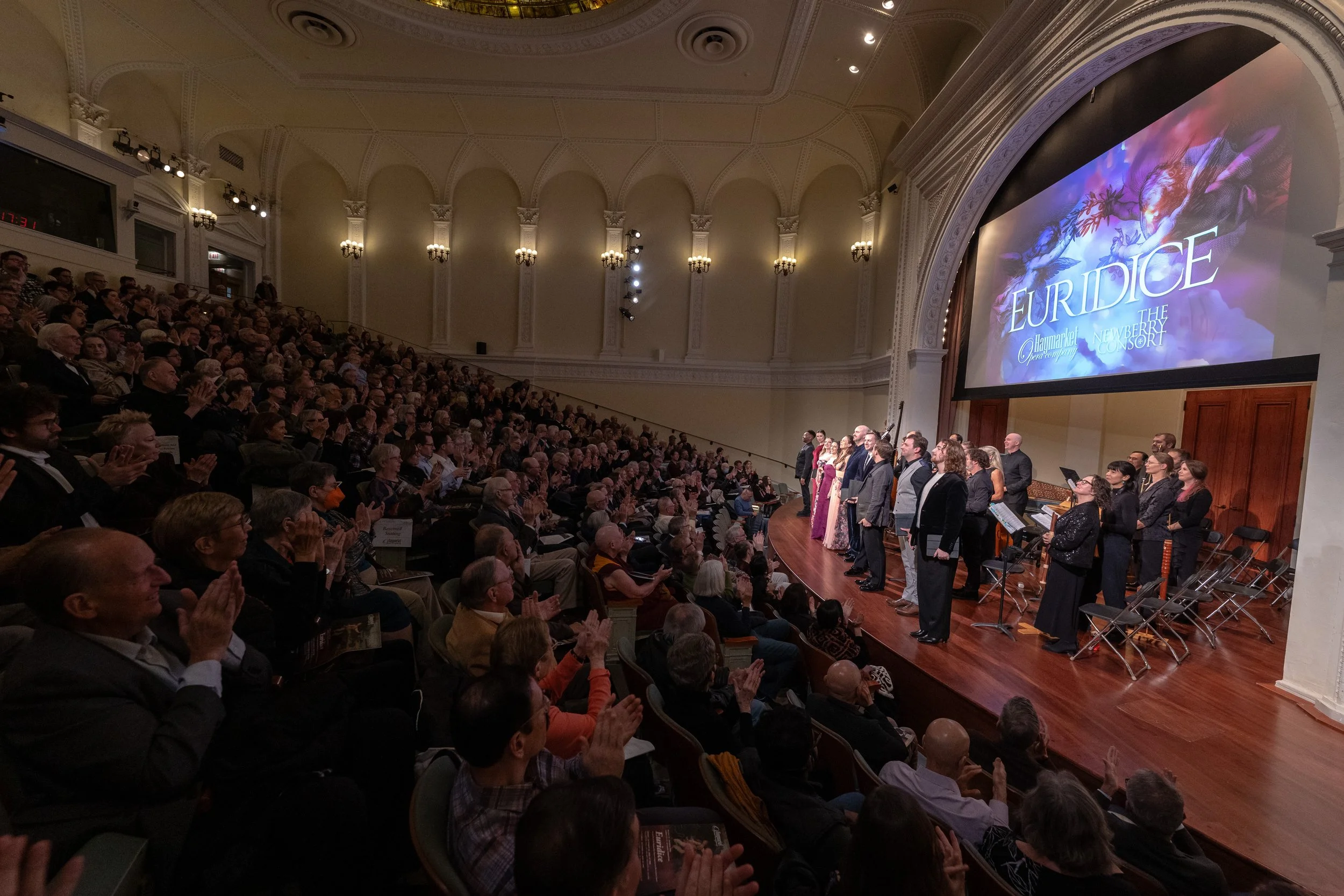
Euridice, Haymarket Opera Company and The Newberry Consort, 2025. Photo: Elliot Mandel
And now we come to my great pleasure in joining Haymarket and The Newberry Consort for this work: The challenge of preparing an obscure and unexpected historical work becomes a fun challenge when your colleagues are experts, easygoing, and dedicated to finding the beauty and interest on every page of the score. Haymarket Opera is a well-known and also unique entity in the United States: one of only a handful of companies mounting primarily Baroque opera. The Newberry Consort is a collection of singers and instrumentalists, led by Baroque trombone expert Liza Malamut, specializing in music of the 17th century. Their collaboration brought almost every historical musical expert in Chicago into the same room, and we were able to delight in sharing our knowledge and interest in this music. I couldn't have asked for a more exciting team of colleagues to get this work on its feet.
We performed Euridice on Oct. 24th and 25th to sold-out crowds in Chicago and Evanston. Our lengthy ovations suggested that the audience was able to appreciate our detailed work, since even as a lover of Baroque music, I can recognize that it may be a challenge to listen to recitative for two hours. The best way, and with pride, the most successful way to share such work with our listeners, is to dedicate our time, passion, and interest to being as specific as possible. I'm so glad I was able to do my part to help bring this remarkable work back to life after 425 years!
Learn more about Haymarket Opera Company and The Newberry Consort’s 2025 performance of Peri’s Euridice.
About the author

Bass-baritone Jonathan Woody has been featured with historically informed ensembles such as Apollo’s Fire, Boston Early Music Festival, Tafelmusik Baroque Orchestra, Philharmonia Baroque Orchestra, Portland Baroque Orchestra, and Oregon Bach Festival, earning praise for being “charismatic” and “riveting” (The New York Times). Also an avid performer of new music, Jonathan has premiered works including Ellen Reid's p r i s m (2019 Pulitzer Prize winner), Ted Hearne's The Source, Missy Mazzoli’s Breaking the Waves, and Du Yun’s Angel’s Bone (2017 Pulitzer Prize winner). Jonathan has performed on the operatic stages of Opera Lafayette, American Opera Projects, and Beth Morrison Projects.
About The Haymarket Review: This new digital publication including thoughts about the work produced by Haymarket is designed to deepen our connection to audiences, nurture and feed audience curiosity about historical performance, offer critical opinions and thoughtful reflections on our performances, and provide a forum for Haymarket and its audience to connect through sharing insights, opinions, learning, and expertise.