

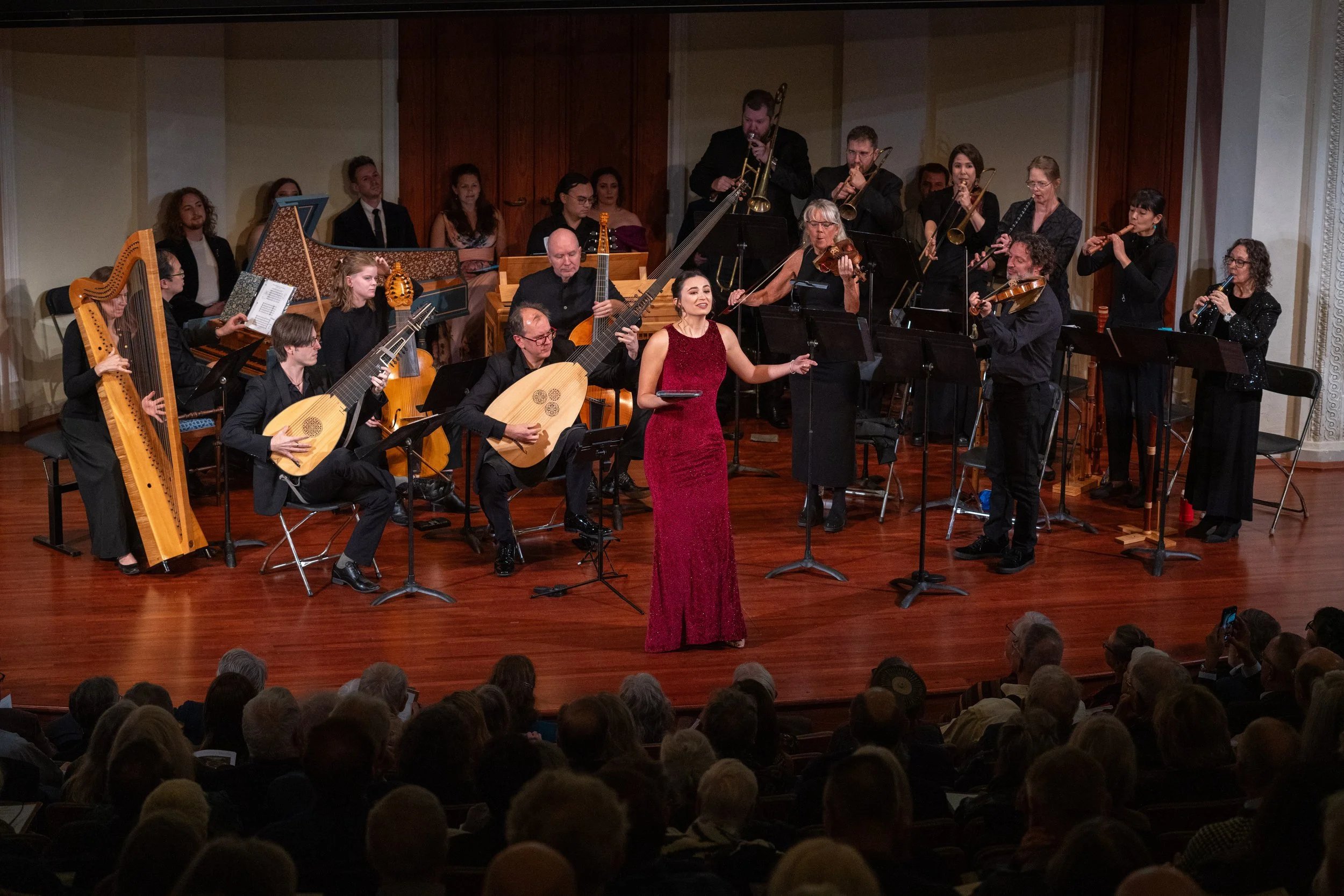
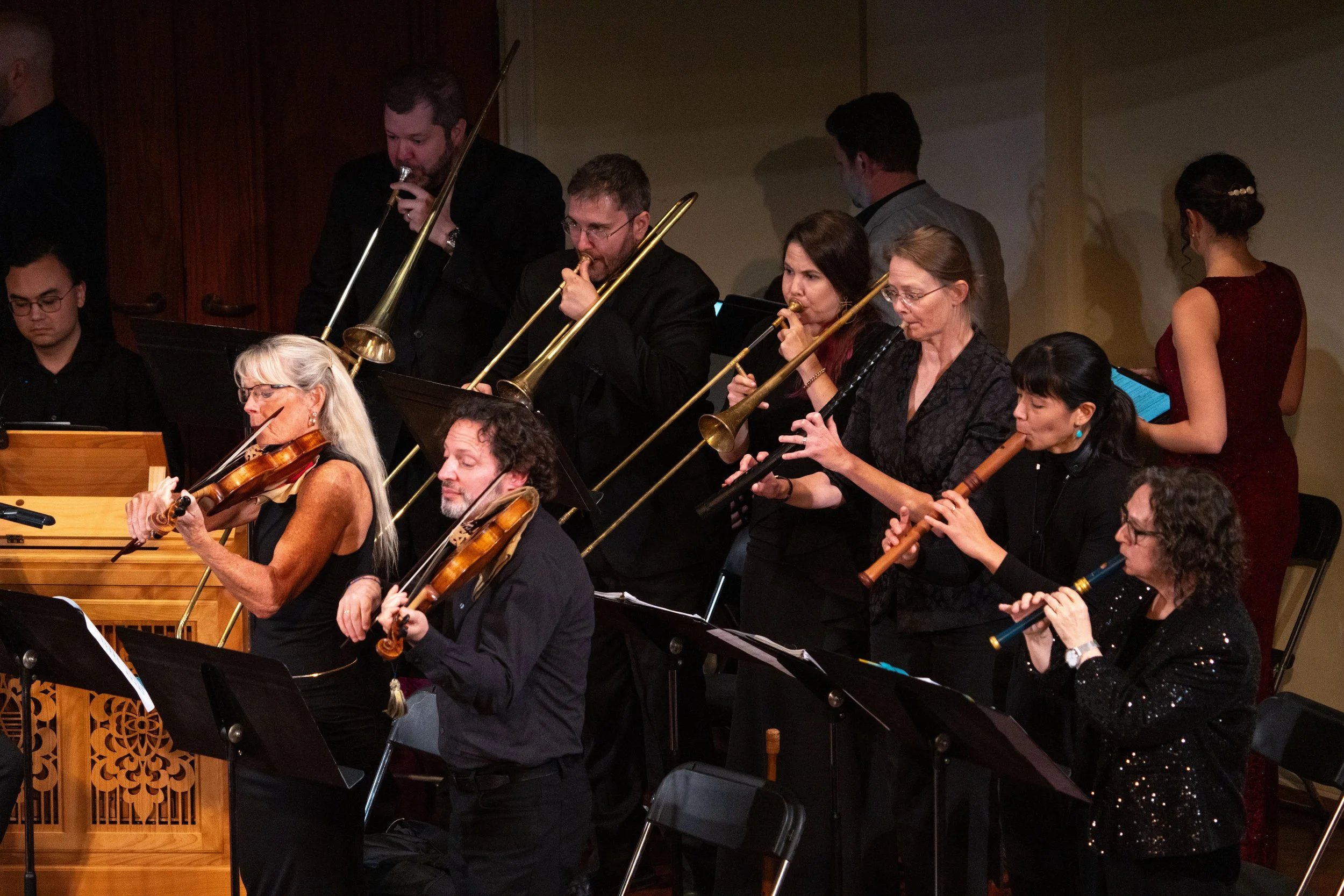
Euridice, Haymarket Opera Company and The Newberry Consort, 2025. Photo: Elliot Mandel
Members of the instrumental ensemble on the historical instruments for Peri’s Euridice
Our recent concerts of Jacopo Peri’s Euridice in collaboration with The Newberry Consort featured an instrumental ensemble playing on 17th-century instruments. Learn more about these unique instruments directly from the musicians themselves.
Cornetto | Liza Malamut
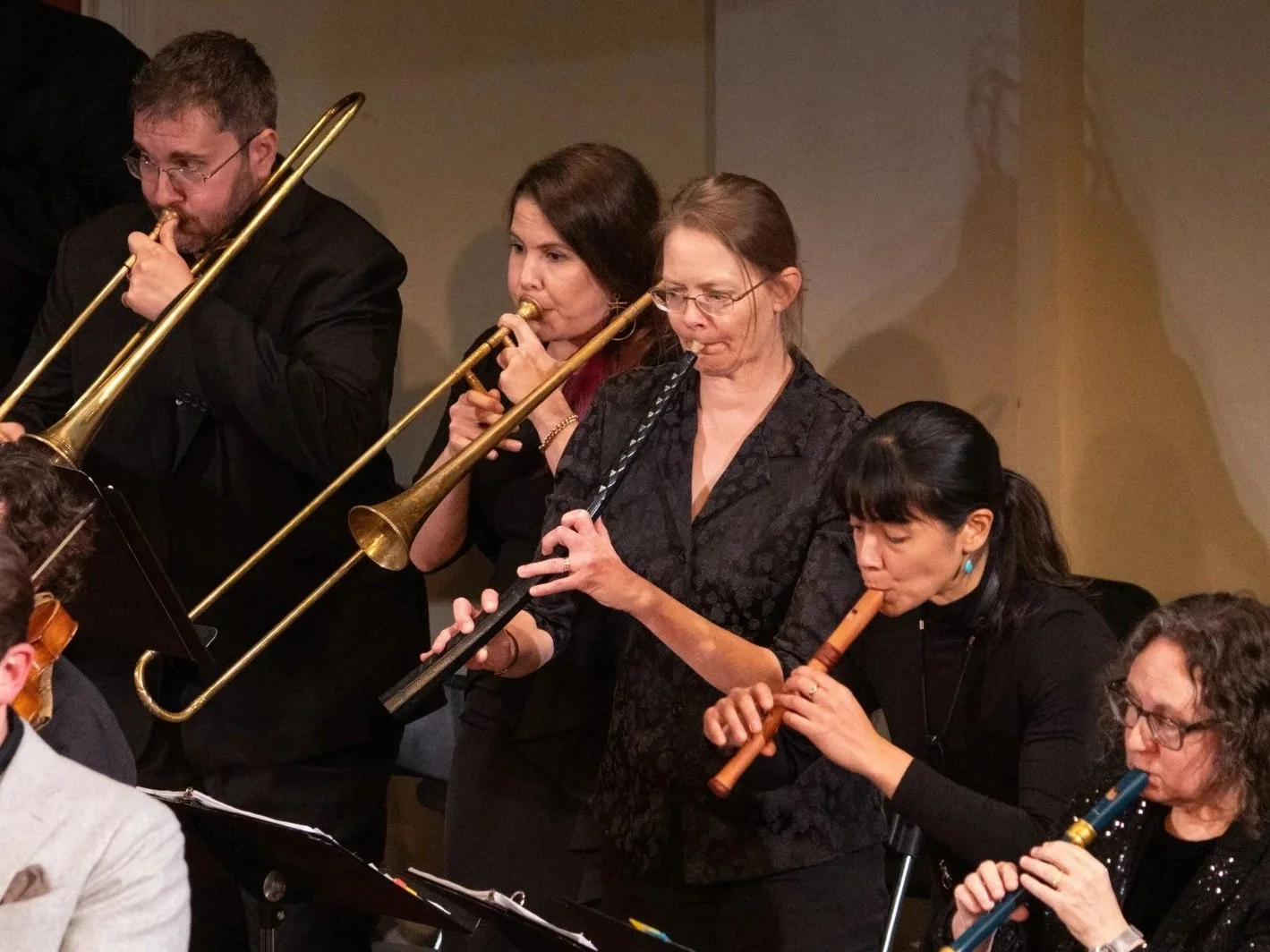
Euridice, featuring Kiri Tollaksen playing the cornetto (center), Haymarket Opera Company and The Newberry Consort, 2025. Photo: Elliot Mandel

Double Portrait with a Cornet Player by Bartolomeo Passarotti (c. 1577 and 1579), Musei Capitolini, Rome.
The word “cornetto” comes from the word “cornet,” or “little horn.” While it is likely that the cornetto descended from lip-blown instruments made from animal horns, the instrument used during the 16th and early 17th centuries is carved from wood and usually wrapped in leather. The instrument could be straight or curved, but the latter was more ubiquitous, especially in Italy and France. The cup-shaped mouthpieces require the player to use the same “buzzing” technique to produce sound as brass instruments (such as trumpets and trombones), but the open fingerholes, like those of a recorder, place the instrument solidly in hybrid territory. Even so, the cornetto was often grouped with trombones, especially in Italy, where the famous cornetto-and-trombone ensemble Concerto Palatino performed until the mid-18th century. The cornetto’s high, crystalline timbre was often compared to a boy’s voice and was prevalent in sacred and secular music, doubling or substituting for voices. In addition, the cornetto’s fingerhole system allowed players to achieve a high level of virtuosity, and players could often be found performing highly technical solo works or enhancing ensemble performances with graceful ornaments.
Despite the instrument’s popularity, a combination of new instrument technology (and, likely, outbreaks of bubonic plague) caused the use of the cornetto to decline and eventually die out, with some of the last remaining written parts to be found in Gluck’s Orfeo and Handel’s Tamerlano. While a brief attempt to revive the instrument came about in 1880, its true resurgence can be credited to 1950s instrument makers and historical performers, many of whom paved a way for our performance of Peri’s Euridice today.
Sackbut | Liza Malamut
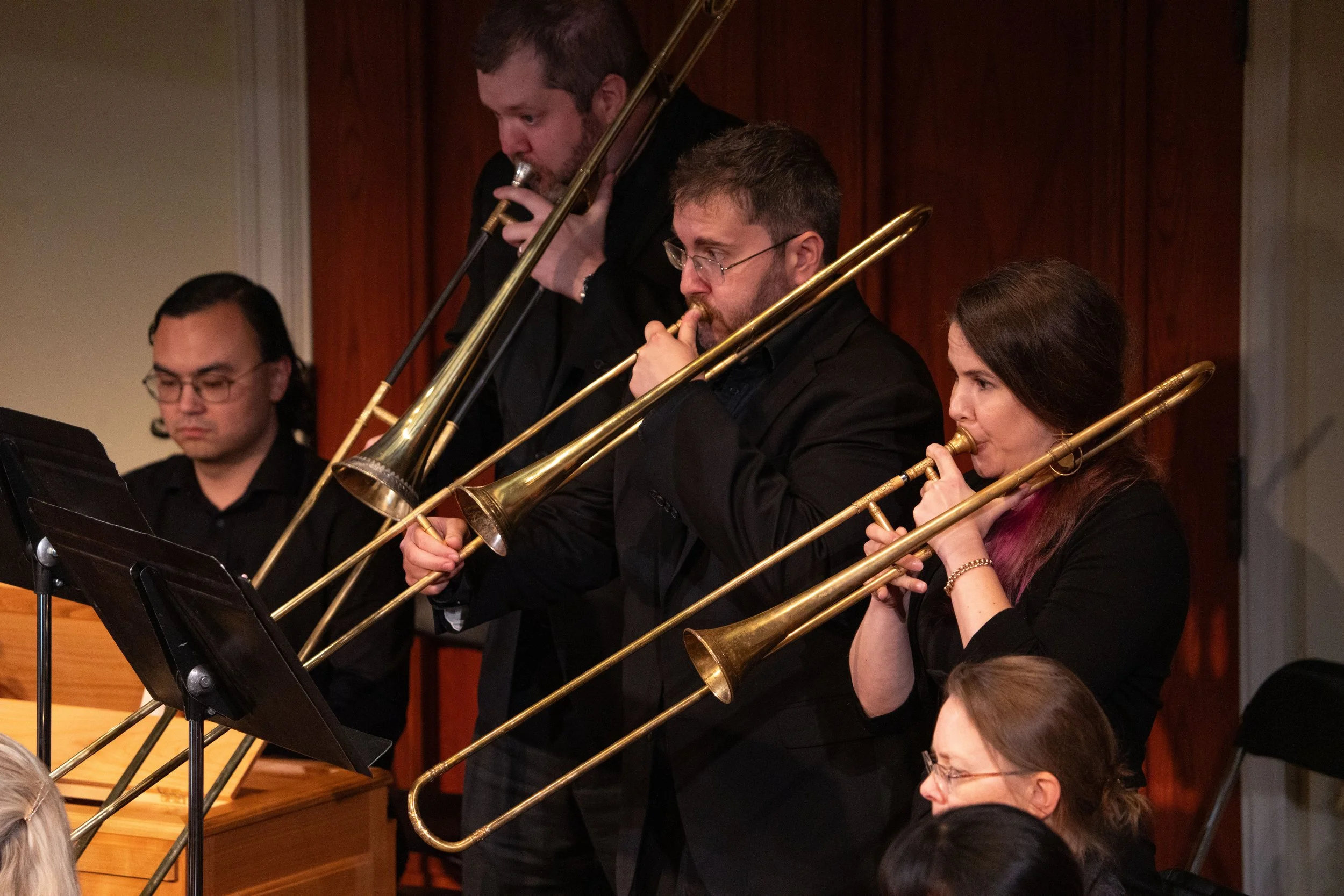
Euridice, featuring Liza Malamut, Ben David Aronson, Garrett Lahr playing the sackbut, Haymarket Opera Company and The Newberry Consort, 2025. Photo: Elliot Mandel

Celebration of the Ommegang in Brussels: the procession of Our Lady of the Sablon by Denys van Alsloot (1616), Museo del Prado, Madrid.
Sackbut is just another word for trombone! The word “sackbut” comes from the French saquebot, and roughly translates to “push and pull,” or the motion that the player uses to extend and retract the slide. The Italians used the word “trombone,” which literally translates to “big trumpet.” True to its name, the trombone evolved from the “natural” trumpet, which had no valves or keys and required the player to manipulate pitches solely with the lips and airstream. Seeking ways to make the instrument more flexible, brass-instrument makers invented the slide. First mentioned in 1439 in Ferrara, the double slide was transformational for Renaissance music. For the first time, wind instrumentalists could not only play all the notes of the chromatic scale, but tune them spontaneously to any pitch or temperament. As a result, trombonists were highly in demand. By the mid-16th century, trombonists could be found playing outdoors with “loud” bands, with chamber ensembles as continuo or consort instruments, and, most importantly, as supplements or even substitutes for human voices. Over time, the trombone grew larger as its function changed. However, the symphonic instruments we see today are the least changed of all western instruments—a testament to the perfection of the slide technology.
Like many instruments, the trombone became associated with notable archetypes or imagery, especially in opera. Because of trombones’ ubiquity in sacred music, composers often used them to evoke death or divine judgment. Familiar examples may be found in Monteverdi’s Orfeo and Mozart’s Don Giovanni, but the first occurrences were likely in Italian intermedii during the 16th century. Accordingly, you will hear our orchestration of “underworld trombones” in Peri’s depiction of Hades.
Harp | Claire Happel-Ashe
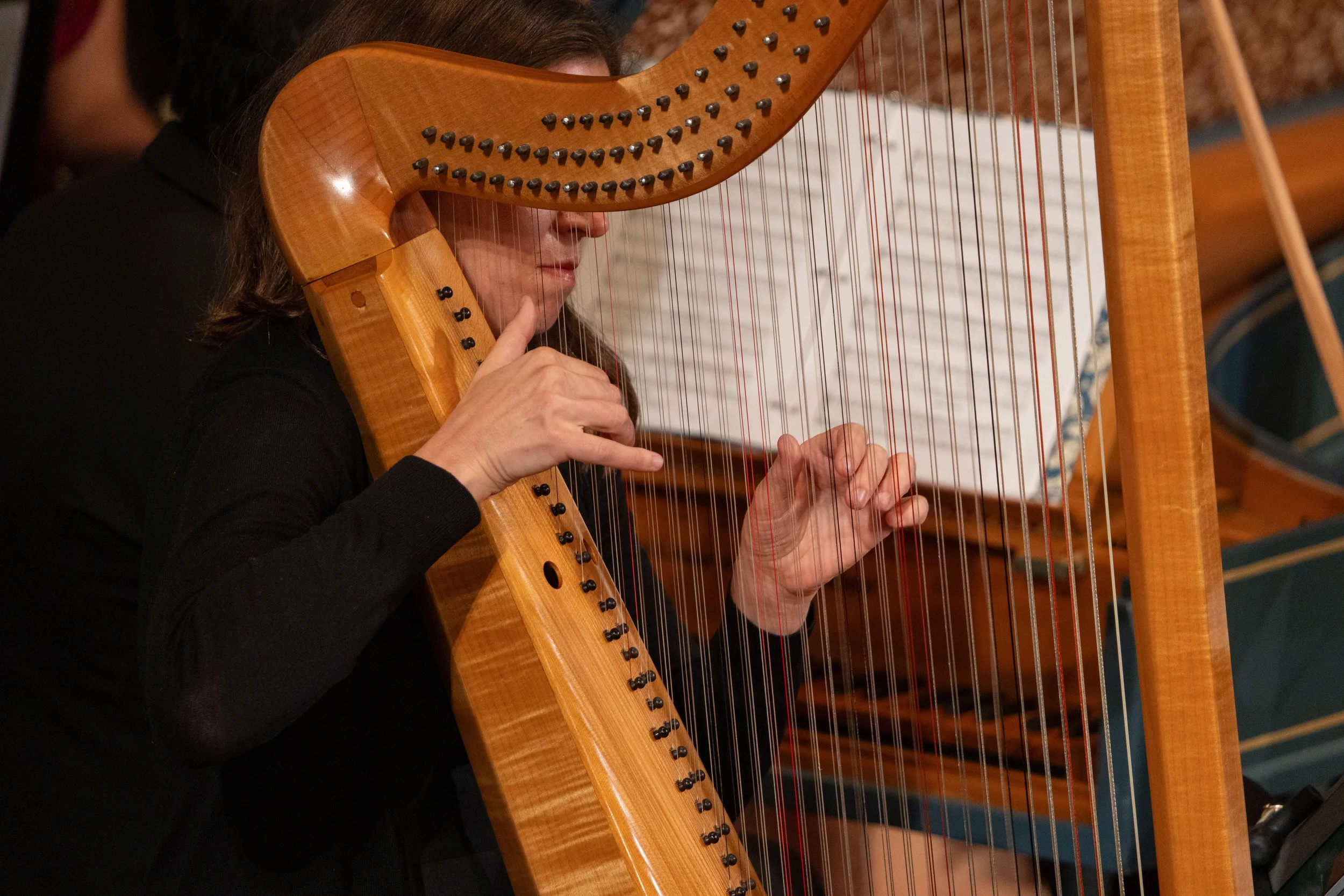
Euridice, featuring Claire Happel-Ashe playing the harp, Haymarket Opera Company and The Newberry Consort, 2025. Photo: Elliot Mandel
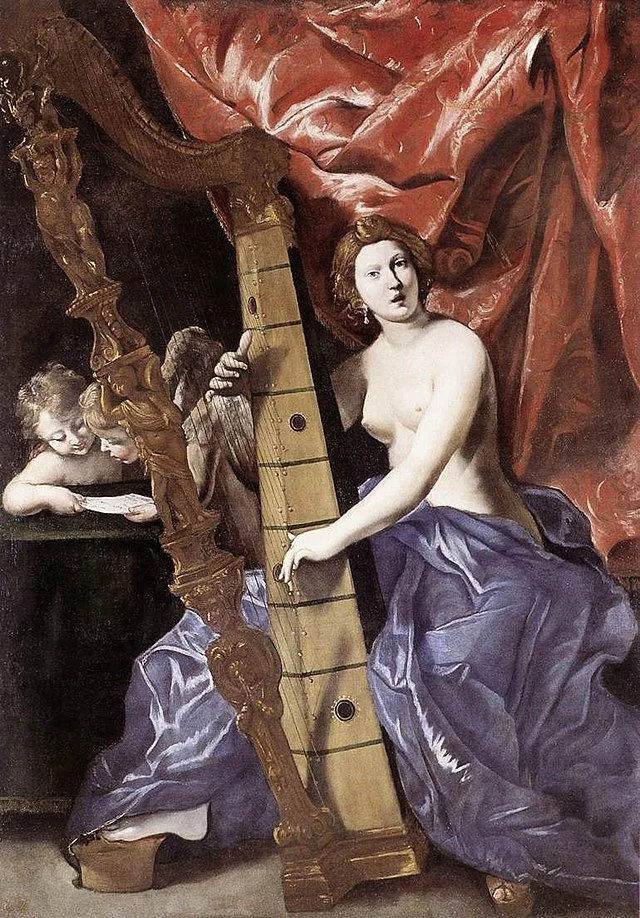
Venus plays the Harp (Allegory of Music) by Giovanni Lanfranco (c. 1630-34), Galleria Nazionale d'Arte Antica, Rome.
The harp used in this production is a reconstruction of an Italian arpa doppia from the late 16th and early 17th centuries. The term "doppia” refers to the instrument’s size (as with the double bass), rather than the number of string rows. These harps varied between two and three ranks of strings and were most prevalent in Rome and Naples, though they also appeared in Florence at the 1589 La Pellegrina intermedii (in which Peri performed), in Ferrara among the Concerto delle Donne, and in Mantua in Monteverdi’s Orfeo, among many other appearances.
Iconographic evidence suggests that experiments with multi-rowed harps began in the 14th century, prompted by the ever-present dilemma of creating a harp with 12 notes per octave within the reach of human arms. In three-rank instruments (called triple harps in English), the two outer rows provided diatonic pitches—tuned with either B-flats or B-naturals, depending on the hexachord used—while the inner row provided the chromatic notes. With seven chromatic strings per octave, harpists using the mean-tone temperament favored at the time had access to a greater amount of pure thirds. All strings were made of gut, and the expansion of the instrument’s bass register during this period gave it a resonance well suited to continuo playing.
Three surviving treatises describe the structure, tuning, and qualities of the arpa doppia: Galilei’s Dialogo della musica antica e della moderna (Florence, 1581), Mersenne’s Harmonie universelle (Paris, 1636), and Roman harpist Bartolomeo Giovernardi’s Tratado de la Musica (Madrid, 1634). The arpa doppia was admired for both its sound and its symbolism. In a letter responding to Marin Mersenne, the Florentine theorist Giovan Battista Doni recommended harps and viols for onstage use because “their appearances have something simple and majestic, and they best of all represent Antiquity.” Doni and Giovernardi also praised the harp’s ability to produce dynamic nuance—forte and piano—through the direct contact of the player’s fingertips with the strings, a quality they considered made it a superior instrument. Agostino Agazzari, in his treatise on continuo practice, lists the harp as both a foundational and ornamental instrument. He praises it as suitable everywhere, “as much in the treble as in the bass,” urging players to employ all of its possibilities: “sweet plucking, responses between the two hands, trills, etc.”
Although Peri’s list of instrumentalists does not explicitly list the harp for Euridice, his preface praises virtuoso Giovan Battista Giacomelli on the lira grande, calling him “most excellent in every part of music.” Credited by Vincenzo Giustiniani with introducing the arpa doppia to Rome, Giacomelli is also associated with the arpa Estense, one of the few surviving examples of an arpa doppia. Now housed at the Galeria Estense in Modena, it was commissioned in 1581 by Alfonso II d’Este, Duke of Ferrara, and decorated by Giulio Marescotti, an artist frequently employed by the Gonzaga family in Mantua.
The Harpsichord and Organ | Jason Moy

Lady at the Virginal by Frans van Mieris the Elder (1658), Staatliches Museum Schwerin.
One of the defining characteristics of early modern opera was the presence of the basso continuo, a group of instruments that played the bass line and provided harmonic and rhythmic underpinning for the music. Keyboard instruments—harpsichord and organ—played a fundamental role in the continuo group, with the bright, incisive attacks of the harpsichord keeping a clear, audible tactus, or pulse, for the singers and instrumentalists, while the sustained tone of the organ helped reinforce the harmony and provide support for the singers. Claudio Monteverdi’s seminal opera Orfeo (1607) gave uncommonly specific instructions for which continuo instruments should play when, oftentimes utilizing the harpsichord in some of the larger-scale movements or dances, and reserving the organ for moments of introspection or to lend an air of gravitas when gods, goddesses, or noble characters were singing. Monteverdi’s score calls for an organo di legno, a Renaissance organ with wooden pipes. The organ used in our production of Peri’s Euridice featured three ranks of all-wooden pipes and was made in the 17th-century tradition by Henk Klop in the Netherlands. The harpsichord was made in 1984 by the noted Canadian builder Edward Turner, and modeled after an antique Italian instrument by Elpidio Gregori from 1786. Despite its 18th-century provenance, Gregori’s original (and Turner’s faithful replica) bears many hallmarks of the 17th-century Italian style of harpsichord building, with its all-brass stringing and cypress soundboard giving it an unmistakably Italian timbre so perfectly suited for an early opera like Euridice.
Theorbo | Brandon Acker
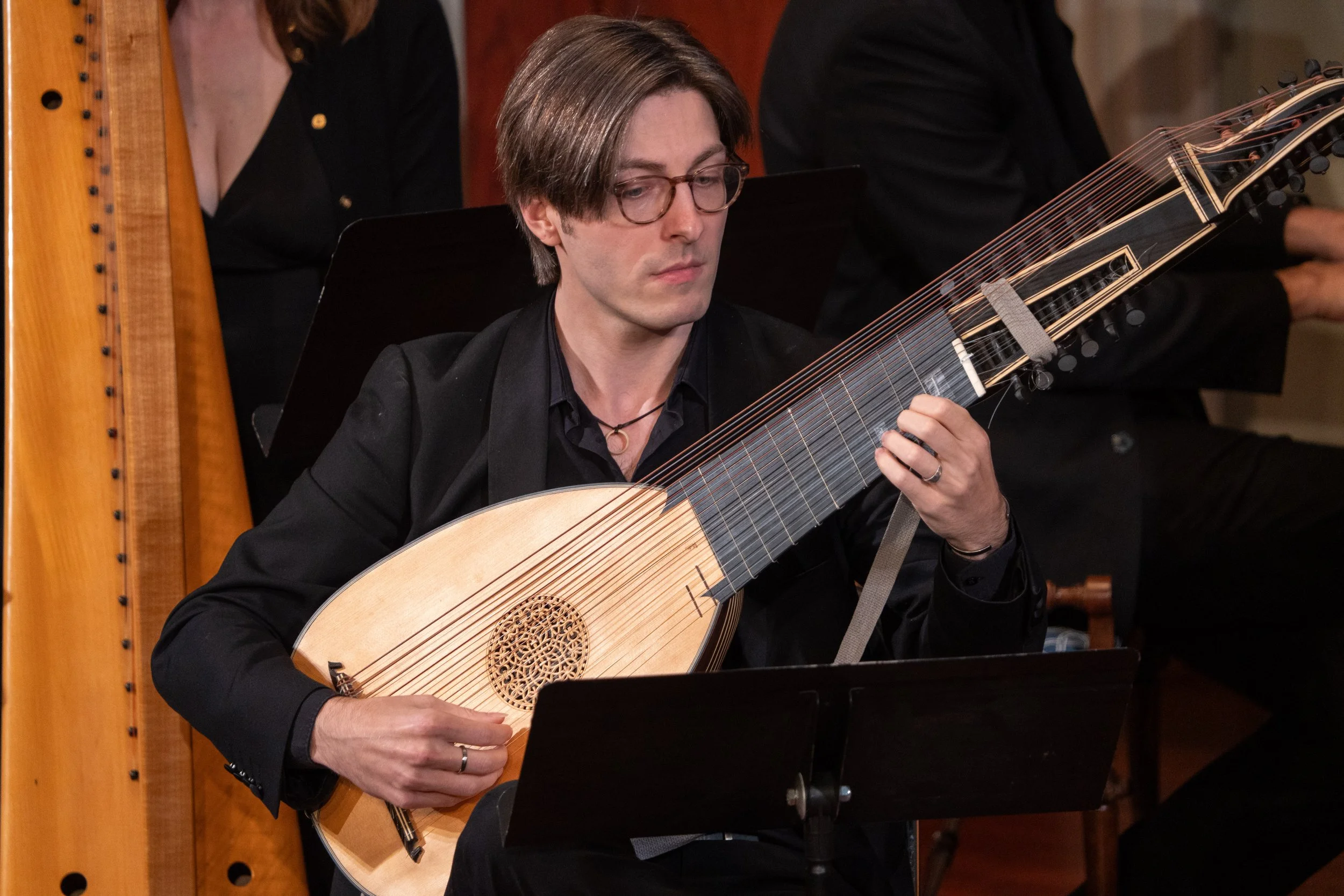
Euridice, featuring Brandon Acker playing the theorbo, Haymarket Opera Company and The Newberry Consort, 2025. Photo: Elliot Mandel

Portrait of a Man Playing a Lute by Bartolomeo Passerotti (1576), Museum of Fine Arts, Boston.
For Haymarket’s recent production of Peri’s Euridice, I played theorbo, a 14-string instrument invented in Italy for the explicit purpose of playing a new style of music which led directly into the birth of opera. The instrument can be thought of as half guitar and half harp, since the first seven strings are played similar to a guitar and the long seven strings are tuned in a scale and only played open.
A theorbo player’s role in an ensemble is rather like that of a jazz guitarist or pianist. We improvise over a chord chart (figured bass) and we pay great attention to the text and attempt to amplify its meaning with added arpeggios, strums, and other effects. When and where we play is not indicated in the score and therefore left to the discretion of the performer/director.
We were lucky enough to have two pluckers for these performances, which is likely less than they would have used at the time. One reviewer attending a Baroque opera in the 17th century apparently complained that they couldn't see the soprano through the "forest of theorbos."
Lirone | Adrienne Hyde
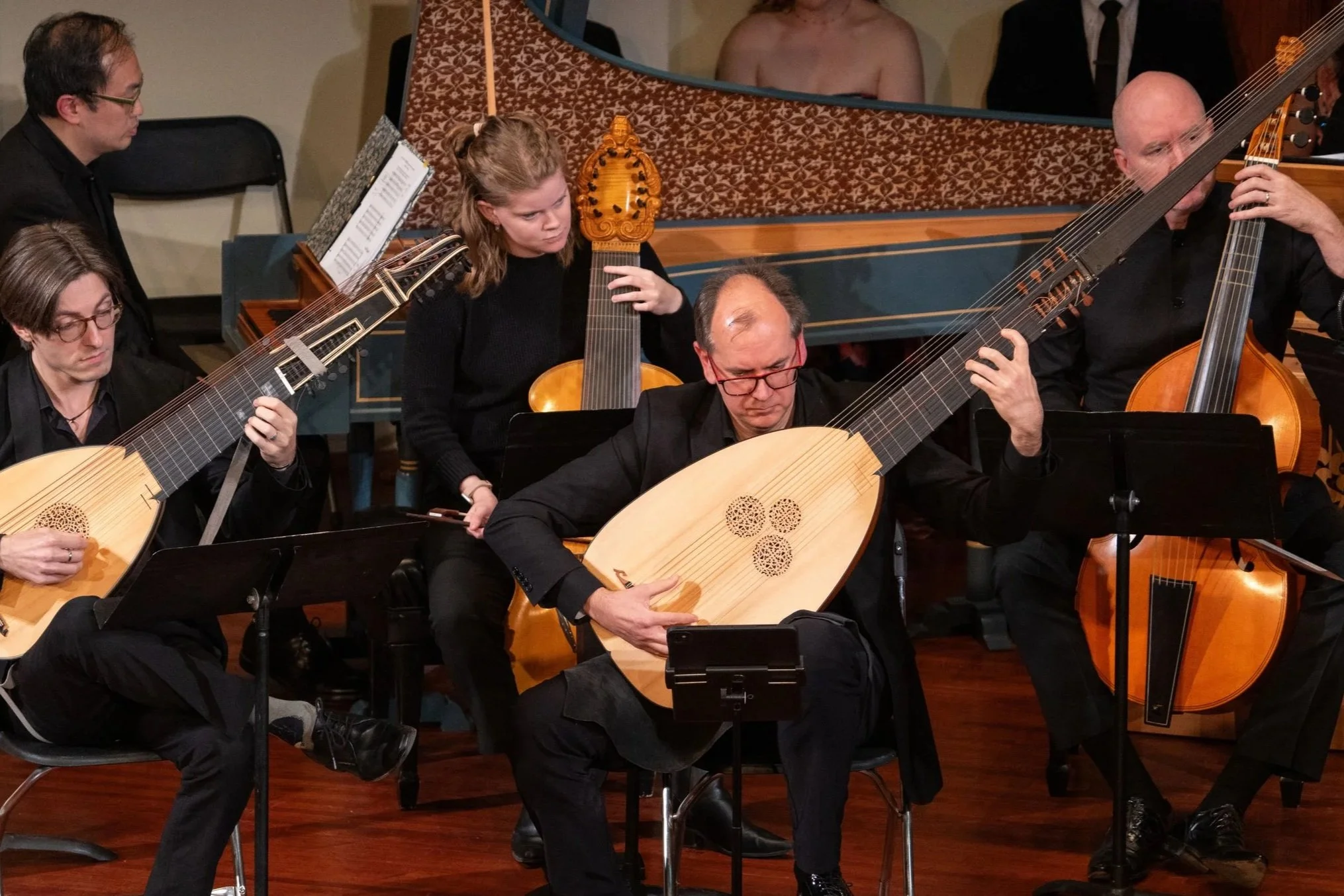
Euridice, featuring Adrienne Hyde playing the lirone (center), Haymarket Opera Company and The Newberry Consort, 2025. Photo: Elliot Mandel

Young Woman with a Lira da Gamba by Ferdinand Bol (1653), Kunsthistorisches Museum, Vienna.
The lirone is a bowed string instrument with anywhere from 9 to 16 strings (yes, it’s a lot of strings!). It’s held between the legs, which is why it’s also called the lira da gamba (literally, lyre of the leg). One of its defining features is its flat bridge, which means I can only play chords, no melodic lines. It’s not meant to be a solo instrument, but rather it attends to the voice and accompanies the most expressive moments of early Italian operas.
The lirone is an imperfect continuo instrument, so you’ll never hear me playing alone. I always work alongside another continuo player, someone usually responsible for handling the true bass line. My job is to bring the dynamic shape to the continuo section. I’m the one in the continuo group who can sustain chords and control the volume, which creates a really special emotional affect. However, because I have a flat bridge, I can’t just skip over strings or notes that don’t fit the chord. So I am constantly solving a little musical puzzle, choosing which notes to play based on what the harmony requires.
I tune my lirone using a re-entrant system, meaning the string pitches don’t just go up in ascending order like a violin; they go up and then down and then up and down, over and over again. As a result, on my instrument, on my right side I have flat keys grouped together, and on my left side I have sharp keys grouped together. This also means that the far-most right string on my instrument is an Eb, and the far-most left string is a D# (two different pitches, in the non-equal temperament I’m using).
What I love most about the lirone is its symbolic and emotional role in early music. In 17th-century Italy, it was often used to accompany singers in deeply expressive or dramatic moments (especially laments, or scenes involving gods or celestial beings). Basically, if someone in your opera is dying, or a divine figure is making an appearance, that’s when you’ll hear me playing!
This incredible instrument was lost to history after the middle of the 17th century, but thanks to its modern-day champion Erin Headly, the lirone is experiencing its own renaissance. If you’re curious to learn more, visit her website at lirone.org!
Viol | Craig Trompeter
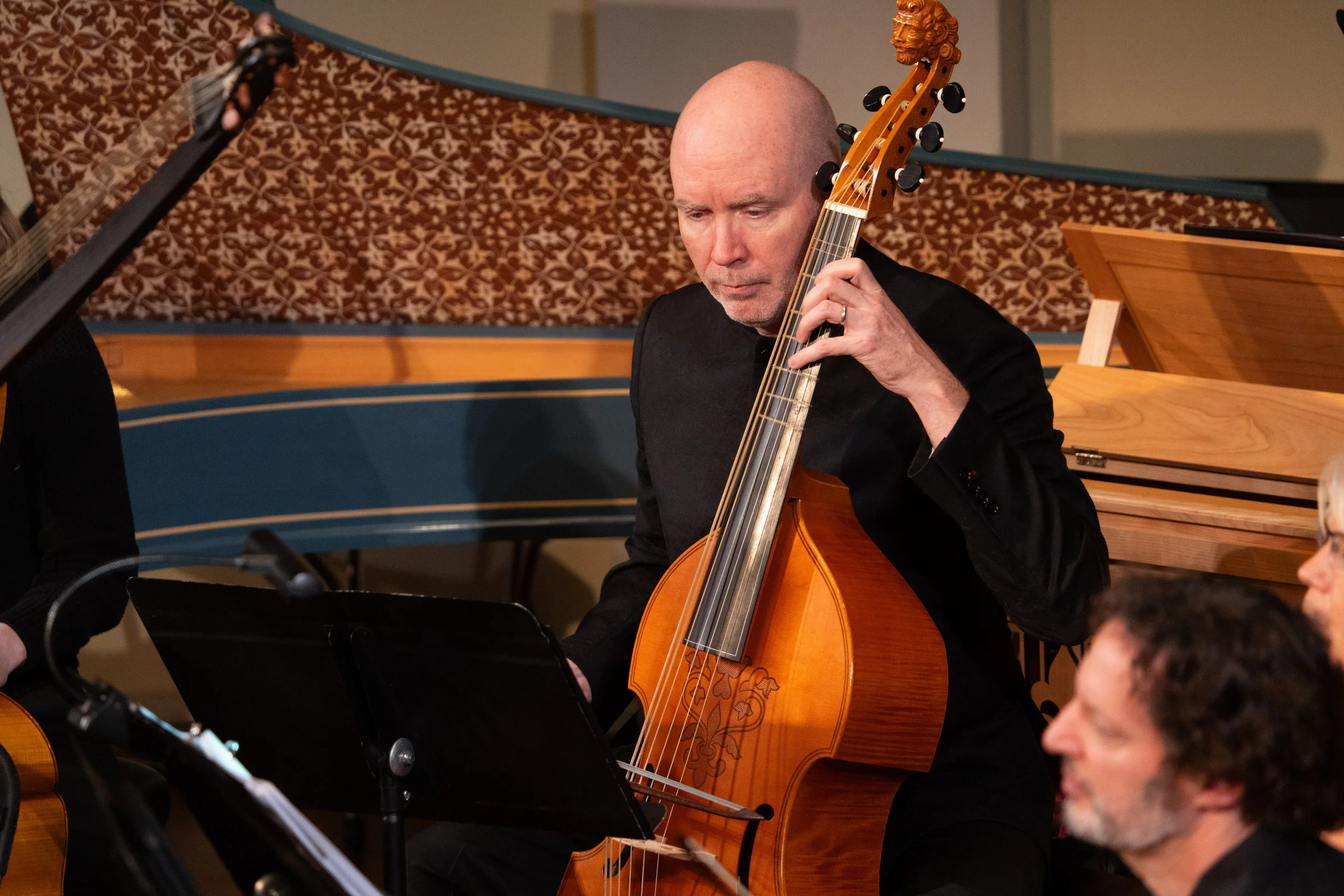
Euridice, featuring Craig Trompeter playing the viola da gamba, Haymarket Opera Company and The Newberry Consort, 2025. Photo: Elliot Mandel

Portrait of a Lady Playing a Viola da Gamba by Caspar Netscher (1639-84), National Trust.
The viola da gamba, often shortened to viol, is sometimes mistakenly called the ancestor of the cello. In fact, the two belong to entirely different families. The cello, part of the violin family, most commonly has four strings tuned in fifths and is most often played with an overhand bow grip. The viol family, by contrast, has between five and eight strings tuned mostly in fourths, frets tied onto the fingerboard (showing its relationship to the lute family) and is played underhand, even the smallest of the family resting vertically on the legs—hence da gamba (leg viol).
The viol was associated with the upper echelons of society. Under the Este family, the city of Ferrara became a powerful magnet for viol players. In 1498 Cesare Borgia (the inspiration for Machiavelli’s Il principe) asked Ercole d’Este to lend him his viola arcu pulsantes, i.e. “viols played with a bow,” for a diplomatic mission to France where the instrument was highly regarded. “We call viols those instruments with which the aristocracy, merchants and other people of quality pass their time,” wrote Philibert Jambe de Fer in 1556. It was an instrument for important and solemn occasions, not unlike the wedding of Marie de’ Medici to Henri IV in 1600. Later in the instrument’s history, Marie’s grandson Louis XIV employed the virtuoso Marin Marais as his personal chamber musician.
The viol’s upright posture can be traced back to instruments held on the knees as early as the 11th century. By the late 15th century, bowing had been applied to the plucked Spanish vihuela, producing the vihuela de arco—the earliest form of the viol. With the support of powerful patrons such as the Borgia family, the instrument spread quickly into Italy, where it took root in the refined culture of Renaissance courts. In Castiglione’s 1528 Il Cortegiano, a book written to instruct young men on the best qualities of a would-be courtier, the fictional character Signor Federico remarks that the viol is “...most delightful to accompany recitation…; this adds so much grace and power to the words that it is truly marvelous.”
While there is no evidence that the viol was used in the small-scale performance of Peri’s Euridice, we added it to the ensemble to provide discreet accompaniment in recitative and to function as either a middle voice or the bass in the additional instrumental music.
Learn more about Haymarket Opera Company and The Newberry Consort’s 2025 performance of Peri’s Euridice.
Contributors
Euridice, Haymarket Opera Company and The Newberry Consort, 2025. Photo: Elliot Mandel
Claire Happel Ashe, harp
Brandon Acker, theorbo
Adrienne Hyde, lirone
Jason Moy, keyboards
Liza Malamut, sackbut
Craig Trompeter, viol
About The Haymarket Review: This new digital publication including thoughts about the work produced by Haymarket is designed to deepen our connection to audiences, nurture and feed audience curiosity about historical performance, offer critical opinions and thoughtful reflections on our performances, and provide a forum for Haymarket and its audience to connect through sharing insights, opinions, learning, and expertise.