

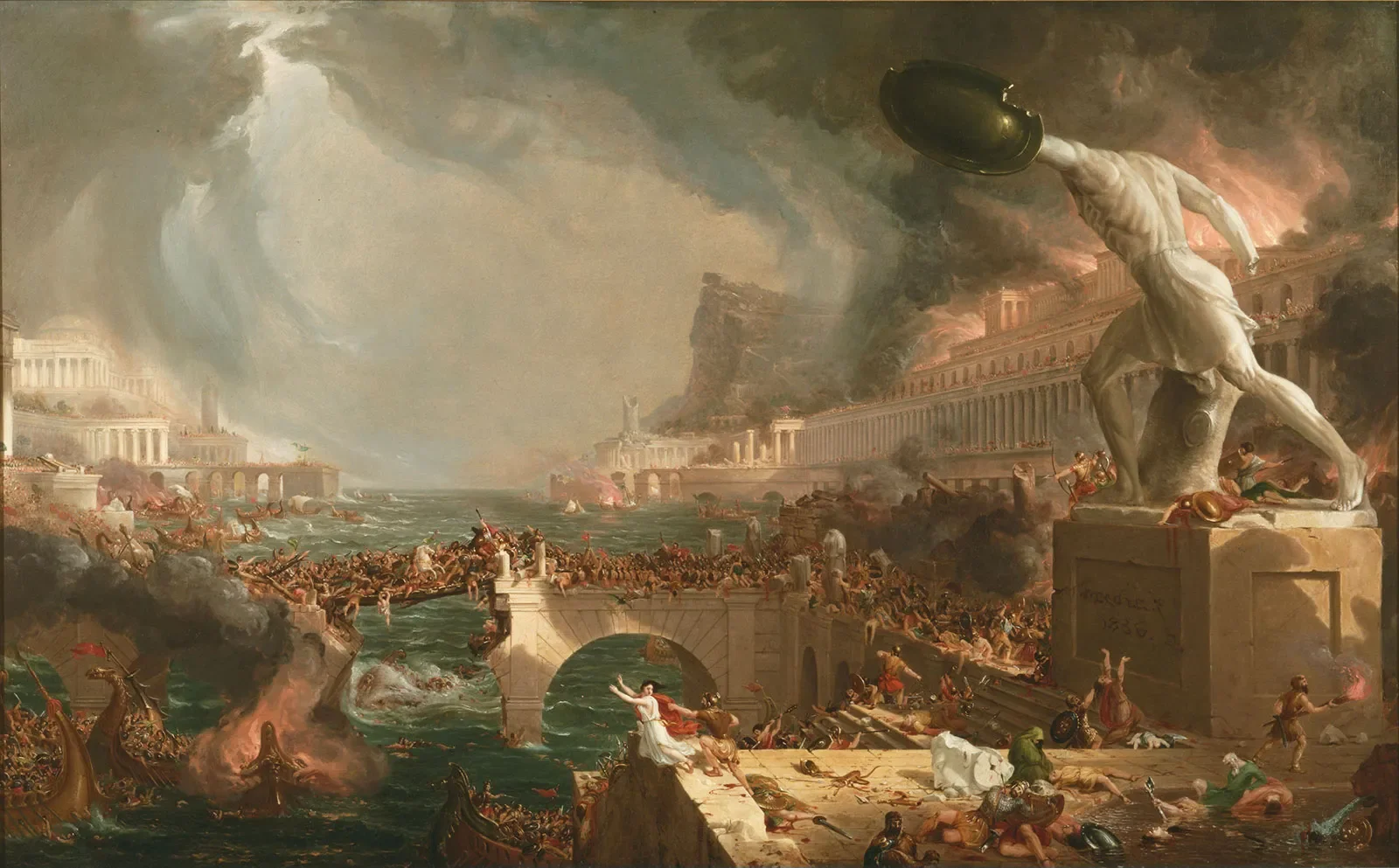
Thomas Cole (1801-1848), The Course of Empire - Destruction, 1836. New York City, New York Historical Society.
Terror, and compassion, (and much more) in Metastasio and Vinci’s Artaserse
by Mario Armellini
Artaserse is the luckiest of my sons. All the others have had various fortunes; but this one, through the obstinacy of fate, has always been firm in the saddle. Even dramas have their protective deities.
With these words Metastasio wrote, on March 1, 1762, from Vienna to his brother Leopoldo, about Artaserse, the most famous and performed of his drammi per musica. There was, however, too much modesty in them: the poet could not fail be fully aware that this ”son”, the seventh of his career as a librettist, was a perfectly crafted dramatic, scenic and emotional-sentimental machine; and that, precisely by virtue of that perfection, it had earned the extraordinary popularity he enjoyed throughout Europe.
Certainly, the play’s fame and dissemination were determined by its first two highly influential productions, staged almost simultaneously during the 1730 Carnival season in Rome (Teatro delle Dame) and Venice (Teatro di San Giovanni Grisostomo). Their music, respectively, was by the “Neapolitan” Leonardo Vinci, already a veteran of Metastasian drama, and by the Saxon Johann Adolf Hasse, who was a Metastasian debutant. Vinci’s Artaserse — who, from 1726 onwards, was Metastasio’s reference composer for four years — was first given on February 4th; Hasse’s premiered a week later, and both productions ended on February 21st, Shrove Tuesday.
Given the documented presence in Rome during that period of both Metastasio and Vinci, it is reasonable to assume that, as staged, the Roman Artaserse reflected, both musically and poetically, the exact intentions of the authors, whether or not they were constrained in their artistic choices by the customs of operatic production of the time.
In Artaserse, the moment of greatest dramatic and expressive interest of the drama seems to reside in the sequence of scenes that from I.11 leads to the end of the first act (I.15), and which would constitute its authentic “dramatic specificity.” These are the facts: In the palace of the kings of Persia, Arbace — who has just had an amorous encounter with Princess Mandane, daughter of King Serse and sister of Prince Artaserse— encounters his father Artabano, commander of the royal guards. The latter has just assassinated the king, and asks his son for his sword, while at the same time giving him his own bloody one. Shortly thereafter, the regicide is discovered. Artaserse, artfully induced by Artabano, hastens to have his brother Dario killed, whom he believes to be the culprit. Meanwhile, rumours spread that Serse’s murderer was not Dario, but someone else, caught fleeing with a bloody weapon. When the order to bring out the apparent murderer is given, Arbace—Artaserse’s brotherly friend, Artabano’s son, the brother of Semira (Artaserse’s beloved lover), and Mandane’s beloved lover—is brought on stage. Confused, Arbace attempts no defence. He could expose his father’s guilt, but he would thus be failing in his duties of filial love. He therefore limits himself, five times, to laconically proclaiming his innocence. The characters on stage, all tied to him by different relationships, listen to him stunned and, without believing his protestations of innocence, one after the other, confused, indignant, doubtful or pervaded by fury and pity, abandon him to his fate, each one having sung an aria characterised by a particular emotional colour.
That sequence of five scenes, in the sudden collapse of an innocent man’s emotional and existential certainties, had a powerful pathetic charge. It must have represented, then as now, one of the strong points, if not the strong point, of the entire drama. Indeed, after having saturated the stage by progressively piling up all the characters (I.8-10), Metastasio presents the dismantling, piece by piece, of Arbace’s social, family, and sentimental relationships: the young man is rapidly abandoned by those by whom he believed himself loved by (friend, father, sister, lover), to remain alone on stage to vent his dismayed grief.
For Aristotle (Poetics), one of the principles of theatrical emotion resided in the representation of an innocent, similar to ourselves, undeservedly struck by misfortune—that’s to say in that union of pity and terror that constituted the essential principle of the ”most perfect tragedy”: ”pity for the innocent, terror for those who resemble us.” While refusing to reduce everything to a mere synthesis of pity and terror, the Aristotelian idea is also largely shared by Metastasio in chapter VI of his late Estratto dell’arte poetica d’Aristotile (before 1773), the theoretical essay in which the Roman poet enunciated not only his general poetics of theatre and opera, but also, and perhaps above all, a thoughtful a posteriori defence of the choices made during an intense career as a theatrical poet. In it, in addition to other pathetic situations present in his dramas, all of which have a powerful pedagogical-moral and cathartic value, Metastasio also made clear reference to his Artaserse:
Human passions are the necessary winds with which one navigates this sea of life […]. Now, our affections are not limited to terror and compassion alone: admiration, glory, aversion, friendship, love, jealousy, envy, emulation, the avid ambition of gain, the anxious fear of loss, and thousands and thousands of others that are composed of the concurrence and mixture of these, are also among those winds that push us to act and which we must learn to control, if we wish to secure our private life and public tranquility […]. When we see an innocent son generously sacrifice his own glory and his life for the preservation of a father […] we flatter ourselves that we too are capable of doing the same: and, nourished by such noble ideas, we can also hope that sometimes we will become capable of imitating them.
For Metastasio, the fate of that “innocent son” (Arbace) who “generously sacrifice[s] his own glory and his life for the preservation of a father” (Artabano) must have been the cause of the unleashing in the audience of that multiplicity of passions that, with “terror” and “compassion,” contribute, educating us, to our edification. A multiplicity of passions arose not only from the condition of the innocent struck by misfortune, but also from the different reactions of the characters who interact with him.
In light of these poetic assumptions and of the constructive canons of eighteenth-century dramma per musica, Metastasio succeeds in creating from a single event—the revelation of Arbace’s apparent guilt —a complex chain of scenes and emotional outbursts that gradually lead to the pity and terror aroused by the character’s existential ruin. And Vinci, employing a range of expressive strategies, places his music at the service of that emotional drama in such an organic and coherent relationship with the text that it suggests a work literally carried out elbow to elbow with the poet.
The part of Arbace (the primo uomo), the true protagonist of the drama, was entrusted to one of the most established soprano castratos of the time, Giovanni Carestini, while that of Mandane (the prima donna), given that women had been banned from performing on stage in Rome since 1676, could only be assigned to the soprano castrato Giacinto Fontana, known as il Farfallino, a great specialist in travesti roles. The choice of the contralto castrato Giuseppe Appiani for the character of Semira (the seconda donna) was entirely similar. As for Artabano, the father of Arbace (the tenore, the third most important character), his part, precisely because he is “the father” was given, according to standard practice and long-standing custom, to the tenor Francesco Tolve, while that of Artaserse (the secondo uomo) was entrusted to Raffaele Signorini, once again a soprano castrato.
Thus, to construct with these characters the scenic and emotional gradation that leads to Arbace’s complete abandonment and annihilation, Metastasio and Vinci had to reckon with the rules that at the time guided the literary and musical composition of a dramma per musica. Unwritten, but universally shared, these rules worked in the world of opera with the obviousness of natural laws. First of all, the poet and musician had to ensure that at least four arias—whose main passion is connected to the surprise, indignation, and pain aroused by the revelation of Arbace’s guilt—follow one another, but this could never be done by placing two overly similar emotional expressions in consecutive arias or in arias already sung by one of the three first parts (Arbace, Mandane, Artabano).
The problem was resolved by Metastasio and Vinci, character after character, in a sequence of five arias very different in typology and passional profile: “Deh, respirar lasciatemi” (Artaserse I.11–aria parlante–disorientation, bewilderment and interior anguish), “Non ti son padre” (Artabano I.12– aria brillante or di portamento–disdain and reprobation), “Torna innocente, e poi” (Semira I.13–aria di mezzo carattere–doubt and confusion), “Dimmi che un empio sei” (Mandane I.14–aria patetica or cantabile–-anger and love, in contrast), and finally, at the end of the act, “Vo solcando un mar crudele” (Arbace I.15–aria di bravura–navigation in the storm as a metaphor for the existential condition of solitude, disorientation and abandonment).
In those five arias, Metastasio achieves the representation of the subjective emotional expression of the characters on stage by fully utilizing the metrical, rhetorical, lexical, and phonic resources offered by the Italian poetic language, and without ever deviating from the laws of “alternation” and “chiaroscuro” of emotions imposed by the dramma per musica genre. Vinci, in turn, interprets the poet’s inventions respecting their meaning and suggestions, but without ever renouncing—although faithful to the formal tradition of the tripartite aria—his own compositional freedom thanks to the continuous diversification of the expressive strategies employed: in those five arias, the composer indeed moves from the almost mimetic depiction of physical discomfort (Artaserse) to the more symbolic one of determination and resoluteness (Artabano) or of internal conflict (Mandane); from the creation of a seemingly incongruous and alienating situation, with respect to the dramatic context (Semira), to the representation descriptive and naturalistic of a sea storm, and physiological and psychological of the existential shipwreck (Arbace).
In Metastasio and Vinci, the form of the aria is never given a priori; both certainly draw on the formal model inherited from tradition, but reinterpret it each time in order to satisfy the most diverse expressive purposes of the situation. From aria to aria, the form is constantly rethought and the various stylistic and constructive parameters are brought back into play. Poet and musician, each one within his own competences, gives verbal or sonic consistency to the various stages of astonishment, anguish, and pain of the characters on stage, all affected by Arbace’s guilt. The entire sequence of scenes and arias that ends Act I prolongs and heightens the tension arising from Arbace’s guilt, finally discharging itself, like a long-awaited storm, only in the final aria, in the sonic and emotional tumult of its colossal evocation of the tempest, and in the vision—certainly compassionate, perhaps even terrifying—of the innocent man vilified and “abandoned by all.” (Only much later would the explosive coup de théâtre that opens scene I.11 find expression not in the outburst of individual characters, but in a complex ensemble, a quartet, of amazement, disdain and bewilderment. One of the first examples of this would be Baldassare Galuppi’s Artaserse, staged in Vienna, probably under the scrutiny of Metastasio himself, in January-February 1749.)
The result of a perfect understanding between poet and composer, Artaserse was immediately greeted with great success, perhaps also thanks to the fact that it was the last opera composed by Vinci before his death (between May 27 and 28, 1730) that may have lent it the aura of an “artistic testament.” Immediately, initially with the complicity of some of the Roman performers, it began to tour the theatres of Italy, and then of Europe, often with significant “contaminations” from Hasse’s perfectly contemporary and antagonistic score. But that’s another story.
© 2005 - 2026 Mario Armellini
About the author
Mario Armellini has been a maître de conférences (associate professor) at the Université de Rouen Normandie since 2009, having previously taught at the universities of Bologna, and Urbino. He studied at the University of Bologna, where he earned a laurea in Arts, Music and Performing Arts (1989) and a doctorate in Musicology (1996). He also held a research fellowship at the CNRS (French National Centre for Scientific Research – Institute for Research in Musicology) from 2015 to 2017. A specialist in 17th- and 18th-century Italian and French opera, and in 16th-century music printing, he has published a book on the two 'Armide' operas by Lully and by Gluck (Passigli: Florence, 1991) as well as several articles in scholarly journals, edited volumes, conference proceedings, and encyclopædias; he is currently working on a critical edition of Lully’s 'Roland' (Olms: Hildesheim-Zürich-New York). Having previously served as scientific director and chief curator of the Civico Museo Bibliografico Musicale in Bologna (1995-2005), he selected the works exhibited in the city’s music museum (2004). Since 2019, he has been a member of the scientific committee for the 'Œuvres complètes' (Complete Works) of Jean-Baptiste Lully.
About The Haymarket Review
This digital publication including thoughts about the work produced by Haymarket is designed to deepen our connection to audiences, nurture and feed audience curiosity about historical performance, offer critical opinions and thoughtful reflections on our performances, and provide a forum for Haymarket and its audience to connect through sharing insights, opinions, learning, and expertise.