

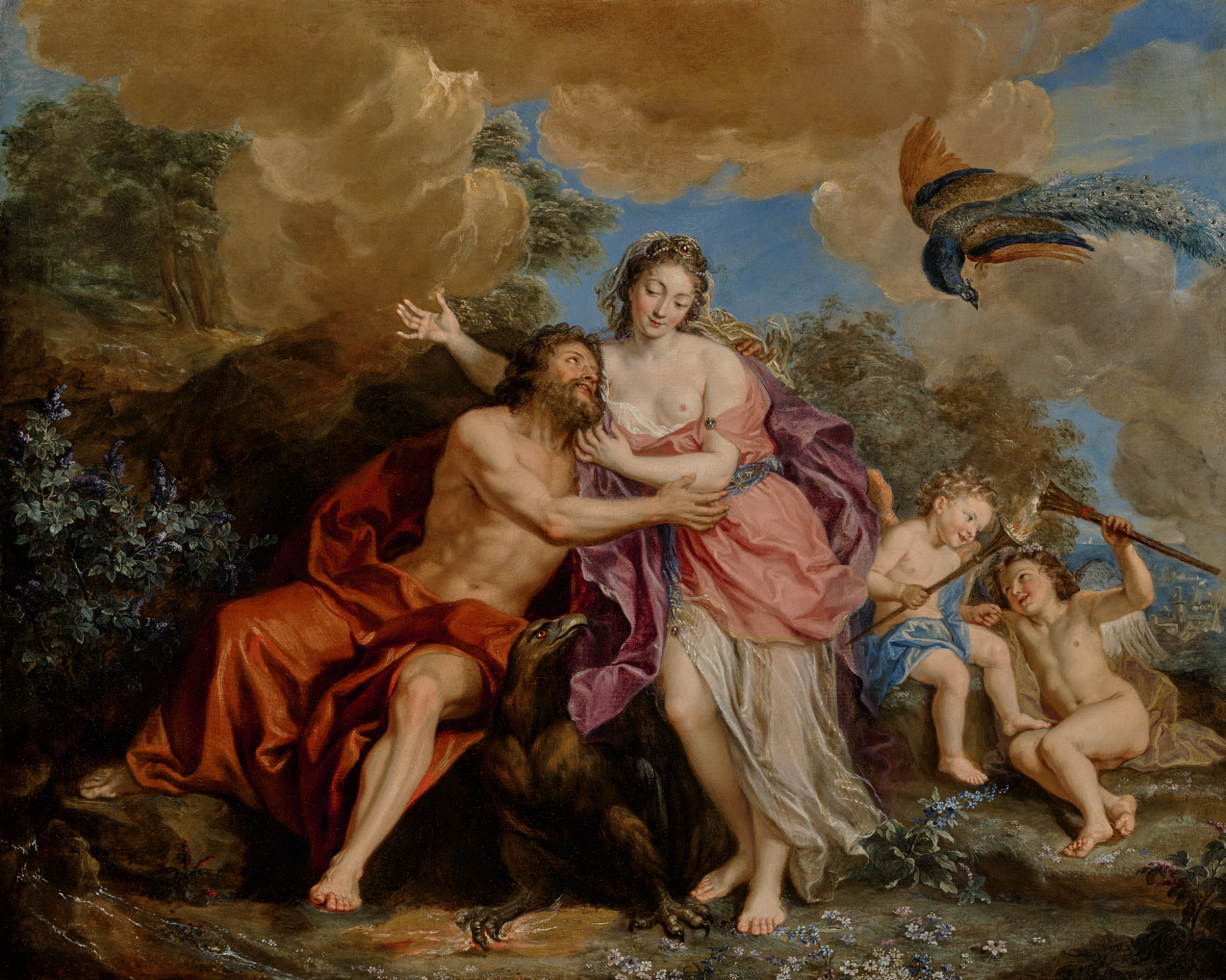
Antoine Coypel (1661-1722), Jupiter and Juno on Mount Ida, 1700s. Private collection.
Remaking Myth, Seria Style
Virtually all the conditions that produced opera seria and its cousins—the azione teatrale, the festa teatrale, and the serenata—have changed radically since the eighteenth century. Singers’ training hardly resembles that of early modern singers, nor do their experiences and assumptions about the world match those of eighteenth-century operagoers. The voices of castrati who dominated opera seria are gone, along with the knowledge, belief systems, and cultural conditions in which they were embedded and the spaces they inhabited. Theaters, salons, and gardens all accommodated forms of viewing and listening in which continuous, fixed attention was more the exception than the rule.
In short, we lack the customs and consciousness that informed early modern opera-going, those myriad dimensions of cultural-cum-emotional existence that the French sociologist Pierre Bourdieu named “habitus,” which extend to domains of music. Not to mention the means of production that were divvied up among impresarios, orchestra players, architects, painters, poets, and composers, the last of whom typically coached singers in rehearsal and made last-minute revisions, replacements, and cuts, with or without input from poets. As John Rosselli stressed, opera seria, in its pace, immediacy, and expediency, was in essence a form of musical journalism.

La Semele, Haymarket Opera Company, 2026. Photo: Elliot Mandel
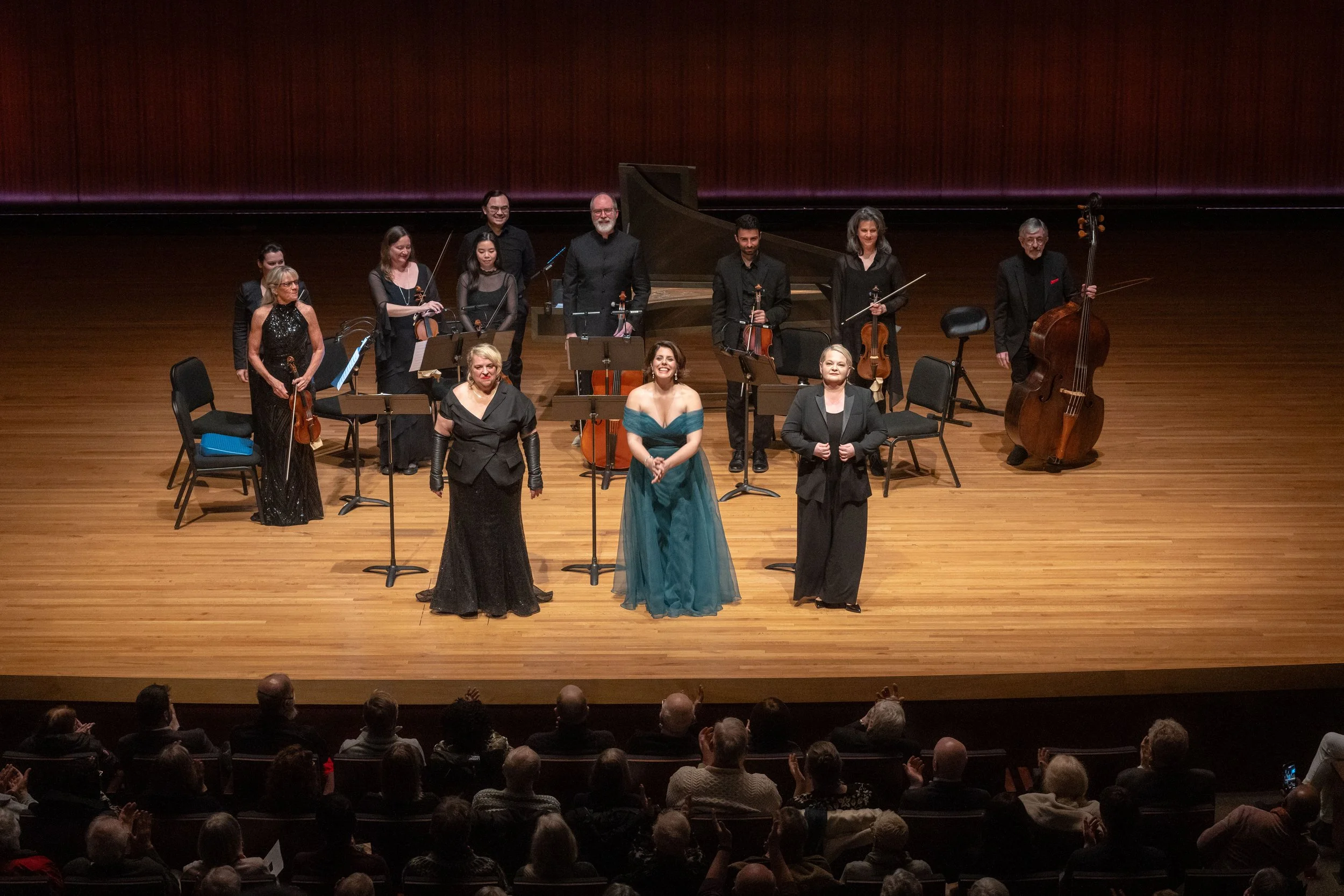
When pressed to adapt to present-day conditions, a modern revival of an opera seria or a seria-like stagework might be undone by any one of these factors, not least for viewers who hold themselves to standards of full-time absorption in whatever spectacle is placed before them. All the more reason to cheer for Haymarket’s brilliant production of Johann Adolf Hasse’s La Semele, o sia La richiesta fatale (Semele, or The Fatal Request), on a libretto by Francesco Ricciardi. Its string orchestra, led by Craig Trompeter, delivered the nuanced harmonic language and contrapuntal imagination of Hasse’s German-tinged Neapolitan score with great verve, digging into the deft voice-leading traded among the three dazzling leads: Emily Birsan in the title role, Elizabeth DeShong as Jove (Giove, or Zeus of ancient Greek fame), and Karina Gauvin as Juno (Giunone, aka the Greek Hera).
Louise K. Stein keenly surmises that their eighteenth-century avatars were the same singers who were on hand to sing the lead roles for the opera season that opened at Naples’s Teatro San Bartolomeo in fall 1726. Only one of the three was female, Marianna Benti Bulgarelli (1684-1734). She would have taken the part of jealous Juno, enraged in every mythical iteration since time immemorial over the infidelities of her consort Jove. The other two were almost certainly famous castrati: Carlo Scalzi (c. 1700–c. 1767-68?), an ultra-high-voiced nimble male soprano as the fetching Semele; and Gaetano Berenstadt (1687-1734), a booming alto who had sung a 1717 revival of Handel’s Rinaldo, created Handel’s eponymous Flavio (1723), and sung Handel’s Tolomeo in Giulio Cesare (1724) before assuming the formidable part of Jove.
Why does all this matter? Since eighteenth-century arias were almost always tailored not just for voice types but for specific singers, any modern-day singer who takes one on is also taking on the voice of someone else. A modern-day soprano wanting to sing Handel might, therefore, look for the range, vocal style, and registral breaks of a Handelian singer who best matches her voice.
What, then, of singing parts written for castrati? Particular challenges arise. Castrati most often sang the parts of princes and youthful heroes, though in cases where they were younger or were singing in papal lands (where female voices were forbidden in the theater), they sometimes sang the parts of female characters. Nevertheless, the problem for today’s singers is neither cross-dressing, which was hardly marked for much of the eighteenth century, nor the fact that castrati sang an octave higher than their unaltered male counterparts. (Soprano castrati sang about an octave higher than tenors; alto castrati an octave higher than basses and baritones—an issue that can be addressed today in various ways without resorting to transposition.) Instead, the problem turns on the affordances of castrato voices as compared with ones available nowadays. Prepubertal castration not only prevented a boy’s voice from dropping but could enhance lung capacity, as chests often grew larger than usual owing to hormonal changes, even larger than the chest sizes and hence lung capacities of unaltered men. Combine the loud, piercing voices that resulted (suited to fill big theaters and churches) with another variable—the fact that castration also preserved the place of a boy’s registral break, which tends to sit a fourth or fifth higher than that of a typical adult, as high as an octave above middle C—and it becomes apparent how difficult it is to “find one’s voice” in the numerous bespoke scores written for castrati.
La Semele, Haymarket Opera Company, 2026. Photo: Elliot Mandel
How miraculous, then, to be treated to the powerful, dexterous, and eloquent voices of Birsan, DeShong, and Gauvin! Wonderful, too, was the marvelous stage action they brought to the show. Far from pining for a full-blown staging, I found myself reveling in the chance to fix my attentions on the gripping music, with all its affective transitions borne along with the sparest of visual means: facial expressions and minimal gestures, savvy deliveries moving kaleidoscopically through the topoi of love, pleasure, rage, grief, and terror, all mustered to deliver the libretto’s riff on the outrageous story of Jove’s love affair with Semele and Juno’s mad quest for revenge. In place of sets, stage action, and full-out costumes we got authenticity, humor, and a stinging dose of irony.
Juno’s fury makes for a crazy tale, and one that, like most myths, has been recited and remade repeatedly for centuries and millennia. Roberto Calasso starts his mind-bending beauty of a book, The Marriage of Cadmus and Harmony (1988), by recounting the tale of Europa’s rape by Jove’s Greek predecessor Zeus, rebeginning each of five different retellings, five different versions of the myth, with the words “But how did it all begin?” How it all began is of little interest in the Semele we heard. The serenata dives right in, presuming a 1726 listenership well acquainted with a variety of Semeles. Each witness to the performance would have had a memory bank loaded with tales of the daughter of Cadmus and Harmony who was taken by the lustful Zeus, tales gathered from Herodotus, Callimachus, or Ovid, or from more recent texts, or from paintings, frescoes, vases, or sculptures.

Giovanni Battista Tiepolo (1696-1770), Juno and Luna, between 1735 and 1745. Houston, Museum of Fine Arts.
Ricciardi’s libretto implicitly reframes the myth in terms that presume an absolutist regime in which power always cascades cosmologically downward from an immortal god to the lower realms of mortals: from royals to nobles (like Count Jan Adam Questenberg, whose court of Jaromĕřice sponsored opera and who was dedicatee of this serenata) and from nobles to nonnobles: merchants, lawyers, doctors, and military men, and beneath them (in descending order) servants, laborers, beggars, and slaves. Mythically speaking, this Semele has more than one deity, of course, but allegorically speaking only one of them really matters. In Ricciardi’s libretto Jove ends up functioning not unlike a Christian god, albeit one whose power is reinscribed in the bourgeois terms of a family. Jove there stands as the “father”—a psychic projection in a kind of family romance. His will transcends all other laws because it is the first and only law (“l’arbitrio di Giove [è] il primo diritto”). A law unto himself, he is the ultimate father figure.
And yet what drives the dramaturgical energy of the story is largely a succession of recitatives and arias. They might seem a routine succession were it not for the fact that it’s this instability that mobilizes them, in this case the instability of an impossible triangulation. As Juno puts it, addressing Jove, “We share a single object: I loathe what delights you.” It’s not just the power of Jove that’s at issue, then, but the impossible position Jove occupies, with all his passions, adventures, and caprices, which constantly threaten the boundaries between ranks and positions, contaminating them and challenging the divides between mortal and immortal.
As they do so, music in this Semele is always ready to fuel the dramaturgy. Glorious examples abound. Hasse exploits the Petrarchan parataxis of Semele’s “Taccio, sospiro, e gemo” (I am silent, I sigh, I quake) to project her qualms about the untrustworthy Jove, having her doubt his fidelity in gently offbeat figurations and delicate chromatic colorings. In “Vago fior sul verde prato” (Lovely flower on the green meadow) he gives her an outpouring of trills and coloratura to declare that “beneath the leaves of a flower lurks a treacherous snake.”
We might rehear those words not as textual matter but as meaning made from musical sound. Beneath the ravishing melismas lies a damning accusation that upsets the balance of power. Jove’s weak rebuttals to Semele’s accusations—which he denies before begging to be let off the hook of his oath to her (“Qual sarebbe il dolor mio / Se veder dovessi, o Dio / Scolorirsi i vaghi rai / Che m’accendono di amor”; in effect, “What would my pain be if I should have to watch the eyes of my beloved dim?”)—expose the precarity of descending to earth to negotiate love on the risky terrain of mortals. But here and elsewhere, music stands ever ready to help: not just to show that gods, like humans, have weaknesses, but to help heal and resolve them. Hence the quintessentially eighteenth-century happy ending. And hence the magic of the Haymarket revival.
About the author
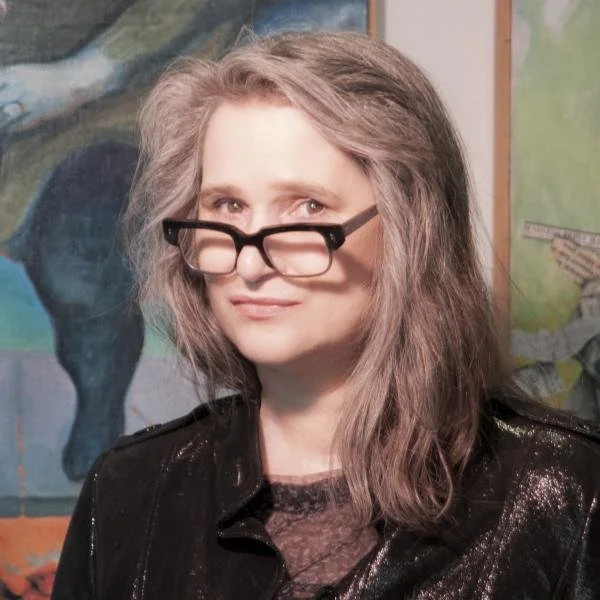
Martha Feldman is the Ferdinand Schevill Distinguished Service Professor in Music and Theater & Performance Studies at the University of Chicago. She is the author of several award-winning monographs: City Culture and the Madrigal at Venice (University of California Press, 1995), Opera and Sovereignty: Transforming Myths in 18th-Century Italy (University of Chicago Press, 2007), and The Castrato: Reflections on Natures and Kinds (University of California Press, 2015), based on her six Bloch Lectures at the University of California, Berkeley. She is also the coeditor of two essay collections, The Courtesan’s Arts: Cross-Cultural Perspectives (2006) and The Voice as Something More: Essays toward Materiality (2019), as well as two special journal issues: “Music and Sound at the Edges of History” (Representations, 2021) and “Sounding the Spectral” (Portable Gray, 2025).
Feldman’s current and recent projects include work on Maria Callas, the choreography of Bintou Dembélé, the voice of Nina Simone, and errant voices in performance. With Martin Stokes and Dafni Tragaki, she is a leader of the Neubauer Collegium-supported multidisciplinary international project “Love / Music: Problematics of a Relationship.”
Her work has been supported by the National Endowment for the Humanities, the American Council of Learned Societies, the American Philosophical Society, the Getty Research Institute, the Guggenheim Foundation, the Franke Institute for the Humanities, and the American Association of University Women, among others. She is an elected member of the American Academy of Arts and Sciences and a recipient of the Dent Medal of the Royal Musical Association.
About The Haymarket Review: This digital publication including thoughts about the work produced by Haymarket is designed to deepen our connection to audiences, nurture and feed audience curiosity about historical performance, offer critical opinions and thoughtful reflections on our performances, and provide a forum for Haymarket and its audience to connect through sharing insights, opinions, learning, and expertise.