

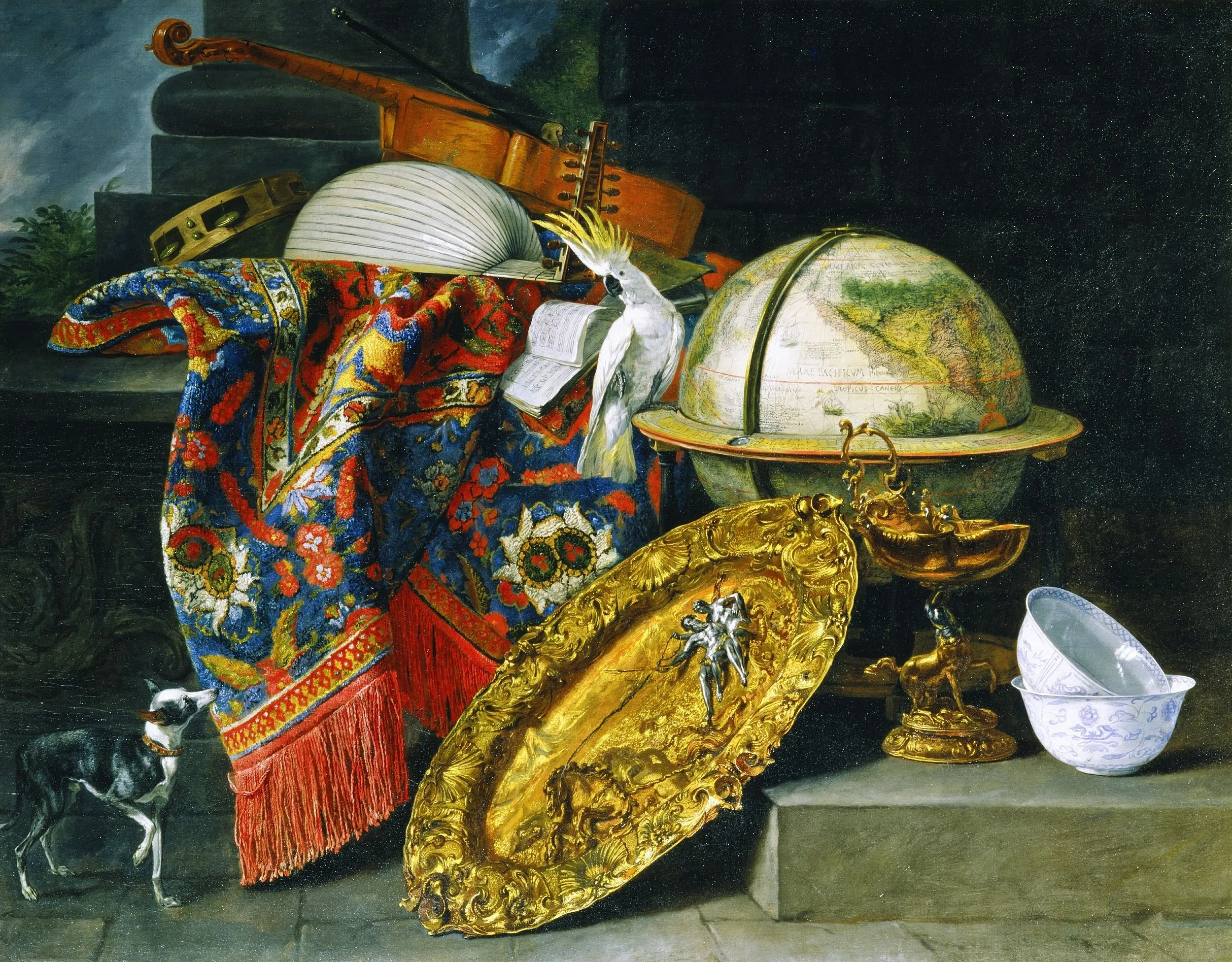
Pieter Boel (1622-1674), Still Life with Persian Rug, c. 1658. Vienna, Akademie der bildenden Künste Wien.
Engraver Brian Clark on preparing editions of Hasse’s La Semele and Vinci’s Artaserse
In my fourth (and final) year at the University of St Andrews in Scotland, the professor of music introduced a course he grandly called “Musical Palaeography”—basically, studying old ways of writing music. Before we had today’s standard clefs and five-line staves, composers used all sorts of weird and now-forgotten systems to write music down so others could sing and play it. Many of those early systems were quite maths-heavy and almost like learning a foreign language. Since music had originally just been a filler alongside my main subjects (French and German), I absolutely loved it.
After graduating, I worked at London’s first classical CD shop, then spent a few years as a journalist. I enjoyed it, but it didn’t quite hit the mark, so I applied for a British Council scholarship to visit what was then East Germany. The idea was to study manuscripts by a composer called Johann Friedrich Fasch (1688–1758) as prep for a possible PhD. But just a week after arriving in East Berlin, a member of the National Library staff handed me a freshly submitted PhD… on exactly that topic. Timing!
Instead of going back into journalism when I returned to the UK two months later, I decided to try my luck as a music copyist. I’d spent days painstakingly hand-copying Fasch’s music, so it felt like a natural next step. This was the late ’80s, when the “early music” scene was still quite new, and musicians were constantly hunting for forgotten pieces. Thanks to a lucky chain of events, within a few months I’d done work for the BBC and been contacted by a publisher supplying nascent groups like The Academy of Ancient Music, The English Concert, The Monteverdi Choir, and The Taverner Consort. They’d also just started using some of the earliest software to convert coded text into printed music. Basically, everything lined up perfectly, and before long I was earning more than I ever had as a journalist.
Fast forward 45 years, and although “early music” has evolved into what’s now called historically informed performance (HIP), there’s still plenty of interest in rediscovering obscure repertoire.
One example is Johann Adolf Hasse's serenata La Semele, which was performed in Naples, where the composer lived for several years, in Autumn 1726.
When you’re asked to produce a new edition of something like that, the first job is to track down reliable sources from the time. Typically for a composer of Hasse's stature, there would be several scores and at least one printed libretto (often with a side-by-side translation), and probably at least one set of performing parts. Unlike operas, however, serenatas were the very definition of occasional works, typically written to celebrate a noble birthday or wedding. They were seldom reprised, so multiple copies rarely exist. If wordbooks were printed at the time, such ephemera hardly ever survive the test of time. Sadly, the only known source of La Semele is a full score belonging to the Gesellschaft der Musikfreunde in Vienna, Austria. They very kindly supplied a full-colour digital scan.
Another example is Leonardo Vinci’s opera Artaserse, which was described in one surviving score as “the finest Italian opera ever written.” It was first performed in Rome in 1730 during the carnival season.
Luckily, for a piece with that kind of reputation, there’s a lot of material: full scores, separate aria scores, some with instrumental parts, even an incomplete set of parts made for the Dresden court (which are now in a Moscow library), plus various printed librettos. These manuscripts are scattered all over the world—there are even full scores in several U.S. libraries.
Back in the early 18th century, music was mostly copied by hand. Once the composer finished his original score, professional copyists would make duplicates, then others would turn those into parts for singers and instrumentalists. Naturally, with so many people involved, mistakes crept in. Part of the editor’s job today is spotting and fixing those. Thankfully, with Artaserse, there were enough sources to cross-check things—though even then, some mistakes had slipped through. When you’re copying something over and over, it’s easy to engage autopilot and not even notice when something doesn’t quite make musical sense.
For this project, I was lucky enough to work with a colleague in the U.S. He’d input the music into Sibelius while I slept, then I’d check it against another source and add the lyrics. He’d then compare it with a third source and move on to the next section. Working like that, we got through the whole opera in under a month and felt pretty confident in the result — though I’m sure performers will still have spotted things we missed!
Once all the notes are in place, the focus shifts to making the music look good and ensuring page turns are practical for singers. After finalising the full score, the next step is preparing the individual instrumental parts. In opera, it’s especially important that players—particularly the strings—can see what the singers are doing, not just their own lines. And of course, page turns need to be carefully planned—otherwise half the orchestra might drop out mid-performance!
If we’ve done our job properly, you’ll just be able to sit back and enjoy Vinci’s take on all the political drama at the Persian court.
About the author
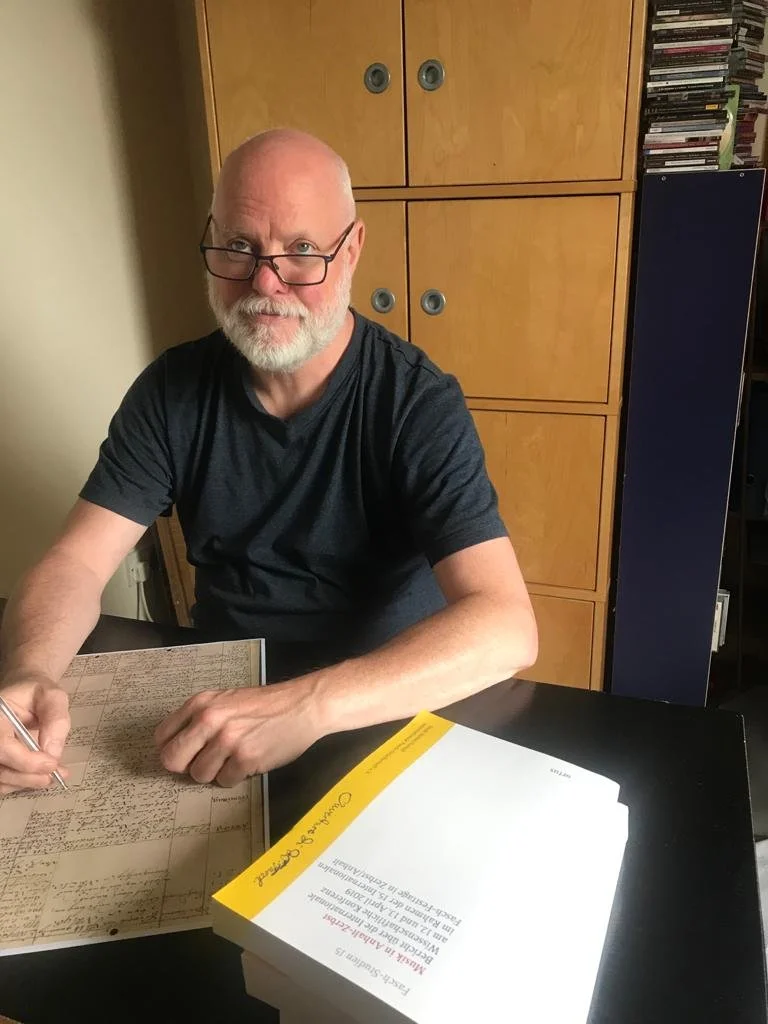
Despite having to ditch the planned PhD, Brian Clark maintains interest in the composer Johann Friedrich Fasch, having come upon his music pretty much by chance in 1988. When asked by friends to direct some concerts at the Edinburgh Fringe Festival, Clark was looking for a composer who would celebrate an anniversary that year; Fasch was born in 1688. The concerts were a huge success—Fasch's music is accomplished and tuneful, and proved very popular with the musicians and the public. Since then, Clark has published well over 100 of his surviving works. In 1997, Clark was awarded the Fasch-Preis der Stadt Zerbst (Germany), where the composer worked as court Kapellmeister for 36 years. Clark is currently working on editions of Fasch’s Latin vespers psalms (which may date from the 18 months he spent in Prague, immediately before he took up the Zerbst appointment) for performances at the Internationale Fasch-Festtage in 2027.
About The Haymarket Review: This digital publication including thoughts about the work produced by Haymarket is designed to deepen our connection to audiences, nurture and feed audience curiosity about historical performance, offer critical opinions and thoughtful reflections on our performances, and provide a forum for Haymarket and its audience to connect through sharing insights, opinions, learning, and expertise.