

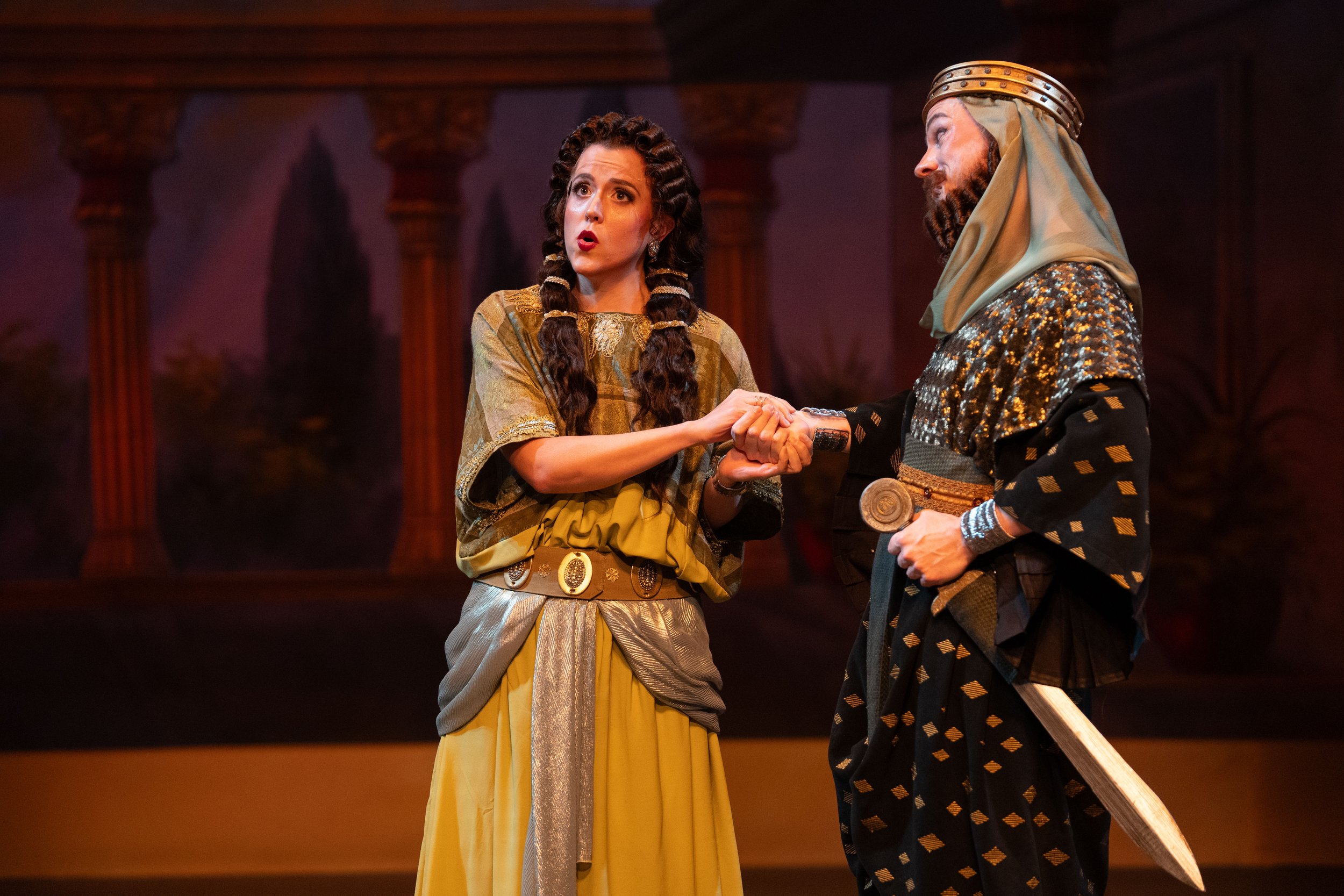
Artaserse, Featuring Elijah McCormack and Ryan Belongie, Haymarket Opera Company, 2025. Photo: Elliot Mandel
What Sarrasine Didn’t Know: Reflections Around Haymarket Opera’s Artaserse
When the French sculptor Ernest-Jean Sarrasine arrived in Rome in the late eighteenth century and attended a performance at a local theater, he was unaware of a peculiar feature of the evening: the star of the show, La Zambinella—who appeared to him as a glamorous femme fatale endowed with extraordinary vocal gifts—was, in fact, a man. A castrato, to be precise: one of the many male singers who, since the late Renaissance, had been transformed into musical wonders through a surgery that prevented their prepubescent voices from breaking. Much has been written on the subject, and this is not the place to address it in full—though for those wishing to explore further, Martha Feldman’s luminous book The Castrato: Reflections on Natures and Kinds is an essential companion.
Sarrasine’s story is, of course, fictional—the invention of Honoré de Balzac, told in the novella that bears his protagonist’s name. Yet the experience Balzac imagines for him—of being utterly charmed and seduced by La Zambinella—is one I return to again and again, both as a scholar and as a teacher. It is a fixture of my courses on opera and voice, and it gives me much to think about: not only for the cultural richness of the story and its many ramifications, but because Sarrasine’s predicament uncannily mirrors the reaction of my students—and, I would argue, of most contemporary audiences—when they first encounter the marvels of Baroque opera.
Sarrasine’s bewilderment had a specific cause: he came from France, a country that never quite caught the castrato fever that inflamed the rest of Europe. My students’ surprise has a different origin. For them, non-binarism and gender-bending in life and performance are familiar features of contemporary culture—and yet the discovery that such phenomena existed long before modernity consistently produces a particular kind of astonishment, followed, more often than not, by genuine fascination.
When I need to offer historical evidence for the world Balzac fictionalizes, I typically turn to one venue above all others: the Teatro delle Dame in Rome, which hosted some of the most celebrated operas of the eighteenth century—works conceived primarily for and performed by castrati, who were called upon to sing both male and female roles—a circumstance that added layers of complexity to an already dizzying theatrical world. The castrato voice, with its high-pitched timbre and flamboyant vocal fireworks, already carried audiences into a realm of ecstatic appreciation and irresistible desire; when combined with cross-dressing and the deliberate confusion of gender on stage, the effect must have been nothing short of intoxicating.
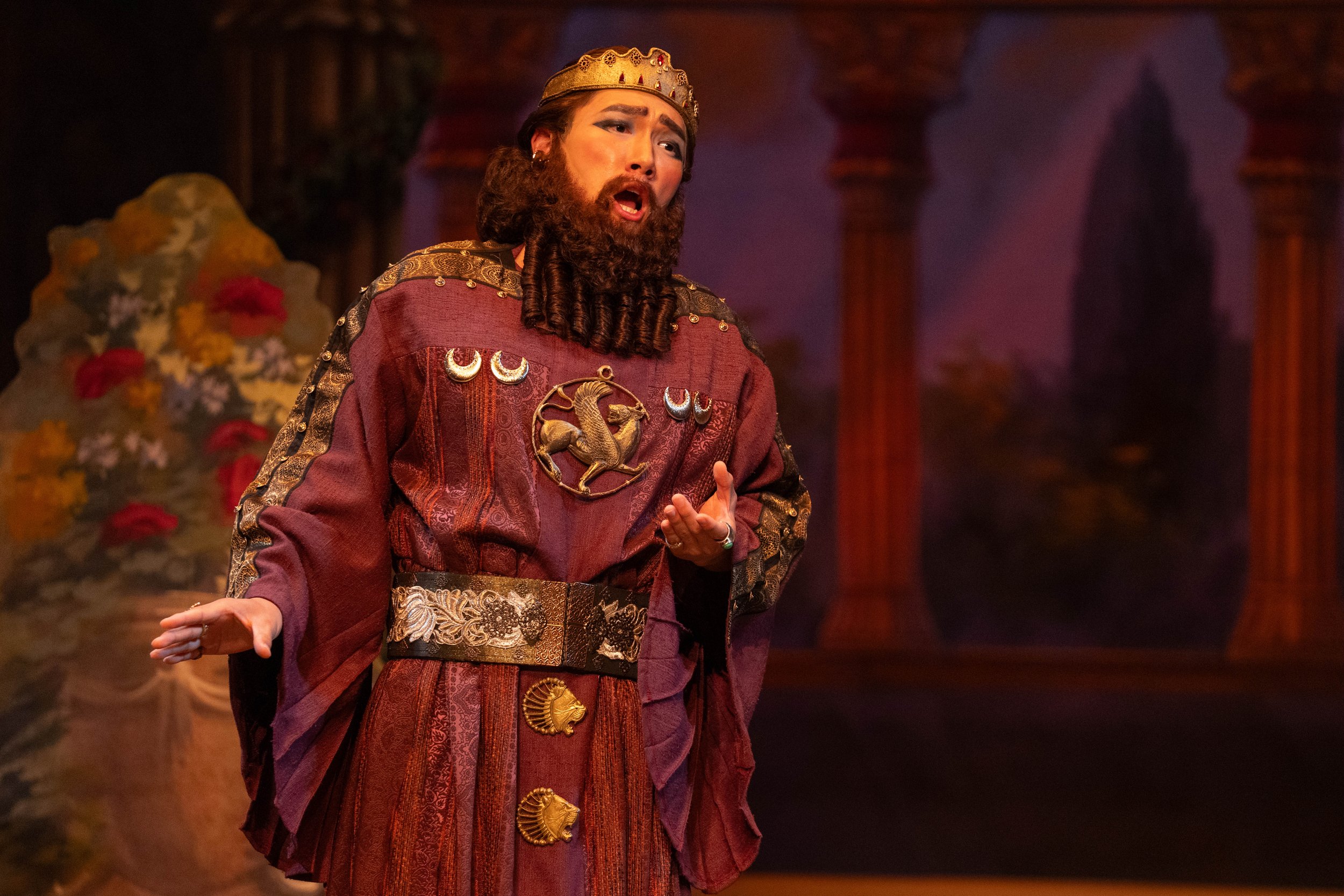
Artaserse, featuring Kangmin Justin Kim, Haymarket Opera Company, 2025. Photo: Elliot Mandel
If one opera can stand as the signature title of this kaleidoscopic universe, it is the musical gem that the Haymarket Opera of Chicago has now revived and recorded: Leonardo Vinci’s Artaserse, first performed at the Teatro delle Dame on February 4, 1730. Set to a libretto by the most influential opera librettist in history—Pietro Metastasio, then on the eve of his move to Vienna as poet of the imperial court—Artaserse encapsulates all the defining features of Baroque opera seria. The plot draws loosely on ancient history, specifically the turbulent succession to the Persian king Xerxes, and balances two interlocking concerns: political intrigue and love.
As those fortunate enough to attend the Haymarket production will readily confirm (and how welcome it is that those who were not there can now turn to the recording!), Leonardo Vinci’s music is truly remarkable. It brings to life a libretto that is itself a masterwork, and the two illuminate each other with striking force.
To appreciate what Vinci achieves, it helps to understand what Metastasio brought to the table. Opera seria of the period was governed by a canonical distinction between recitative and aria: the former moved the action forward, the latter gave voice to a character’s inner world—emotions laid bare, passions anatomized. In lesser hands, this structure could become formulaic, a mechanical alternation of plot and feeling. Metastasio refused the formula. His recitatives carry genuine dramatic weight: his characters, whether set in Persia, Greece, or ancient Rome, speak with the eloquence of Latin oratory refracted through the tragic ideals of the French grand siècle—Racine lurks not far beneath the surface. The result is something rare: recitative that one actually wants to listen to.
When it comes to the arias, Metastasio works with the dominant form of his age—the so-called da capo aria, structured in two contrasting sections, with the first conventionally repeated, and elaborated upon, at the close. But here again, he transcends the convention rather than merely observing it. Because he thinks as a man of the theater, not simply as a poet supplying words for musical display, he crafts his aria texts with an eye toward dramatic development, conceiving them not in isolation but as integral to the broader arc of each scene. Understood in this way, each aria stems from somewhere and has somewhere to go. Vinci, for his part, seems to have grasped this instinctively: his musical settings make the arias pulse with forward momentum and anticipation, rather than inviting the listener to linger in lyrical self-contemplation. The emotion is alive, kinetic—always pointing toward what comes next.
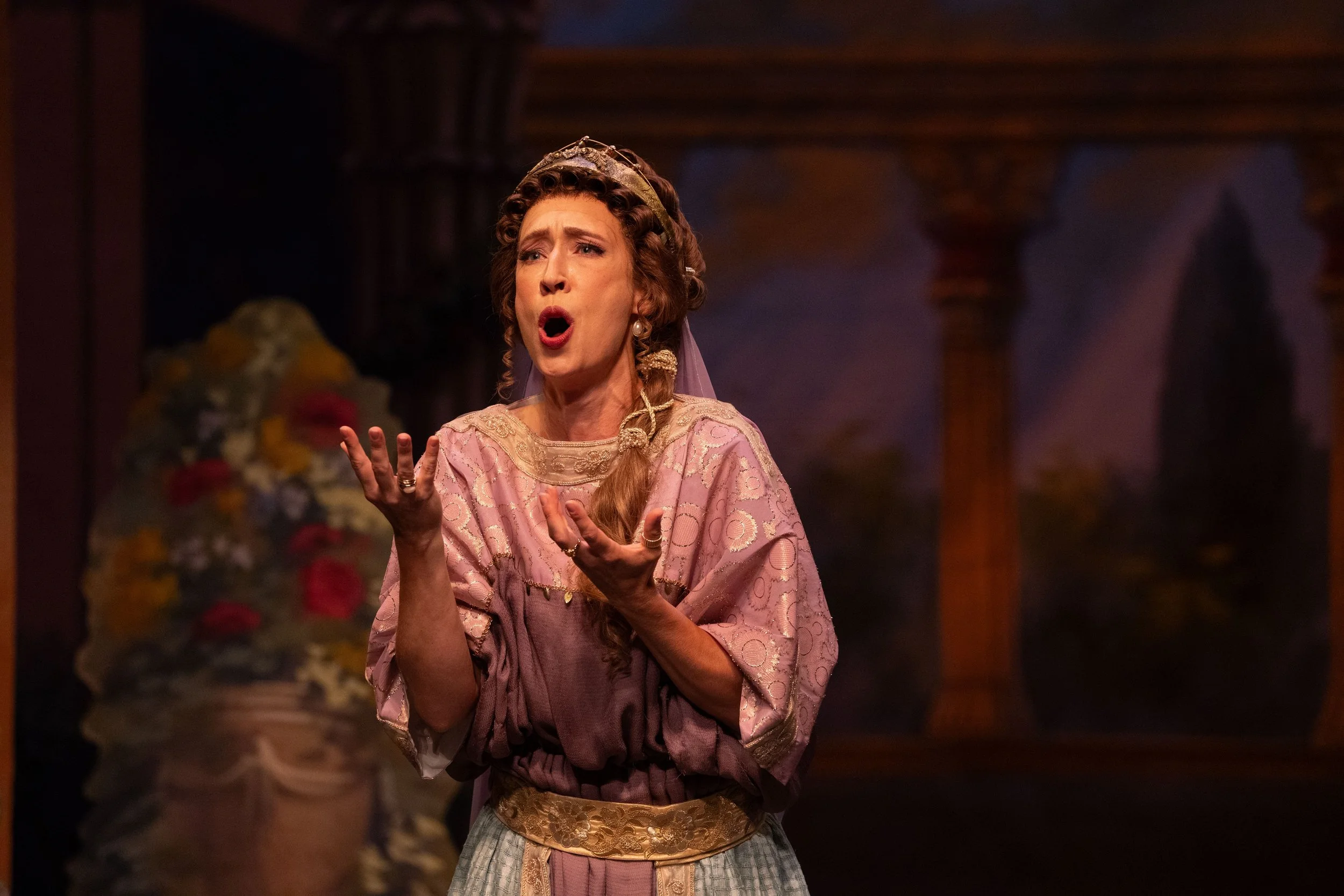
Artaserse, featuring Emily Fons, Haymarket Opera Company, 2025. Photo: Elliot Mandel
The somewhat complex yet perfectly balanced plot of Artaserse provides a generative testing ground for both Metastasio’s poetic experimentation and Vinci’s musical boldness. This is evident not only in the exhilarating virtuosity of the arias—among the most daring in the entire eighteenth-century repertoire—but also in the subtler ways Vinci handles the recitatives. Most are set according to the traditional method of recitativo secco (dry recitative), in which singers deliver their phrases against a basso continuo line typically realized through a combination of instruments left unspecified in the score—harpsichord, cello, theorbo, or some blend of the three—with performers improvising the realization on the spot. But Vinci also ventures into the then still largely uncharted territory of the recitativo accompagnato (accompanied recitative) a form in which the emotional gravity of a given moment demands richer orchestral support, building musical tension in a way that often propels the scene directly into the full melodic force of the ensuing aria. In Vinci’s hands, the boundary between recitative and aria becomes less a wall than a threshold.
This kind of seamless interplay between word and music is especially vital in an opera like Artaserse, and for a reason that may initially seem surprising: all four of its protagonists sing in the same register. The drama at the center of the opera is a tightly wound knot of love and friendship. Artaserse, prince of Persia, loves Semira, who happens to be the sister of his dear friend Arbace; Arbace, in turn, loves and is loved by Mandane, Artaserse’s own sister. Around this quartet of intertwined hearts—already strained to the breaking point by the false accusation that Arbace has murdered Artaserse’s father, the late king of Persia—two further characters orbit at a lower register, both literally and figuratively. Artabano, Arbace’s father and the opera’s true villain, is plotting against the Persian crown; his confidant Megabise nurses an unrequited infatuation with Semira. These are the opera’s only low voices, and their gravitational pull throws the luminous world of the four protagonists into sharper relief.
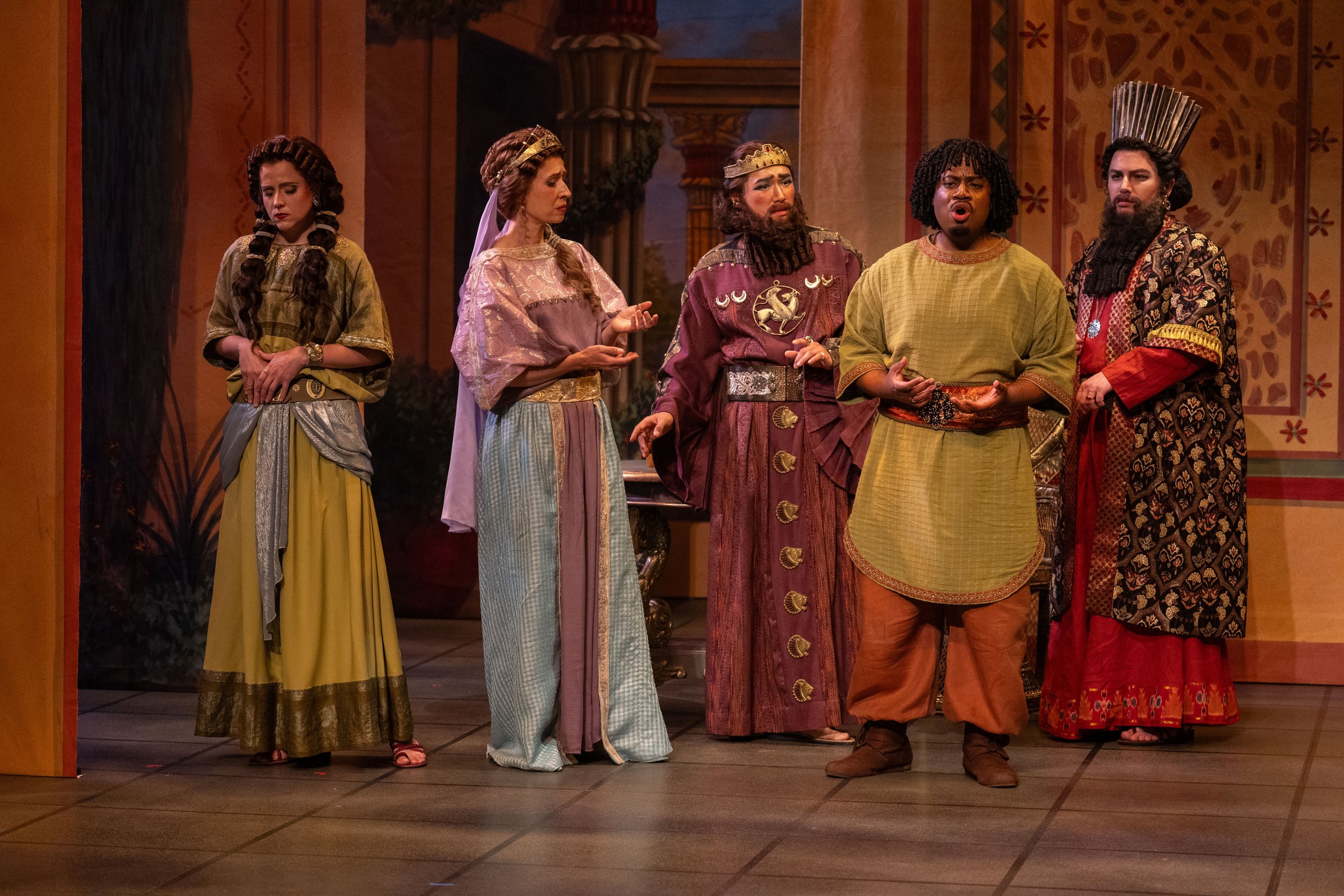
Artaserse, Haymarket Opera Company, 2025. Photo: Elliot Mandel
For those wishing to follow the specific narrative threads that eventually deliver Artabano’s defeat and the full reconciliation of the lovers, the program from the Haymarket production and the booklet accompanying the recording are both excellent guides. What I want to dwell on here is something else: the remarkable—and to modern ears, potentially disorienting—phenomenon of four protagonists who all inhabit the same vocal world.
For operagoers accustomed to the fairly stable binary of “he” and “she” in later operatic repertoire—the tenor and soprano pairings that anchor so much of the nineteenth-century canon, from Violetta and Alfredo to Isolde and Tristan, from Tosca and Cavaradossi to countless others—the fact that in Artaserse both male and female characters sing with soprano voices can be genuinely disorienting. The confusion is sharpest, perhaps, when listening to a recording rather than attending a staged production, where costumes, wigs, and makeup at least offer visual anchors for who is who.
And yet, once one begins to consider that markers of gender identity in the age of Vinci and Metastasio operated on entirely different terms from those of the allegedly more “realistic” nineteenth century, things become less puzzling—and considerably more interesting. In the world of eighteenth-century opera seria, vocal register was not primarily a marker of gender but of age and social standing. The high-pitched—and highly seductive—voices of Artaserse and Arbace signified nobility, virtue, aristocratic distinction, and above all youth. It was entirely “natural” (if the result of a violently artificial act) that the voices of the two heroes should sound like those of their beloved female counterparts. And in the case of the Roman premiere of Artaserse, where Semira and Mandane were also performed by castrati, the blending of the four voices would have been especially mesmerizing: similar not only in register but in timbre. That said, each singer, then as now, would have brought their own distinctive vocal color to the part. Which opens onto a further qualification worth noting in passing: scholars have persuasively argued that the vocal color of the castrati differed in subtle but meaningful ways from the clearer timbre of female sopranos and mezzos—a fascinating digression, though one that would take us too far from our present focus.
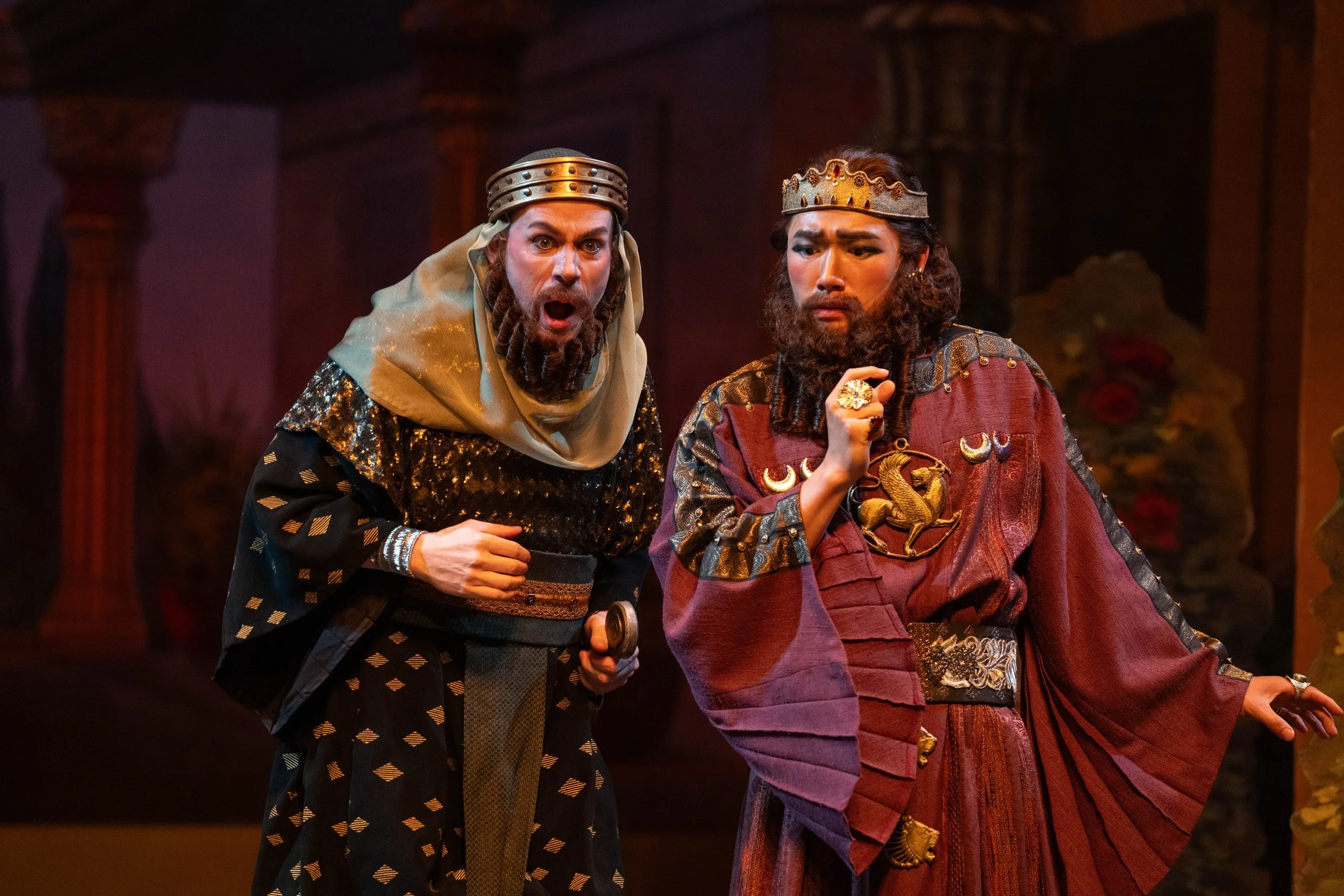
This brings us to an obvious question: given that castrati no longer exist, how can modern productions of an opera like Artaserse recover even a fraction of those enigmatic, irretrievable voices? The answer, happily, lies in today’s countertenors and male sopranos, who allow those voices to reverberate across the centuries—not as replicas, since there is no way to know how close any modern performance comes to the original sound, but as living resonances that offer both genuine food for thought and, more immediately, ample occasion for musical delight.
The Haymarket Opera production of Artaserse meets this challenge with a vocal palette that is at once diversified and deeply considered: two countertenors in the roles of Arbace and Artaserse, a mezzo-soprano as Mandane, and a male soprano as Semira. The result is an ensemble that challenges conventional acoustic expectations while honoring the spirit of Vinci’s original design. We may never be able to fully re-experience the kind of vertiginous confusion that overcame the fictional Sarrasine on that Roman evening—but a production and recording such as this one brings us closer than we might have imagined to the musical wonders of Baroque opera. And that, it turns out, is no small thing.
About the author

Eugenio Refini is Professor of Italian and Chair of the Department of Italian Studies at New York University, where he also directs the Medieval and Renaissance Center. He holds a PhD from the Scuola Normale Superiore of Pisa and previously taught at Johns Hopkins University. A Fellow of the American Academy in Rome, he has received the NEH Rome Prize in Renaissance and Early Modern Studies (2019) and research fellowships from the University of Warwick, Harvard's Villa I Tatti, the Bodleian Library, and the Warburg Institute, among others. His work explores how classical texts were translated, adapted, and reimagined across the medieval and Renaissance periods, tracing their passage through rhetoric, drama, music, and the human voice. His books include The Vernacular Aristotle: Translation as Reception in Medieval and Renaissance Italy (Cambridge, 2020) and Staging the Soul: Allegorical Drama as Spiritual Practice in Baroque Italy (Oxford, 2023). He is currently writing a book on the afterlife of Ariadne's lament, from Monteverdi to modernism.
About The Haymarket Review: This digital publication including thoughts about the work produced by Haymarket is designed to deepen our connection to audiences, nurture and feed audience curiosity about historical performance, offer critical opinions and thoughtful reflections on our performances, and provide a forum for Haymarket and its audience to connect through sharing insights, opinions, learning, and expertise.