

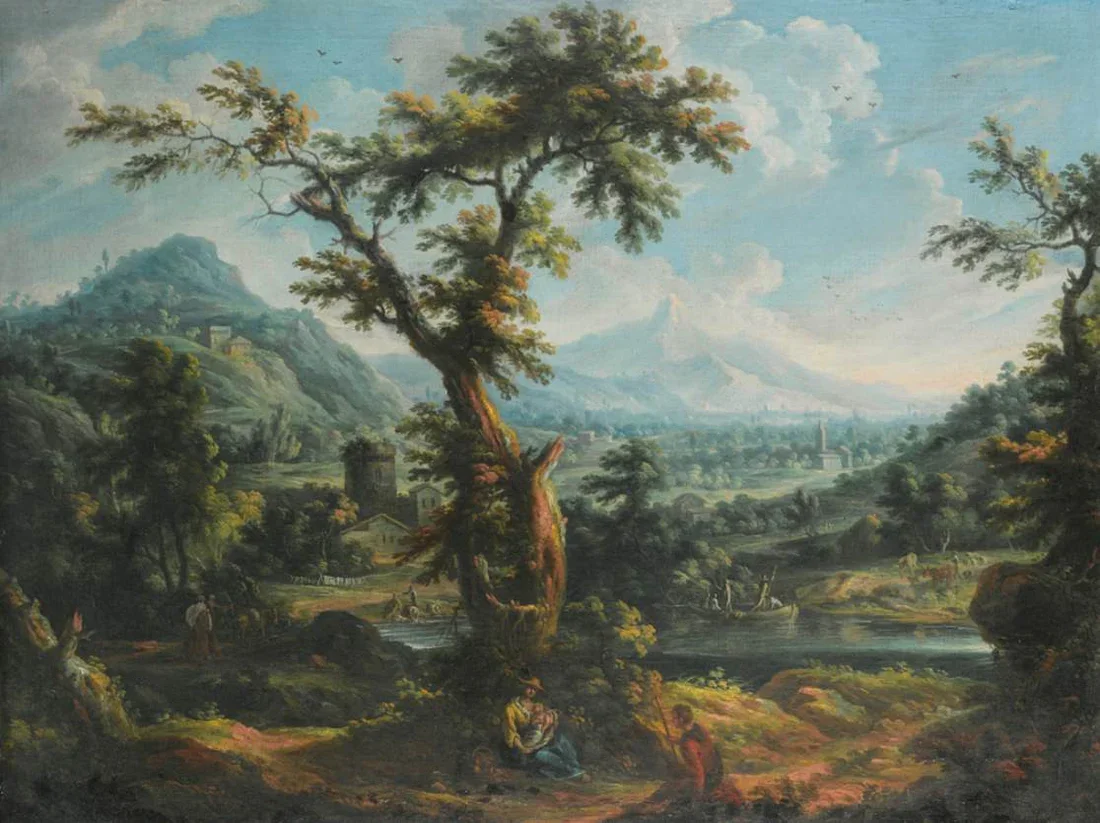
Scipione Cignaroli (1690-1766), View of the Susa Valley, 1763. Private collection.
Long Live Artaserse
An Exciting Rediscovery
Eighteenth-century Italian opera, with the exception of Handel’s works and certain operas by Vivaldi and Hasse, still faces a historical paradox today: it is studied more than it is performed on stage, especially in its country of origin. As for Leonardo Vinci (c. 1690–1730), a notable exception was the 2023 production of Li zite ngalera at Milan’s Teatro alla Scala,which has only in recent years begun staging works by Cavalli, Cesti, and Monteverdi. Today, opera seria—the most successful artistic form of the 18th century and the most widespread form of entertainment among the aristocracy and European rulers who competed to secure the best musicians—survives primarily on paper for the eyes and ears of musicologists or in recordings for a select and enthusiastic audience.
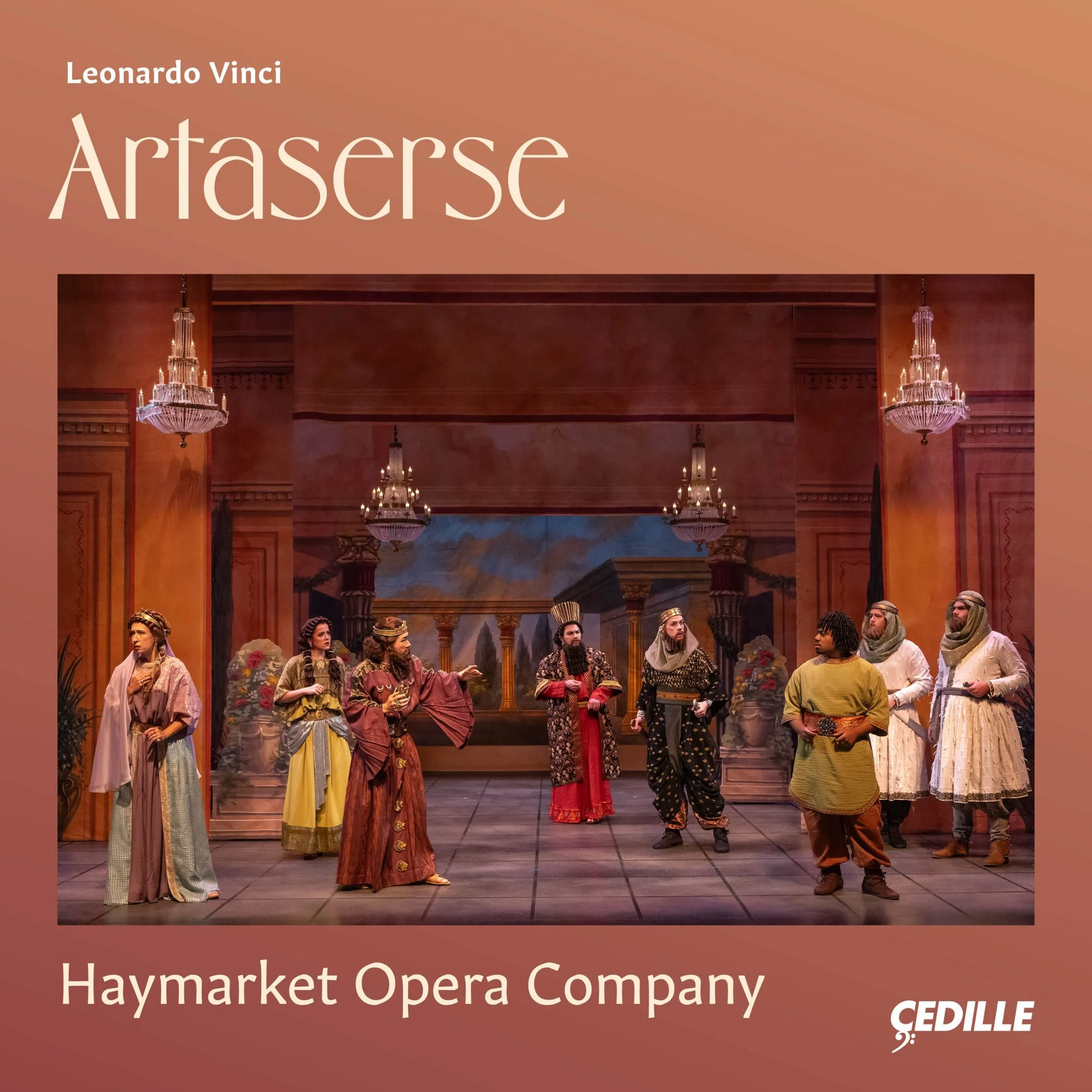
Artaserse, Album cover courtesy of Cedille Records, 2026. Photo: Elliot Mandel
Therefore, the production of Vinci’s Artaserse by the Haymarket Opera Company of Chicago and the release of a CD by Cedille Records can only be greeted with enthusiasm. This is the second recording of the opera, following the one conducted by Diego Fasolis for Virgin Records back in 2012. In the case of the very recent Cedille recording, there are two CDs: one containing the complete work, the other featuring only the “pezzi chiusi,” that is, without the recitatives. Even more important, in my opinion, is that the opera graced the stage in Chicago, at Jarvis Opera Hall, DePaul University, in the summer of 2025, where it was successfully presented to a live audience. In fact, Metastasio’s libretto is a theatrical text in every sense, with well-defined characters, intricate situations, and moral conflicts that can only realize their full potential on stage.
Vinci’s Artaserse is particularly worthy of rediscovery, both for its beautiful music and for its historical significance: it was soon regarded as the model of the “new Neapolitan style” that was conquering Venice and then all Italian and European theaters. This is the first of this musical drama by Pietro Trapassi, known as Metastasio (1698–1782), the most important poeta per musica of the 18th century and an inimitable model of style and elegance. Artaserse was one of the most frequently set-to-music dramas of all time, with approximately 90 productions, including Hasse’s in Venice that same year. It was also the last work by Vinci, who died suddenly in May 1730.
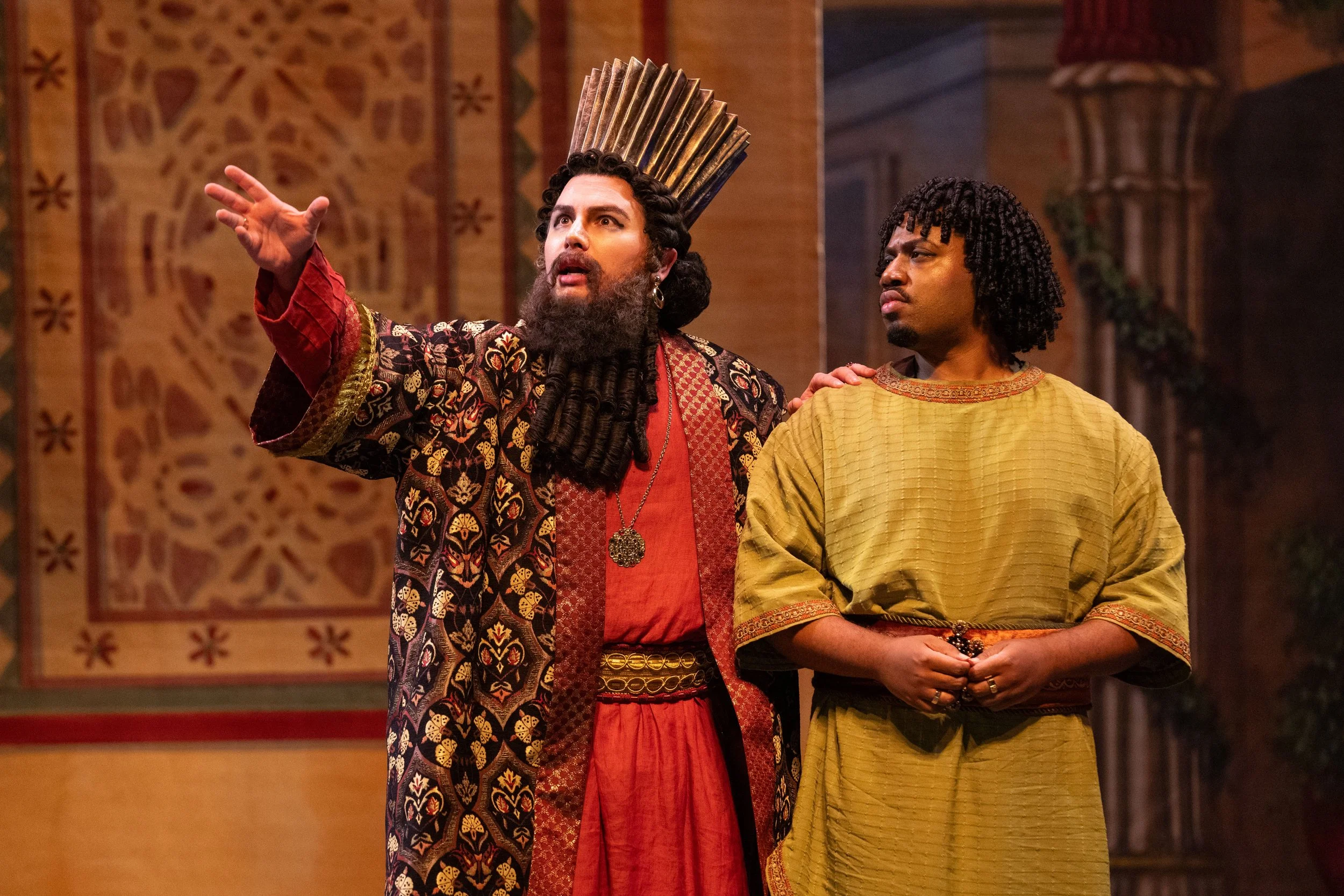
Artaserse, featuring Eric Ferring and Key’Mon Murrah, Haymarket Opera Company, 2025. Photo: Elliot Mandel
The subject is drawn from Persian history, and Metastasio states that he derived it from Epitoma historiarum Philippicarum Pompei Trogi by the Latin writer Justin. The plot has several points of contact with Thomas Corneille’s tragedy: an ambitious father (Artabano) commits regicide, for which his son (Arbace) is unjustly blamed. Out of loyalty and filial love, the son cannot reveal the truth, and the happy ending—a must in operas of this era—comes only at the very last moment with the punishment of the villain, who is exiled rather than executed, thanks to an act of clemency by Artaserse. Compounding the plot is the romantic entanglement involving Princess Mandane, Artaserse’s sister, who is in love with Arbace, and Semira, Arbace’s sister, who is Artaserses’s lover but is also coveted by the treacherous Megabise.
The opera premiered at the Teatro delle Dame in Rome on February 4, 1730, with an all-male cast, consisting mostly of castrati, as was customary in the capital of the Papal States. The title role was performed by Raffaele Signorini, while the roles of Mandane and Arbace were entrusted to two of the most famous castrati of the era, Giacinto Fontana (Farfallino) and Giovanni Carestini, both well known to Vinci, who undoubtedly composed the arias with their vocal and acting talents in mind. Artabano (the sole tenor) was Francesco Tolve “the Neapolitan,” Semira was Giuseppe Appiani, and Megabise was Giovanni Ossi.
Carestini (1704–1760) had worked with Vinci on Catone in Utic* (Rome, 1727), Flavio Onicio Olibrio (Naples 1728), in the serenata La contesa dei numi (Rome 1729), and in the other opera of the 1730 season, Alessandro nelle Indie, another dramma by Metastasio in which Vinci employed much of the same cast. It is therefore not surprising that Arbace’s role is the most important from both a musical and dramatic standpoint: he plays the hero forced to lie to save his father, Artabano, a regicide, despite being in love with Princess Mandane (sister of Artaserse) and a friend of the latter. He is the typical Metastasian character torn between affection and duty.
The best-known example of this emotional state is the famous aria “Vo solcando un mar crudele,” placed specifically at the end of Act I and preceded by a recitative that is not “secco” but “accompagnato” by the orchestra. In this aria di paragone” Arbace, at the mercy of “fortune’s whims,” compares himself to a ship tossed by the waves. In section A, the orchestral accompaniment, which includes oboe and trumpets, evokes the raging storm while the voice winds through dizzying scales, rapid quatrains and tercets, and wide leaps. The aria was considered a highly successful example of the fusion of poetry and music and became a true hit of the era, Carestini’s signature piece. We even know that the other great castrato of the time, Farinelli, always refused to sing it because it was too closely associated with his rival.
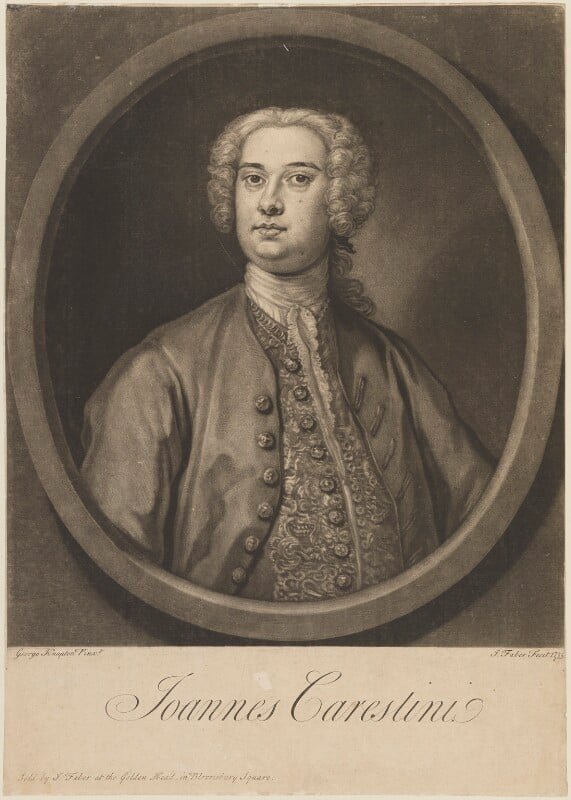
John Faber Jr (1684-1756), after George Knapton (1698-1778), Giovanni Carestini, 1735. London, National Portrait Gallery.
Later accounts by Burney, Hasse, and Quantz also attribute to Carestini a handsome appearance, an imposing stage presence, a range of two octaves (a–A’’), and great ease in the brilliant passages he sang from the chest. Farfallino, on the other hand, specialized in en travesti roles (i.e., female roles) and had portrayed the titular heroine in the production of Metastasio’s Didone abbandonata, set to music by Vinci (Rome 1726). The role of Mandane features a variety of arias and moods that swing between the tenderest love (“Conservati fedele”) and the most tempestuous fury (“Dimmi che un’empio sei” and “Va tra le selve ircane”).
Model of a New Style
Artaserse’s fame was immediate and enduring. We find a significant example of this in the historical novel Cent’anni by Giuseppe Rovani (1818–1874), one of the leading figures of the Italian literary movement known as “Scapigliatura.” The protagonist, the tenor Amorevoli, is preparing to perform in Venice at a private concert to be attended by Count Algarotti, the composer Tartini, and two operatic stars, Faustina Bordoni and Giustina Turcotti. Eager to showcase his talents, Amorevoli rehearses several pieces on his spinet, including “a grand recitative from Vinci’s Artaserse, the master of obbligato recitatives.” In his hotel room, Amorevoli begins to sing softly, but “when he moved from the arias to Vinci’s recitative, the declamatory music, stirring him to enthusiasm, made him project his full voice, as if he were on the stage of a grand theater.” From the final note of the recitative, “a prodigious B-flat,” sung at the top of his lungs, a commotion ensues that culminates in a duel. Rovani intertwines fact and fiction: it is true that Angelo Amorevoli was one of the most celebrated tenors of the era, and that he sang the role of Artabano with great success in Naples in 1738; however, the grand accompanied recitative Rovani mentions is intended for the character of Arbace, and is therefore the result of a literary invention.
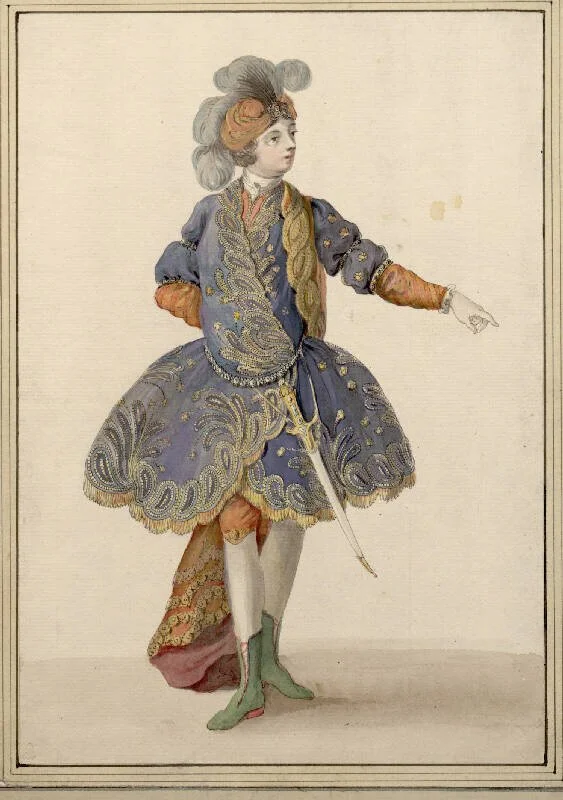
Francesco Ponte (b. 1725), Angelo Amorevoli as Sebaste in the opera Artemisia, 1754. Vienna, Albertina Museum.
Whether fact or fiction, this passage from Rovani’s novel (set in the 18th century but written in the second half of the 19th century) clearly shows that the fame of Vinci’s work and his distinctive style was still alive more than a century later. The novelist’s account is just one of many testimonies to the enduring fame of Artaserse, which was almost immediately regarded as one of the finest examples of the “new Neapolitan style,” brimming with that “grace,” “expression,” and “fertility [of invention]” typical of the author, to use the words of Metastasio himself, in a letter to the famous singer Farinelli (Vienna, November 12, 1749).
Charles Burney, too, in his A General History of Music from the Earliest Ages to the Present Period (1789), praises Vinci’s “new style” “in which the melody of the voice-part was more polished, and the accompaniment more simple and quiet” and commends him for his ability to blend music and poetry (History of Music, vol. 2: 917).
The Travels of Artaserse in the Eighteenth Century
The opera’s success is also evidenced by its many revivals. Following its premiere, Artaserse was staged again in Rome the following year, and then in numerous other cities: in 1730 in Florence, in 1731 in Fano, Livorno, Pesaro, Naples, and Ferrara, in 1732 in Vienna and Perugia, in 1733 in Camerino, in 1734 again in Perugia, in 1738 in Naples; in 1739 in Florence; in 1740 in Macerata; in 1743 in Palermo and Naples; in 1746 in Dresden; in 1747 in Pistoia; in 1749 in Pisa; and in 1754 in Parma. In fact, the Italian opera world of that time was not based on a repertoire of a few “classics” as is the case today, but rather on the constant demand for new operas. Furthermore, the arias were altered to suit new performers: an interesting case involving our Artaserse occurred during the Milan performance, where the young castrato Caffarelli dared to challenge the famous Carestini by also proposing a storm aria, but went so far as to choose an aria by his rival Farinelli, “Sono qual nave” (from Mitridate).
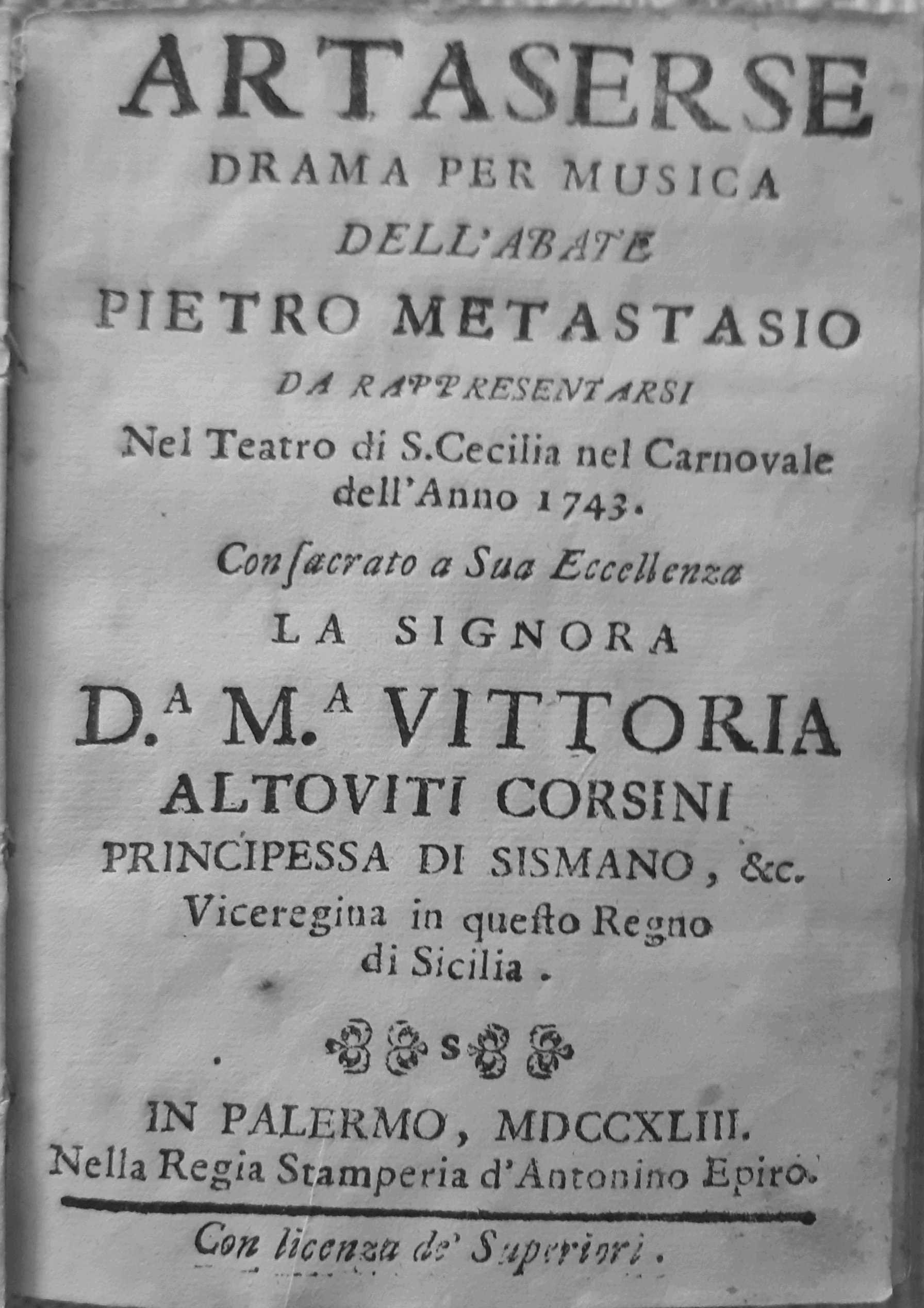
Pietro Metastasio (1698-1782), Artaserse: Drama per Musica (1743). Palermo, Nella Regia Stamperia d'Antonino Epiro.
In the case of Artaserse, we can note the presence of two cities central to the dissemination of Italian opera abroad: Vienna (where Metastasio lived for much of his life) and Dresden. In fact, we should also include London, where the opera was presented in the form of a pasticcio by Handel under the title Arbace in 1734. As for Italy, alongside the central-northern circuit, we find two cities in the South. While the case of Naples is not surprising given the city’s musical prominence—where Vinci himself (a native of Calabria) had studied—the case of Palermo raises more questions. Only two of Vinci’s operas were performed in Sicily during the 18th century: Semiramide (Catania, 1740) and, indeed, Artaserse, which was staged at the Teatro Santa Cecilia, then the island’s principal opera house. The libretto clearly attributes the music to Vinci, but the score is lost, and from the libretto we can only infer that some arias were omitted or altered. To whom do we owe the arrival of Artaserse on the island? Perhaps to the viceroy of the time, the Florentine nobleman Bartolomeo Corsini, who had connections with both Neapolitan and Florentine theatrical circles and could therefore easily procure the libretto and the music. The production also stands out for the presence of a leading singer, Giuseppe Tedeschi, known as Amadori, in the role of Arbace. Here too, we can assume that it was Corsini who facilitated the singer’s arrival in Sicily; he would later perform only on the most prestigious stages, including Vienna in 1750.
The performance
Unlike in the 18th and 19th centuries, when opera composers wrote with specific singers in mind, today it is necessary to find singers suited to roles conceived for performers of exceptional talent. Haymarket Opera Company’s choice has been rewarded by the result. The cast includes young and esteemed American artists (or those trained in the U.S., such as the acclaimed Korean countertenor Kangmin Justin Kim), who specialize in 17th- and 18th-century music. For the roles of Artaserse, Arbace, and Megabise, the choice fell on three countertenors (the possible alternative would have been a female contralto), all possessing elegant diction, ease in ornamentation, and a pleasant timbre. Semira is portrayed by the soprano Elijah McCormack, a male soprano, endowed with a warm timbre. You can read some of her interesting reflections here in the Haymarket Review. For Mandane, the choice fell on a mezzo-soprano, Emily Fons, who has extensive experience in this repertoire. Her duet with Artaserse in Act III, just before the final chorus, is one of the opera’s gems. Finally, kudos to conductor Craig Trompeter, the driving force behind this magnificent undertaking.
About the author
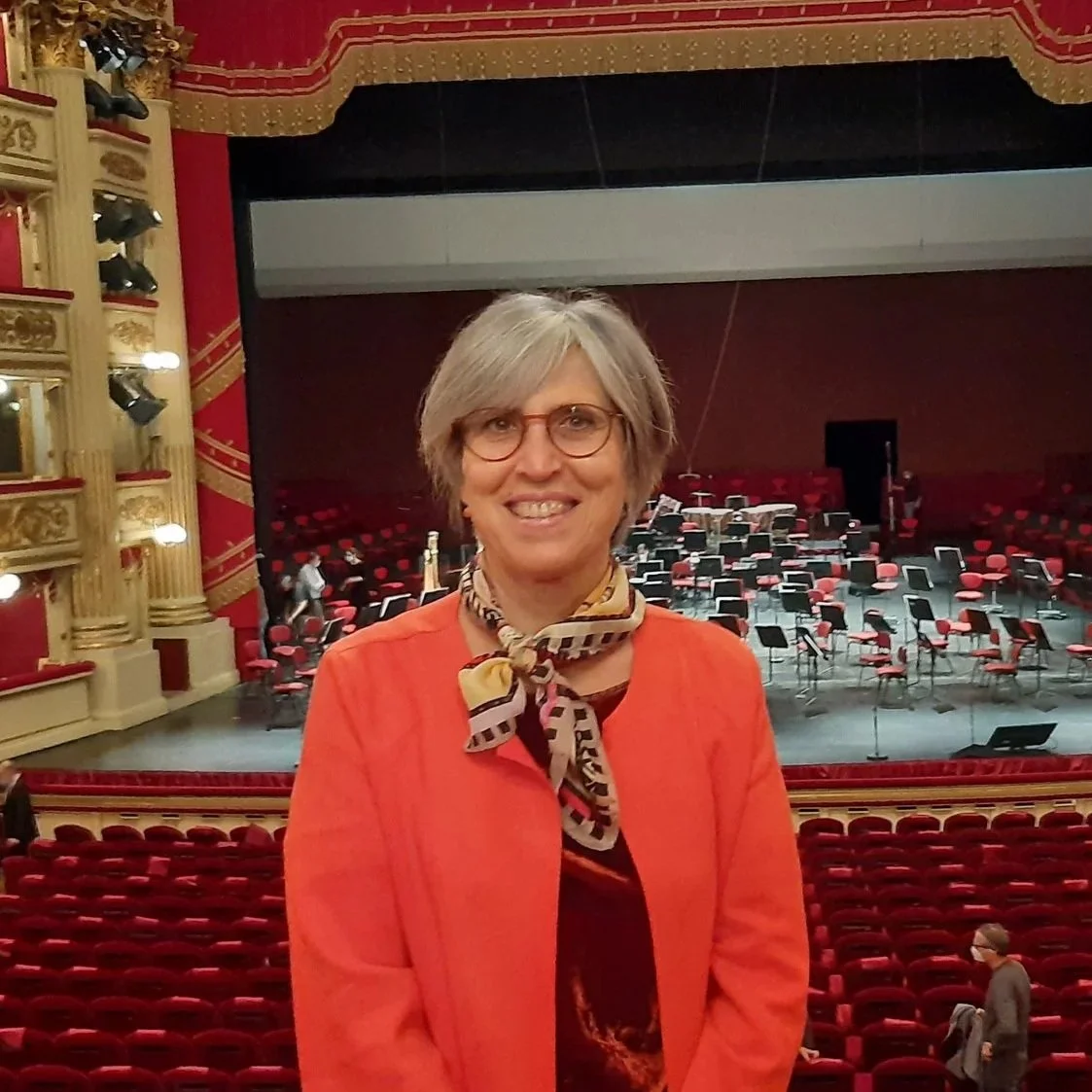
Anna Tedesco is a full professor at the University of Palermo, where she teaches in the undergraduate programs in Arts, as well as in the master’s program in Musicology and Performing Arts. She also teaches in the Doctoral Program in Music and Performing Arts at Sapienza University of Rome. She was visiting professor at the universities of Salamanca and Madrid (Complutense).
Her research focuses on opera from the 17th to the 19th century: in particular, she has studied musical life in Palermo during the 17th and 18th centuries, the musical patronage of the Spanish aristocracy in modern Italy, the reception of grand opera in Italy, and the influence of the Spanish comedia on 17th-century opera.
She is a member of the IMS Study Group “Cavalli and 17th-Century Venetian Opera.” She contributed to the Cavalli Critical Edition (Bärenreiter) with the critical edition of Egisto with Giuseppe Collisani and Nicola Badolato. More recently, she has focused on the reception of Monteverdi’s theater in Italy during the first half of the 20th century.
About The Haymarket Review: This digital publication including thoughts about the work produced by Haymarket is designed to deepen our connection to audiences, nurture and feed audience curiosity about historical performance, offer critical opinions and thoughtful reflections on our performances, and provide a forum for Haymarket and its audience to connect through sharing insights, opinions, learning, and expertise.