


Guercino (Giovanni Francesco Barbieri), Saul Attacking David, 1646. Galleria Nazionale d'Arte Antica, Rome.
Matthieu Dupas on Charpentier's
David et Jonathas
The June 21 performance of Marc-Antoine Charpentier’s David et Jonathas, superbly conducted by Jory Vinikour, showcased the Haymarket Opera Orchestra’s mastery of the French Baroque repertoire and the vitality of Chicago’s operatic scene. In a city anchored by institutions such as Lyric Opera of Chicago, smaller companies flourish and distinguish themselves by exploring repertoires beyond the standard canon. Haymarket’s achievement, however, lies not only in bringing lesser-known music to audiences, but also in fostering reflection on the historical and cultural questions these works continue to raise.

David and Jonathan Window, St. Mark’s, Portobello, Edinburgh, Scotland, 1882.
Charpentier’s opera offers a revealing alternative to the model of French lyric tragedy usually associated with Lully. More restrained in its dramatic means and less reliant on spectacle, it nonetheless explores with remarkable intensity the relationship between David and Jonathan, placing at the center of the drama a bond between two young men instead the heterosexual love plot that typically drove operatic action. The work demonstrates how opera can serve as a site for reflecting on questions of intimacy, friendship, and gender, and Haymarket’s programming choices encourage such reflection. The company staged David et Jonathas only one year after its production of Hasse’s Antonio e Cleopatra (1725), whose principal roles were originally written for castrati, and, as general director Chase Hopkins has noted, scheduled the performances during Chicago’s Pride Weekend. Such choices draw attention to the rich history of gender nonconformity and alternative forms of attachment embedded within the operatic tradition. They also resonate with the modern reception of the biblical figures themselves. In the twentieth century, both the French Christian gay association David et Jonathan (founded in 1971) and New York’s House of David and Jonathan, the first recognized gay synagogue in the United States, adopted their names from the biblical pair. Whatever conclusions one draws from these appropriations, they testify to the enduring capacity of the story of David and Jonathan to serve as a point of reflection on masculinity, love, and friendship, and on forms of intimacy that exceed conventional social categories—the very kinds of exceptional attachments that opera, as a genre, usually privileges.
Marc-Antoine Charpentier’s (1643-1704) career never achieved the institutional prominence enjoyed by his great contemporary, Jean-Baptiste Lully (1632-1687). An Italian-born composer who became the favored musician of Louis XIV, Lully not only invented the French genre of tragédie en musique but he also established it at the center of court culture as a form of entertainment that celebrated and legitimized royal authority. Born in Paris, Charpentier spent several formative years in Rome studying with the renowned Giacomo Carissimi (1605-1674), whose influence left a lasting mark on his musical language. Unlike Lully, whose fortunes were closely tied to the institutions of royal power, he worked primarily within the religious, educational, and aristocratic circles of Paris. Although he never obtained a position comparable to Lully’s at court, he achieved considerable recognition through his collaborations with Molière and through a substantial body of sacred music. Premiered in 1688 at the Jesuit Collège Louis-le-Grand, David et Jonathas emerged from the intellectual and religious milieu of “la Ville” rather than from the culture of “la Cour” that shaped Lully’s operas, a contrast that sheds light on many of the work’s aesthetic and ideological particularities.
By the late seventeenth century, the Society of Jesus occupied a central position within the Catholic reform movement inaugurated by the Council of Trent (1545–1563). Although closely aligned with the Bourbon monarchy, the Jesuits remained committed to a political theology that subordinated temporal authority to a higher moral and spiritual order grounded in Catholic doctrine. Their educational and cultural mission sought both to consolidate Catholic orthodoxy and to counter the confessional fragmentation produced by the Reformation. Central to this project was an extensive network of colleges, in which rhetoric, theater, music, and the visual arts played a crucial pedagogical role. Unlike many rigorist currents within French Catholicism—notably Jansenism—which regarded the performing arts with suspicion as potential occasions of moral corruption, the Jesuits viewed aesthetic experience as a powerful instrument of moral formation and religious persuasion. The Collège Louis-le-Grand, one of the most prestigious Jesuit institutions in France, was a particularly important site for the cultivation of these practices and consequently developed into a major center of musical production and performance in the seventeenth century.
The cultural milieu of Louis-le-Grand differed significantly from that of Versailles. Rather than serving the immediate ceremonial needs of the royal court, it addressed an audience drawn largely from the educated urban elites who staffed the administrative, legal, and ecclesiastical structures of the increasingly centralized French monarchy. It was within this context that Charpentier and his librettist, Father François Bretonneau, developed in David et Jonathas a new type of tragédie en musique. Rooted in biblical history and Christian moral reflection, yet fully receptive to the aesthetic innovations of contemporary musical theater, the work reflects the characteristic ambitions of Jesuit culture: the reconciliation of religious instruction with artistic pleasure. In both its thematic concerns and its representation of political authority, friendship, and masculinity, David et Jonathas offers a vision markedly different from the court-centered ideology that underpinned Lully’s operas. The result is a work whose aesthetic and moral complexity exemplifies the distinctive contribution of Jesuit humanism to French Baroque culture.
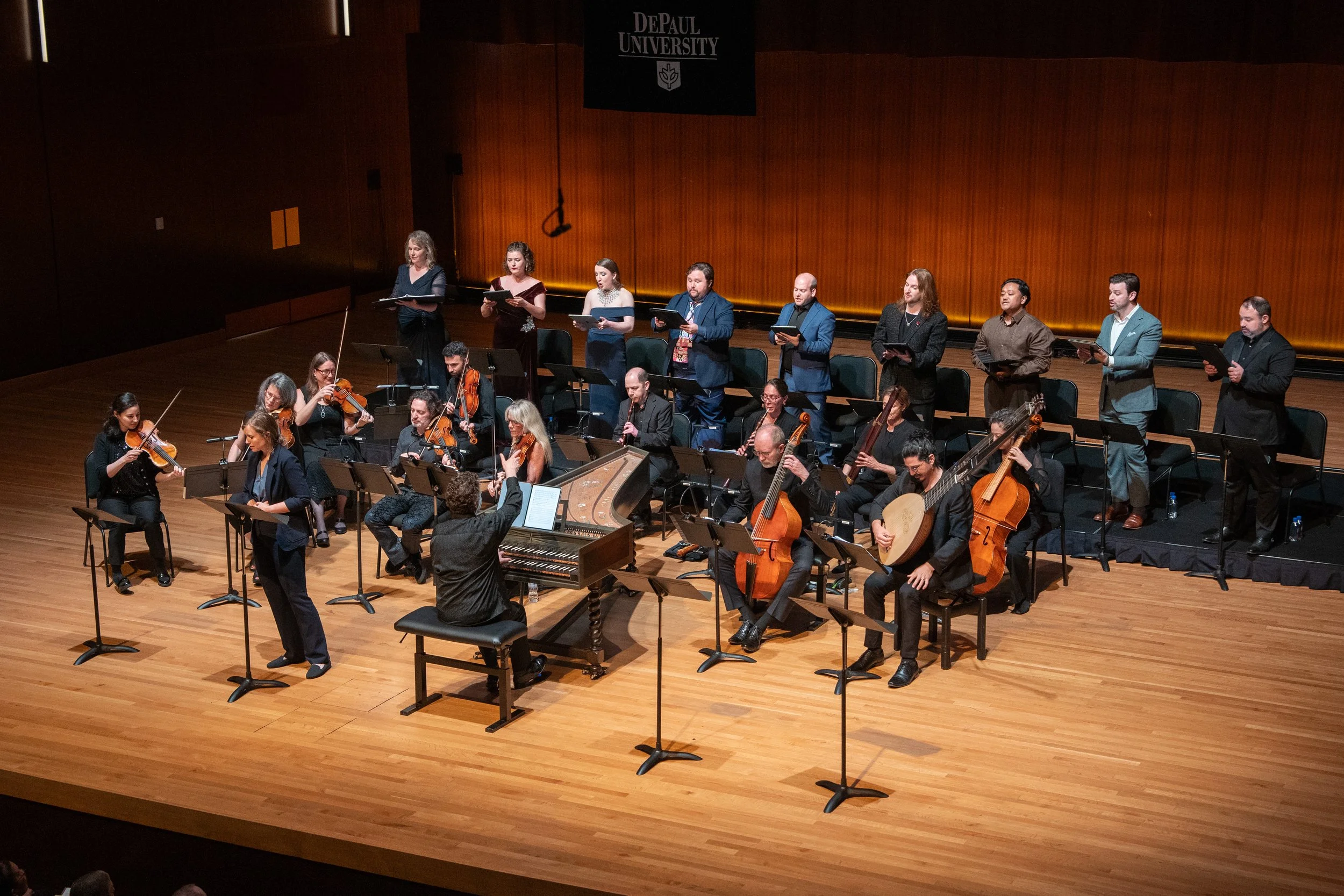
David et Jonathas, Haymarket Opera Company, 2026. Photo: Elliot Mandel
The originality of David et Jonathas lies first in its form. The work was conceived as part of a double theatrical program in which a spoken tragedy in Latin by the Jesuit Father Chamillart, centered on the downfall of Saul, alternated act by act with an opera sung in French and devoted to David and Jonathan. This unusual structure generated a complex network of correspondences and oppositions typical of the Baroque aesthetics: between speech and song, rhetoric and music; between Latin, the language of learned and ecclesiastical culture, and French, accessible to women; and between the sphere of political action, represented by Saul’s exercise of sovereignty, and that of private and affective experience, embodied in the relationship between David and Jonathan. In comparison with the courtly model established by Lully, where recitative and dramatic action occupy a central place, the resulting musical drama appears more restrained and more concentrated. This apparent austerity gives rise to an unusually intense expressiveness that readily justifies Haymarket’s decision to present the work without scenery or costumes.
The originality of David et Jonathas, however, lies even more profoundly in its content. Whereas Lully and Quinault typically structured their operas around a gallant plot culminating in the union—or frustrated union—of a hero and a heroine, Charpentier and Bretonneau replaced romantic love with the biblical narrative of friendship between two young men. The remarkable achievement of the work is that it does so without abandoning the musical and affective language of the Lullian tragédie en musique. The expressive vocabulary developed to represent amorous passion is redeployed to depict the bond between David and Jonathan. As a result, the opera simultaneously appropriates and transforms the dominant operatic conventions of its time, preserving their emotional force while directing them toward a radically different object. This contrast between form and content is constitutive of the work itself: formally indebted to the traditions of French lyric tragedy, it places at its center a model of human attachment that diverges strikingly from the courtly and heterosexual paradigms that ordinarily governed the genre.
In his presentation of the opera, Jory Vinikour emphasized the contrast between the prologue of David et Jonathas and those found in Lully’s operas. In the prologues to the lyric tragedies of Lully and Quinault, Louis XIV is routinely celebrated, either directly through divine figures or, more often, through allegorical personifications such as Glory or Victory. These prologues establish an explicit connection between the king’s political achievements and the amorous adventures of the opera’s protagonists. Repeated from one work to another, this narrative framework presents the love stories of Cadmus et Hermione (1673), Atys (1676), and Armide (1686) as reflections of the monarch’s own glory. The king is represented not as a ruler obeyed through fear but as one who inspires affection and admiration. Yet this representation marks a significant departure from earlier models of monarchy. Louis XIV is no longer presented primarily as a Christ-like sovereign, a symbolic husband of the nation, or a paternal ruler modeled on God the Father. Instead, he appears above all as a lover whose authority rests less on coercion than on the affection of his subjects and whose legitimacy derives from the virtues of gallantry. By casting the king as a gallant hero, the prologue made the absolutist order attractive to courtly elites at a moment when political and military functions were increasingly absorbed by the centralized state. Gallantry, which combined erotic desire with civility, offered aristocratic men and women new forms of sociability beyond the confines of kinship. The prologue thereby presented absolutism and gallant culture as mutually reinforcing, united in the figure of Louis XIV himself.
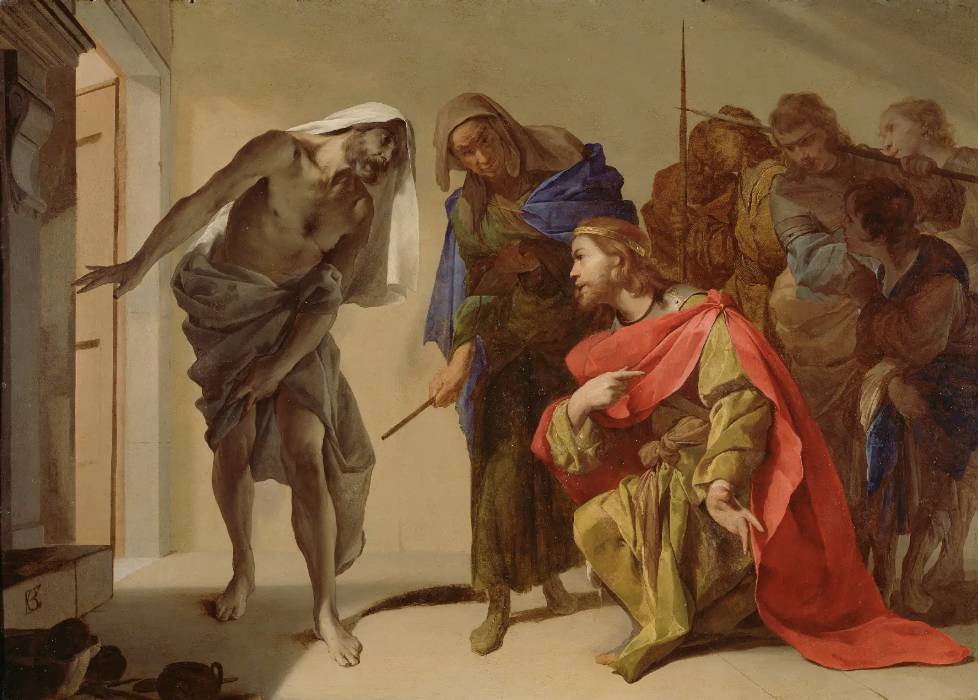
Bernardo Cavallino, The Shade of Samuel Invoked by Saul, ca. 1650–1656. J. Paul Getty Museum, Los Angeles.
In Charpentier and Bretonneau’s work, the prologue retains its political function but takes a completely different path. Instead of opening with an allegorical celebration of the reigning king, it opens with the episode of the Witch of Endor—the “Pythonisse” in Bretonneau’s text—who foretells to Saul his impending downfall and the rise of David—an episode that in the Bible occurs only the day before the battle. Shifting this event to the beginning of the two plays—since it introduced both the spoken tragedy in Latin and the opera sung in French—the prologue bestowed the entire spectacle with a tragic dimension. By announcing Saul’s demise and David’s triumph as early as the prologue, the opera portrayed the providential continuity of monarchical power rather than its present splendor. The issue was no longer the immediate glorification of the sovereign, but the transmission of kingship. Behind the mortal figure of Saul loomed what political tradition would call the king’s “mystical” or “second” body—the king must die, but kingship does not—to which Louis XIV, under the guise of David in the opera, would restitute its heroic energy.
But unlike the Lullian hero, whose greatness is measured by his amorous conquests or misfortunes, David attains heroic status through the sacrifice of his friendship with Jonathan. Here, the monarchy is legitimized not through gallant love but through a friendship subordinated to the demands of Providence, which Saul freely chose to ignore. The prologue thus exemplifies the Molinist notion of “sufficient grace” championed by the Jesuits against the Jansenists: divine grace calls upon human freedom without ever abolishing it. Saul is rejected not because he was predestined to fall, but because he refused to answer God’s call. His downfall thus reveals both the freedom of the individual and the sovereignty of Providence. David’s story consequently becomes one of election—an election that rests on his willingness to submit to Providence and fulfill God’s plan. This willingness is ultimately demonstrated by his decision to wage war against King Saul despite his deep friendship with Saul’s son, Jonathan. Friendship, here, must be sacrificed to God. The tender masculinity embodied by David thus becomes the very medium through which the opera stages the Jesuit reconciliation of human freedom, divine providence, and legitimate political authority.

Rembrandt, Separation of David and Jonathan, 1642. Hermitage Museum, St. Petersburg.
Tenderness constitutes the defining feature of David’s character and the guiding principle of his dramatic trajectory. From the opening acts, it manifests itself in the intensity of his attachment to Jonathan, described as a “tender friend,” and in his constant preference for peace over martial glory. Yet tenderness is not an end in itself: it becomes the very trial through which David is called to pass. The deeper and more legitimate his bond with Jonathan appears, the greater the significance of the renunciation demanded of him. Chosen by God not despite his tenderness but through it, David ultimately accedes to kingship at the very moment he loses “what [he] loves,” transforming tenderness into a principle of sacrifice, mourning, and election. As was customary on the French operatic stage of the seventeenth and eighteenth centuries, this ideal of tender masculinity was embodied musically by the haute-contre voice type. The quintessential heroic voice of French opera, the haute-contre was capable of combining martial valor with the most delicate expression of feeling. By virtue of his vocal range, David belongs to the great lineage of French operatic heroes, including Renaud, Atys, and Cadmus in Lully’s tragédies lyriques. It was a voice type to which Charpentier himself repeatedly turned for noble and emotionally expressive male characters, assigning it notably to Rodrigue in his musical setting of the Stances du Cid. Particularly well suited to David, it captures the dual nature of a character who is at once a victorious warrior and a man of profound tenderness, deeply attached to Jonathan. David thus represents one of the most accomplished embodiments of the French gallant hero, whose greatness does not stand in opposition to sensitivity but is realized through it.
“Tendresse,” defined by Furetière as “a certain sensitivity of the heart and the soul,” referred less in the seventeenth century to a specific emotion than to a disposition to be moved by others, to enter into a relationship of empathy and reciprocity with them. Generally associated with gallant love, it occupied a central place in the high society culture of the Grand Siècle, to the point that Mlle de Scudéry’s famous “Carte de Tendre,” made this affect the very principle of refined sociability. The recurring debate over whether tenderness belonged more to love or to friendship masked another question: that of the relative superiority of these two forms of attachment: heterosexual love or homosocial friendship. Significantly, in Scudéry’s work, the Pays de Tendre is closer to friendship than to love, the latter being relegated to the “Terres Inconnues.” But for Scudéry, who never was married and had a lifelong Platonic relationship with Paul Pellisson, a member of the newly created Académie française, associating tenderness with friendship was a way of resisting 17th-century gallant heteronormativity.
In the operas of Lully and Quinault, tendresse is first and foremost the defining affect of the gallant hero. Far from being a sign of weakness, it marks his capacity to enter into relationships governed by civility, reciprocity, and emotional sensitivity. Gallantry promoted indeed a model of masculinity distinct from older ideals grounded exclusively in martial prowess and patriarchal authority in family life. Within the social world of salons and polite society, men were expected to please, to listen, and to display refinement in their dealings with others, including, notably, women. Gallantry, thus, described a form of masculinity relatively less patriarchal, since it subjected masculine authority to the demands of sociability and mutual recognition, and tendresse became the privileged expression of such disposition to recognize the emotional reality of another person and respond to it with empathy and respect. It is precisely this affective language that Charpentier and Bretonneau appropriated in David et Jonathas. Their innovation was to transfer a form of tenderness traditionally associated with heterosexual gallantry to the friendship between two young men.

Biblical Prince Jonathan and David embrace, La Somme le roy, ca. 1300 AD, add.28162, fol. 6v. The British Library, London, United Kingdom.
Under the guise of this new kind of tender masculinity, Charpentier and Bretonneau thus promoted a different conception of communal belonging. Rather than grounding social bonds in the elective relationships of gallant sociability, they presented friendship as the expression of a deeper moral and spiritual communion. In this context, tendresse ceased to function primarily as the affect of courtship between men and women to become the privileged language of a Christian friendship founded on grace, faith, and self-sacrifice. The opera thus reorients the emotional culture of gallantry toward a more hierarchical and explicitly religious vision of community. Beneath the seductive language of tenderness, the message addressed by the Jesuit faculty to their students is clear: sensitivity, refinement, and gallant manners are not sufficient in themselves; they must be ordered toward obedience to God and fidelity to a higher moral calling. David et Jonathas thus appropriates the affective resources of gallant modernity only to reinscribe them within a theological framework. Behind the tender friendship that unites the two heroes lies the distinctly Jesuit ambition to form an elite capable of reconciling the civility of the modern world with the demands of Christian virtue. The ideal embodied by David on stage is neither that of the warrior nor that of the gallant lover, but rather that of a friend whose tenderness finds its highest expression in sacrifice and obedience to Providence.
In this respect, Bretonneau’s libretto is entirely in line with the treatises on the passions written throughout the 17th century—the most famous of which is perhaps Descartes’s, though it had only a marginal influence on this genre which, in response to the manuals on the perfect courtier, taught laypeople to live in the world as Christians, that is to say, not by eradicating but—an enormous concession to the spirit of the times—by controlling what were then called one’s passions, which very often conflicted with reason and duty. It was in these manuals that it was tirelessly repeated that the friendship between one man and another was a more perfect form of love than that between a man and a woman, due to the carnal dimension of the latter and the inferior status of women compared to men on the scale of perfection. From this perspective, relationships between men and women—which were essentially governed by the family hierarchy—did not carry the same weight as friendships between men on the battlefield or in Church, which were for that reason to be prioritized. It was with this patriarchal worldview—which the absolutist and gallant status quo claimed to have broken with—that Bretonneau’s libretto implicitly reconnected, contrasting in this respect with Quinault’s tragedies, which were celebrated and sometimes criticized for their excessive adherence to gallant tenderness and sentimentality. But in striving to appropriate this deconstructed masculinity in this way, they clearly ran the risk of giving form and substance to yet another form of tender masculinity, the only one that tradition seems to have retained: that of male, homosexual love. The dramatic and musical structure of the musical tragedy lends this friendship a prominence and depth that are entirely unprecedented on both the theological and existential levels, with such intense emotional power—sublimated by the music—that the tender bond between the two friends might have seemed more erotic than spiritual already to the audience of the time.
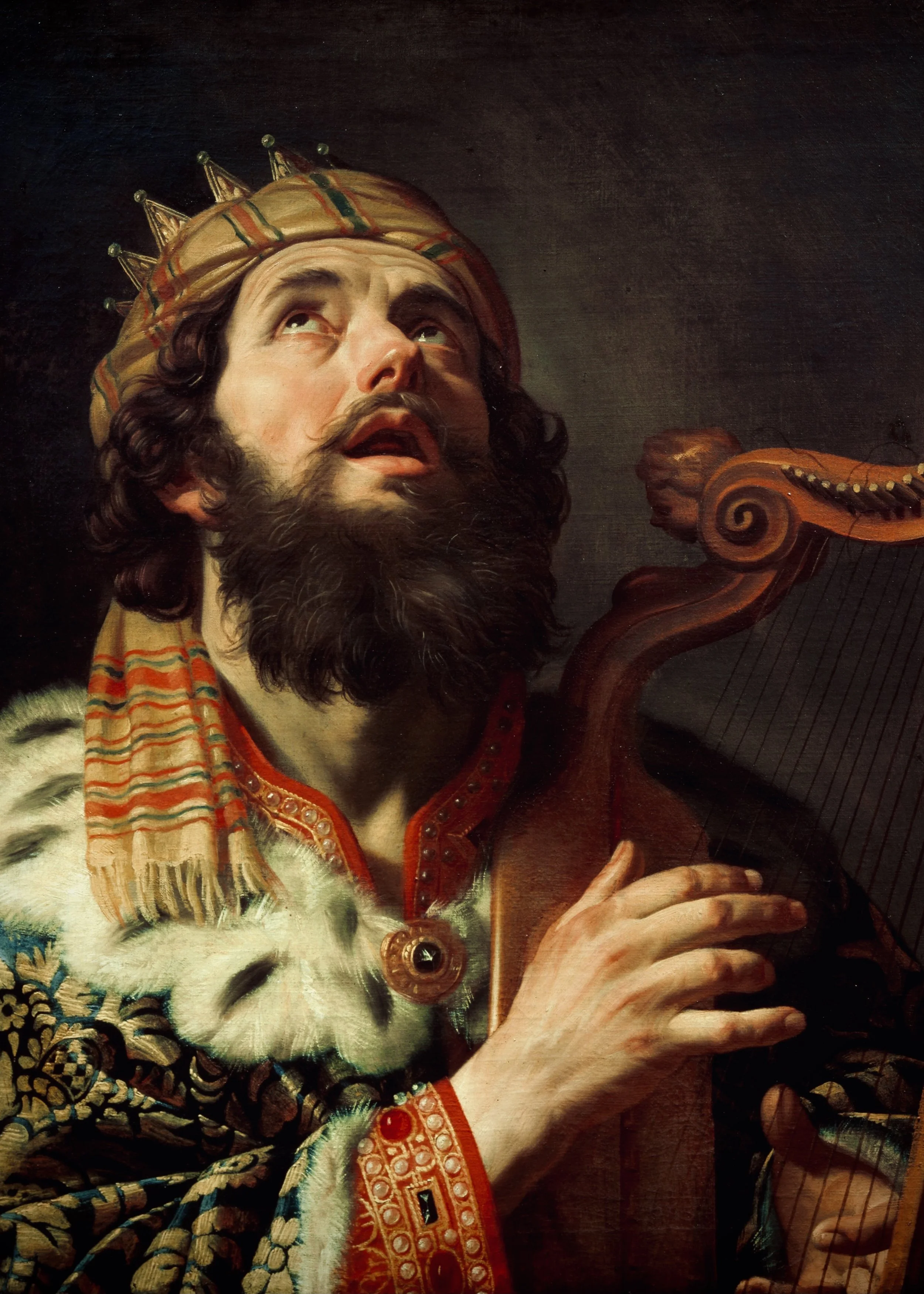
Gerard van Honthorst, King David Playing the Harp, 1622. Centraal Museum, Utrecht.
To understand this ambiguity of the representation of tender masculinity in David et Jonathas, it may be useful to read the opera alongside a work published more than forty years earlier by another Jesuit, René de Cériziers. In 1645, shortly before becoming almoner to the king, Cériziers published Jonathas ou le Vray amy, a treatise on friendship centered on the biblical relationship between David and Jonathan. Bretonneau could hardly have been unaware of this text, which likely served as an important source of inspiration for his libretto. In this work that is written like any other “treatise of passions” fashionable at the time, Cériziers developed, drawing on the biblical example of David and Jonathas, a veritable theory of friendship. Tenderness, jealousy, exclusive devotion, and the desire for a friend’s presence are analyzed in such rich detail that it is reminiscent of the dramatic treatment Charpentier reserves for his characters. Cériziers goes so far as to assert that David loved Jonathan “as his very soul” and explicitly maintains the superiority of male friendship over heterosexual love, making the relationship between the two young men the quintessential model of human connection.
The book’s publishing history is almost as revealing as its content. Although its author enjoyed a brilliant career at court and the work was reprinted in several lavish editions well into the 1660s, the text subsequently sank into relative obscurity, as if French culture had retained a sense of embarrassment—or, at the very least, polite silence—toward it. It would be an overstatement to conclude that Cériziers was already developing a modern conception of homosexuality, a category foreign to his intellectual world. Nevertheless, certain passages strike us today as remarkably intense and unsettling. One of the most famous describes the friend who “clings” to the beloved through “indissoluble” and “invisible” bonds, using vocabulary in which spiritual union takes on an almost carnal dimension. It is precisely in this ambiguous space—between Christian mysticism, the theory of the passions, and the imagination of male attachment—that Charpentier’s opera is also situated. Far from dispelling this ambiguity, in a very Baroque way, David and Jonathas imbues it with new power by transposing it into the language of music, where a spiritual friendship can attain the same dramatic and emotional intensity as the greatest romantic passions.

Gottfried Bernhard Göz, Jonathan Greeting David after Killing Goliath, 18th century.
If Haymarket’s production during Pride Weekend invites such a reading, it is not because it imposes a contemporary category upon a seventeenth-century work, but because David et Jonathas itself demonstrates how unstable the boundaries of gender, desire, and attachment can become once they are placed on the operatic stage. The paradox of Bretonneau and Charpentier’s project is that, in seeking to redirect the affective language of gallant love toward the model of Christian friendship, they produced a work whose emotional force still today exceeds the theological and moral framework designed to contain it. The very means through which the Jesuits sought to spiritualize tenderness—the expressive resources of music, theater, and the passions—endow the bond between David and Jonathan with an intensity that resists clear categorization. What was intended as the exemplary representation of spiritual friendship can never be fully separated from the operatic vocabulary of desire through which it is expressed.
In this sense, David et Jonathas reveals something fundamental about opera as a genre. Opera has always been one of the privileged spaces in Western culture for experimenting with forms of gendered identity and affect that overflow the norms they are supposed to embody. Whether through castrati, trouser roles, cross-gender identifications, or, as here, the transposition of the language of heterosexual love into a relationship between two men, opera repeatedly generates meanings more disruptive than those its creators may have intended. The Jesuit ambition to reconcile modern sensibility with Christian orthodoxy thus produced an unexpectedly queer object: a work in which spiritual friendship becomes inseparable from the possibility of other readings and other desires. Far from neutralizing ambiguity, opera amplifies it. That is perhaps why David et Jonathas continues to resonate so powerfully today, reminding us that the operatic stage remains a place where identities are never simply represented but continuously transformed, unsettled, and reimagined.
About the author

Matthieu Dupas is Associate Professor of French in the Department of French and Italian at Northwestern University. His research examines the history of desire, gender, and sexuality in early modern and contemporary French literature and culture, with a particular focus on erotic cultures in the seventeenth and eighteenth centuries and on the formation of erotic subjectivities from early modernity to the present. His work also explores autofiction, queer theory, and the changing representations of gender, sexuality, and desire in contemporary literature. He is the author of La Galanterie comme mode de vie: Amour, civilité et mariage dans Mélite ou Les Fausses lettres de Pierre Corneille (Classiques Garnier, 2023) and of numerous articles on gallantry, desire, and subjectivity in seventeenth-century French literature.
About The Haymarket Review: This digital publication including thoughts about the work produced by Haymarket is designed to deepen our connection to audiences, nurture and feed audience curiosity about historical performance, offer critical opinions and thoughtful reflections on our performances, and provide a forum for Haymarket and its audience to connect through sharing insights, opinions, learning, and expertise.