

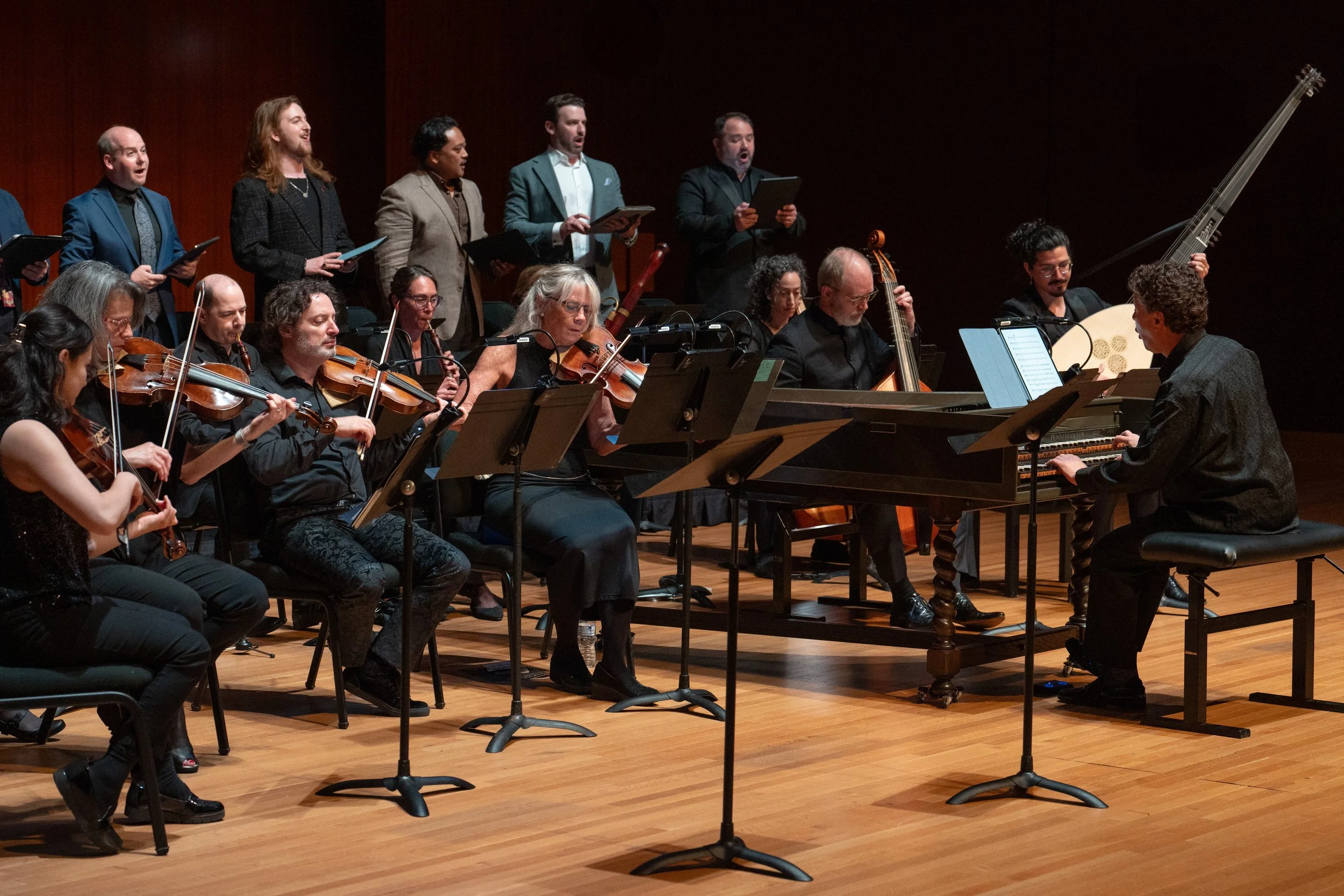
David et Jonathas, Haymarket Opera Company, 2026. Photo: Elliot Mandel
Writer and lecturer Roger Pines on Marc-Antoine Charpentier’s David et Jonathas
When it comes to opera of the French Baroque era, I confess to having been something of a “Johnny come lately.” Why would I have hesitated before finally embracing this repertoire? I suppose it was because my idea of Baroque opera had previously been so radically different: I came to it first via Handel, then Monteverdi and Cavalli second, Purcell third, and the French giants—Lully, Charpentier, and Rameau—a distant fourth. I’m actually quite surprised about this, given that in my listening, writing, and teaching, French for years has been my preferred operatic repertoire. My enthusiasm, however, centered initially on Berlioz, Bizet, and Massenet. Moving back in time from those composers to the Baroque was a massive leap, needless to say, but after so many years of my not giving French Baroque nearly enough attention, I’m now devoted to it and relish the endless riches it has to offer.
Perhaps my coming comparatively late to this repertoire also has to do with the fact that when I discovered opera very early in life, I was grabbed initially by the sound of a voice, rather than the impact of the text the voice was singing (and, of course, text is everything in French opera, the Baroque above all). In my teens, I continued to find myself repeatedly entranced by the miracles that were possible through great vocal technique: how exquisitely could Joan Sutherland trill, whether in Handel or bel canto? How fast could Marilyn Horne sing Rossini coloratura? How softly could Nicolai Gedda float a pianissimo in a Gounod aria? How powerfully could Sherrill Milnes launch his top notes as Verdi’s Rigoletto? Eventually, as I began to listen more carefully, I discovered the visceral side of operatic expression: How intensely could Tosca rage at Scarpia? How passionately could Don José plead with Carmen?
So, reading these details of how I was listening many years ago, if you’re thinking, “It sounds as if, when he was getting into opera, all he cared about was its extremes,” you’d probably be right (he admitted, rather sheepishly). No, the early stages of my devotion to opera weren’t really about savoring the coloristic variety and subtlety that the greatest stage works could achieve in performance. That came later, and it was then, I think, that French Baroque slowly started to become more important to me. Neither in technique, nor in the quality of a singer’s expressiveness, is this repertoire dealing in extremes. A tragédie lyrique feels most illuminating to the listener, in fact, when performed with an inward-looking, less-is-more approach. In Charpentier, the element of overt vocal display definitely takes second place. Virtuosity isn’t totally non-existent in David et Jonathas, I hasten to add, but not once does it draw undue attention to itself.
What has ultimately become clear to me is that French Baroque repertoire challenges us to become more detailed, more perceptive listeners. Charpentier’s score of David et Jonathas certainly reaches heights of captivating beauty, but if we don’t follow the text assiduously and enter fully into its communicative power, we cheat ourselves in the potential impact the piece can have on us.
This is where any non-French speaker can be grateful for the presence of surtitles—particularly if you’re hearing a French Baroque work in concert, as was the case with Haymarket Opera’s performance of David et Jonathas. All of us were compelled throughout to place our focus front and center on the work, rather than on staging, sets, costumes, and so on. It was clear to me that following François Bretonneau’s text every step of the way—and, as a result, recognizing the brilliance with which that text was set by Charpentier—brought Haymarket’s audience very deeply into the piece.
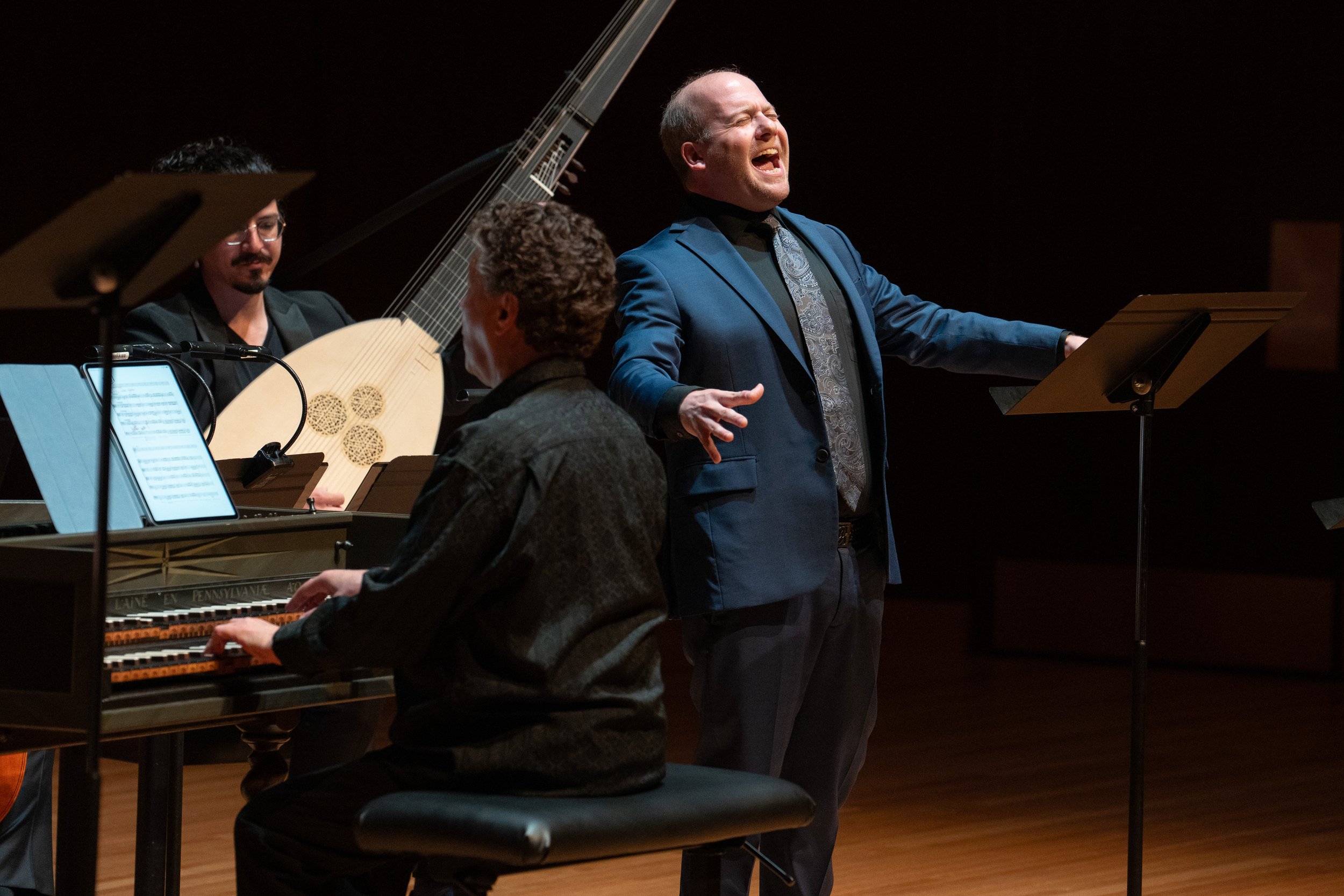
David et Jonathas, Haymarket Opera Company, 2026. Photo: Elliot Mandel
Here the music is truly the servant of the word (rather than the other way around, as is so often the case in much of Italian Baroque repertoire). Consequently, the singers really do need to live the text, giving it true specificity, line by line. I speak French and have always understood what genuinely authentic French should sound like, but I certainly understand the effort it takes to sing persuasively in French. It’s just plain tough to get it right! All the more reason, then, for me to applaud heartily the entire cast of David et Jonathas, who projected the text with such clarity and authenticity.
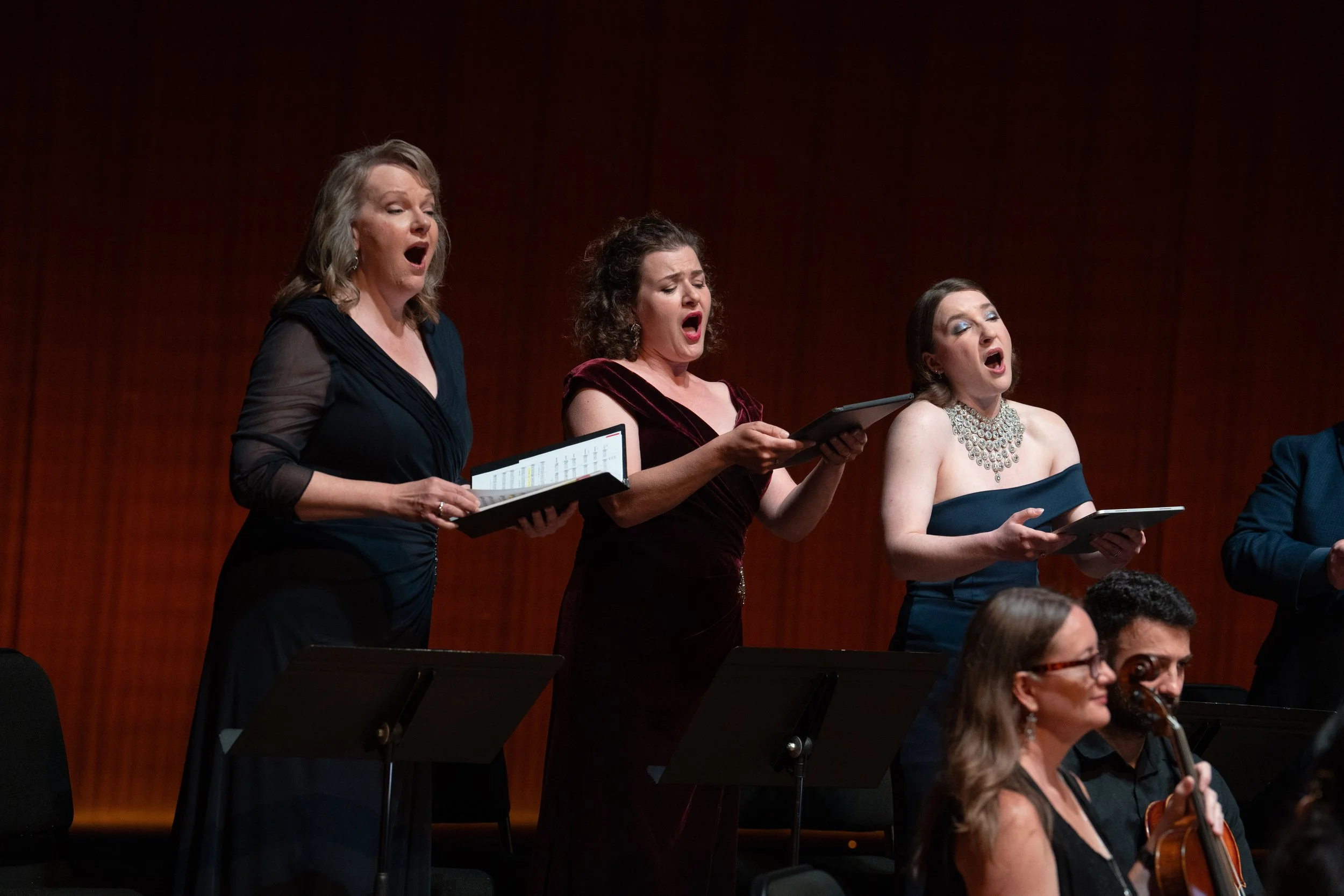
David et Jonathas, Haymarket Opera Company, 2026. Photo: Elliot Mandel
Of course, simple correctness in singers’ textual projection is just the beginning, in that the text in this piece has to be shaped with such penetrating interpretive intelligence. It stems from understanding exactly how to color the voice appropriately, and how to phrase the music conversationally whenever possible. That’s a quality that applies in one way or another to virtually all operatic repertoire, recitative—essentially “sung speech”—having been the most essential structural element from the time of opera’s earliest beginnings.
It’s a bit complicated in Charpentier, though, since so often what we’re getting isn’t recitative as we’re generally accustomed to it in Baroque opera. Yes, we do hear it accompanied frequently by continuo (at Haymarket, the expected combination of instruments—harpsichord, viola da gamba, and theorbo). Much of the time, however, the composer presents lyrically heightened recitative (that is, with a definite discernable meter), with a fuller complement of instruments, to the point where we hear it not so much as standard recitative, but rather, as arioso (a comparatively brief, aria-like passage). The challenge in David et Jonathas—achieved superbly in Haymarket’s performance—is to move absolutely seamlessly from arioso to recitative and back again.
It was with everything I’ve stated above that I experienced Haymarket’s David et Jonathas, in which the piece wasn’t simply done full justice; it was presented with the most extraordinary skill and dedication by all concerned.
In a performance of this caliber, it’s always difficult to know whom to praise first. Perhaps I should begin with the orchestra under the incomparable Jory Vinikour, whose energy, acute stylistic awareness, and total command of his forces across five acts (six if you count the prologue) paid constant dividends. The players were all in rare form, as they invariably are at Haymarket, and one always sensed an extraordinary flexibility in their responsiveness to every nuance of the singers.
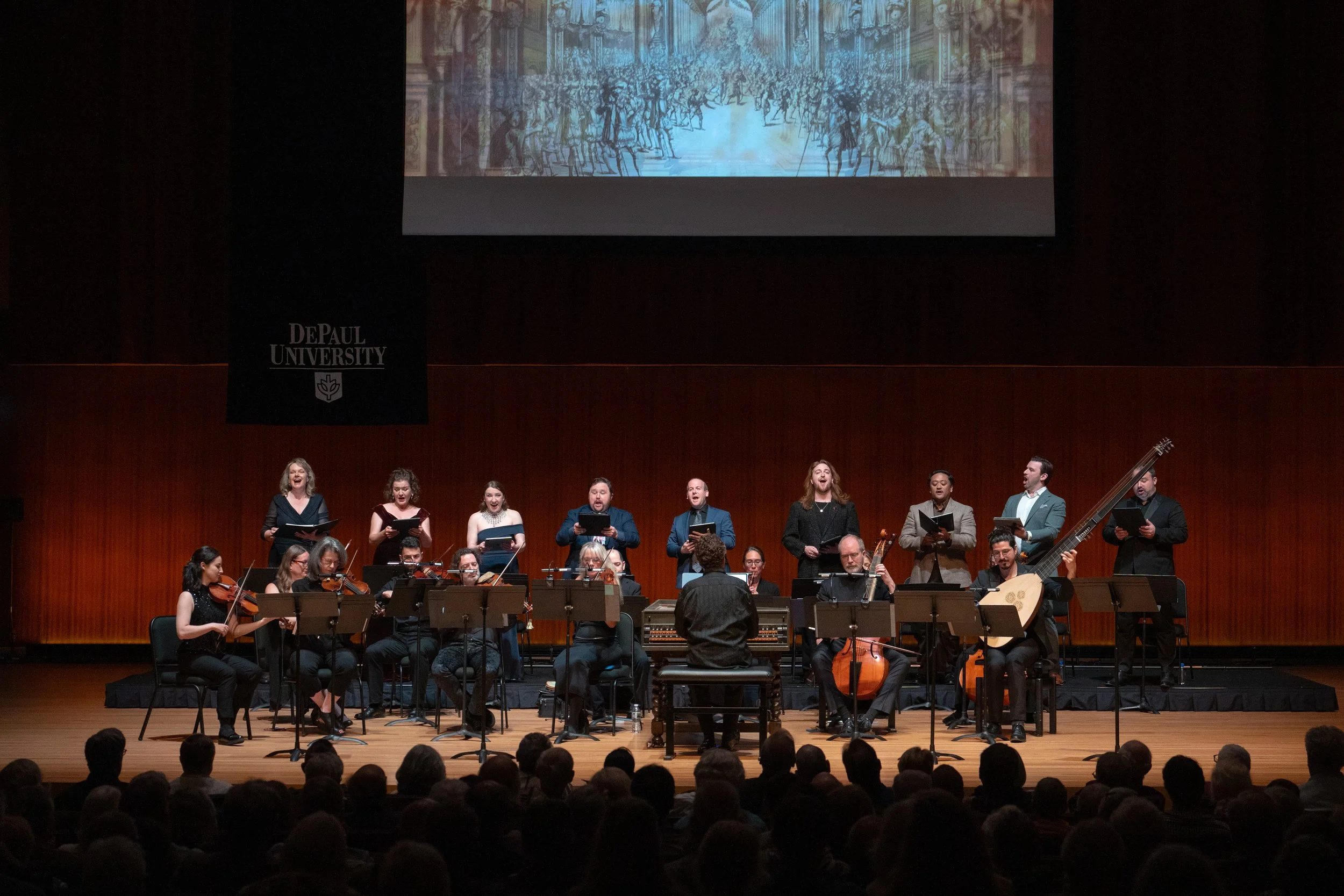
David et Jonathas, Haymarket Opera Company, 2026. Photo: Elliot Mandel
Many of the vocal soloists have excelled in previous Haymarket performances, and it was a great pleasure to hear them again. I want to give a huge shout-out to the nine-member chorus, whose sound was of such fullness that, in the more vigorous moments, we might have been hearing at least twice that number of singers. Charpentier has his chorus contributing mightily as a frequent commentator throughout this work. It made an enormous difference that Haymarket’s chorus was made up of exclusively solo voices. As a result, there was such glorious color in their singing, yet the blend was also invariably ideal. The score gave most of the choristers opportunities to shine alone as well. I remember particularly the Achis of bass Leo Radosavljevic (his is a marvelously rich yet impeccably focused voice) and the Witch of Endor, sung with great precision and vivid personality by tenor Justin Berkowitz.
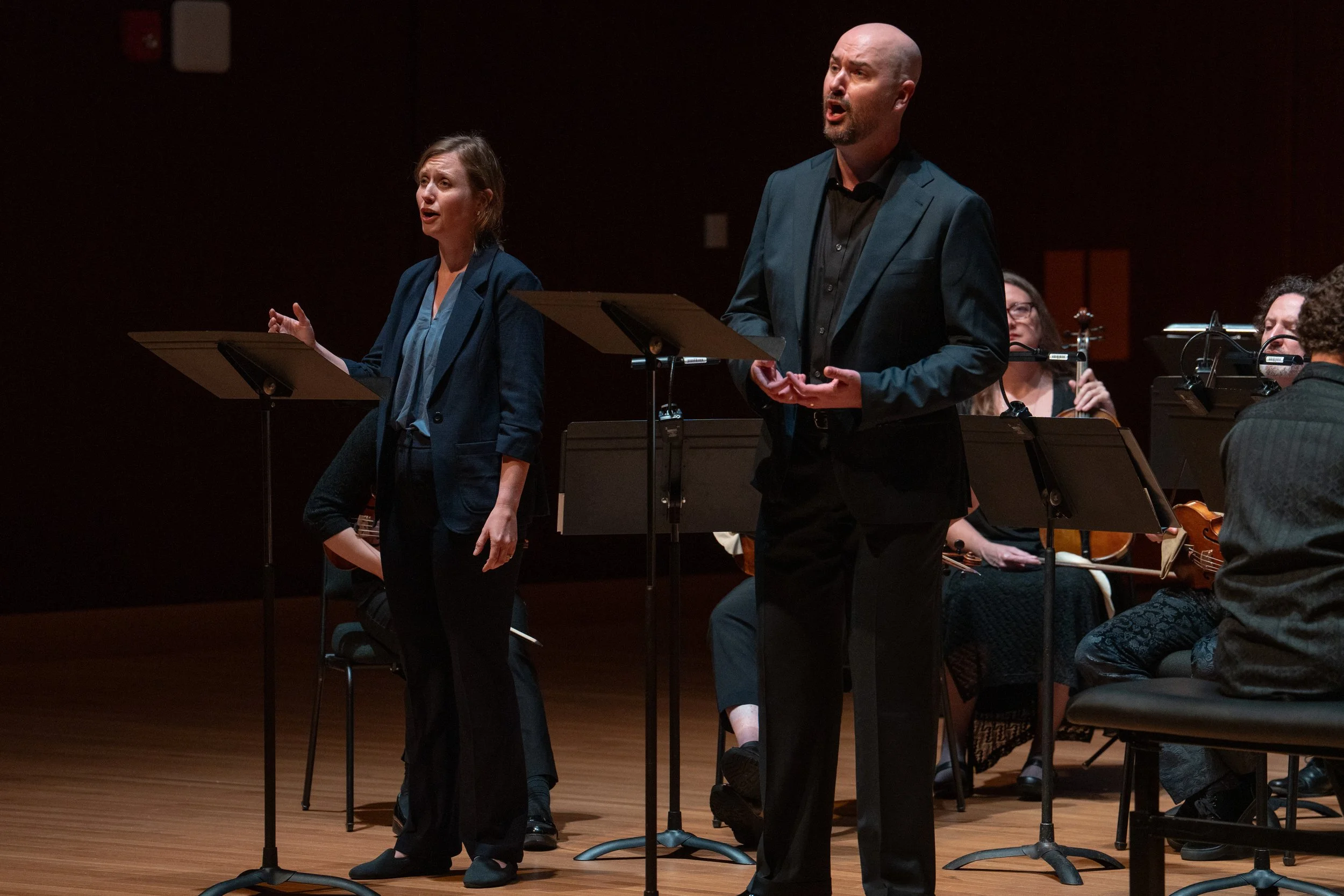
David et Jonathas, Haymarket Opera Company, 2026. Photo: Elliot Mandel
The three leading roles could hardly have been more satisfyingly cast. Jonathas was sublimely sung by Kaitlin Foley, whose crystalline soprano radiated the character’s youthful goodness. Bass-baritone David Govertsen’s grand-scale voice and regal manner splendidly suited Saul, with the arc of his characterization memorably revealing the king’s increasingly tortured emotions.
The magnificent portrayal of David by tenor Scott J. Brunscheen actually transported me back to seventeenth-century Paris, and the very significant development in casting that occurred as French Baroque opera began to establish itself. When Italian works introduced the art form to France, beginning in the 1640s, castrati had generally been playing the central male roles. That voice type was regarded with considerable disapproval in France; as a result, composers of French opera assigned those roles to the haute-contre voice, a lyric tenor whose instrument “sits” much higher than one finds elsewhere in Baroque opera. At Haymarket, Brunscheen exhibited terrific control above the staff, but also a wonderful ring in the voice that an haute-contre doesn’t always possess. What I’ll long remember, though, was this artist’s ability to color the voice to exquisitely beautiful effect in any pianissimo phrase. There was aching tenderness in David’s love for the dying Jonathas, and the final lines—especially “Jonathas ne vit plus!” and “Ciel, ciel, il est mort!”—were devastating.
Those of us who were privileged to be present for this performance will not forget it. With the success of this work’s local premiere, we can only hope that Haymarket’s future seasons will bring more French Baroque masterpieces to Chicago operagoers.
About the author
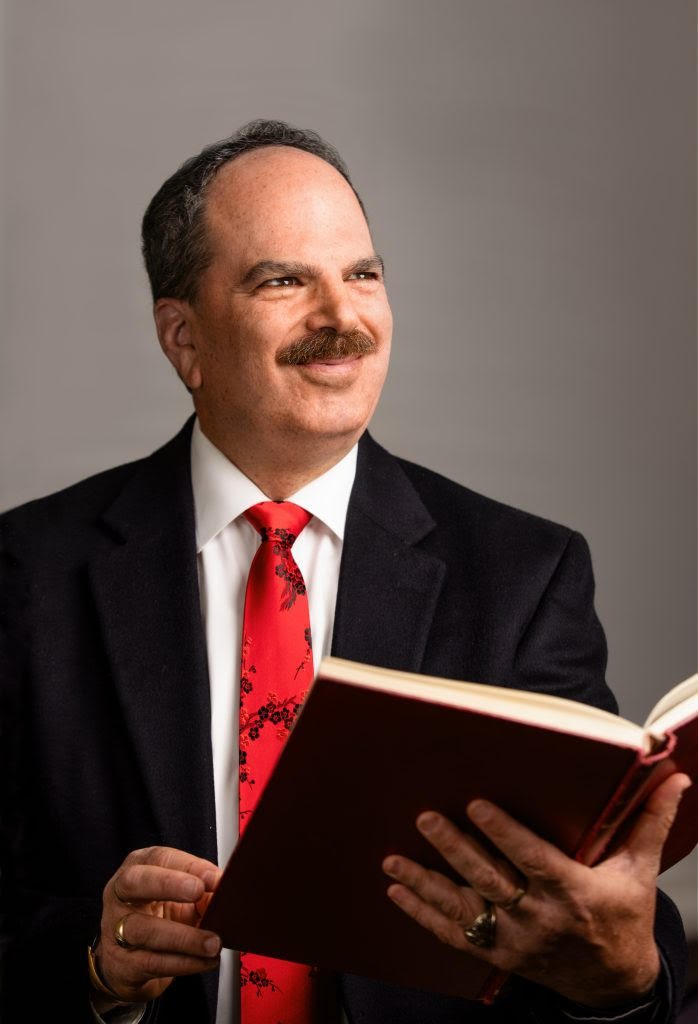
Photo: Kyle Flubacker
Roger Pines is currently a faculty member of Northwestern University’s Voice & Opera department. A repertoire consultant for many distinguished artists and a valued mentor for young singers, Pines has been a judge for the Metropolitan Opera’s Laffont Competition, the Handel Aria Competition, and the national competitions of both Classical Singer and the National Association of Teachers of Singing.
In 2021 Pines concluded his 26-year tenure at Lyric Opera of Chicago, where he served as dramaturg, co-producer and co-host of the live opening-night broadcasts, program editor, and special lecturer/consultant for the young-artist program. He previously held positions at San Diego Opera and The Dallas Opera. Pines has been a panelist on the Metropolitan Opera broadcasts’ “Opera Quiz” since the 2005-06 season.
Pines’s thriving freelance career has recently included lecturing for Yale University, the Curtis Institute of Music, and the University of Texas at Austin; and writing feature articles for Lyric, San Francisco Opera, the Dallas Opera, Opera magazine (London), and Das Opernglas magazine (Munich. He has also previously written for Opera News, Classical Singer, The Times (U.K.), programs of every major North American opera company, and CDs on eight prestigious recording labels.
Pines began his career as a countertenor, performing with noted early-music ensembles in Vienna, Salzburg, Munich, Florence, Venice, and Belgrade.
About The Haymarket Review: This digital publication including thoughts about the work produced by Haymarket is designed to deepen our connection to audiences, nurture and feed audience curiosity about historical performance, offer critical opinions and thoughtful reflections on our performances, and provide a forum for Haymarket and its audience to connect through sharing insights, opinions, learning, and expertise.